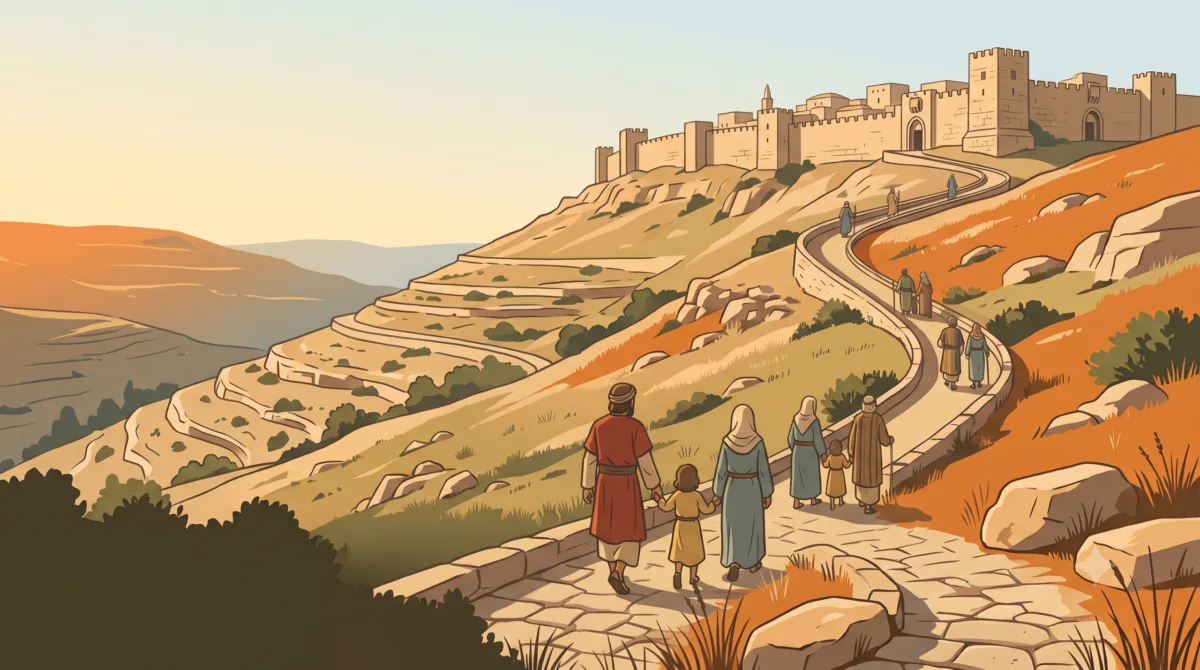
In Psalm 24, David asks, “Who shall ascend into the hill of the Lord? or who shall stand in his holy place?”1 The answer? “He that hath clean hands, and a pure heart; who hath not lifted up his soul unto vanity, nor sworn deceitfully.”2
The answer shows that the question is not just literal, but also asks who will approach the Lord. If David were asking only about physically ascending a hill, the answer would not be clean hands and a pure heart. However, there certainly is an allusion to Jerusalem, as it is often referred to as the Hill of the Lord, and its elevated location required anyone who entered to ascend.
Psalms 120 through 134 are often called the “Songs of Ascents.”3 Tradition holds that these psalms were “sung by Hebrew pilgrims on their way to Jerusalem,” or “while ascending Mount Zion or the steps of the Temple.”4 In that sense, these psalms reflect a literal journey as worshippers ascended to Jerusalem and the temple.
However, these psalms also walk us through a spiritual journey. The themes progress from personal distress to calling upon God and depending on God, then through worship, humility, and unity. They invite readers to consider their own journey toward the Lord. These psalms reflect a physical ascent to Jerusalem and a spiritual ascent to God.
What are the Songs of Ascents?
Psalms 120 through 134 are each introduced as a “Song of Degrees” in the King James Version, or a “Song of Ascents” in most other English translations. Tradition holds that these psalms were sung as people traveled to Jerusalem. They represent a physical journey, but also a spiritual journey as worshippers traveled to the Holy City and the temple.
We gain greater insights into the Songs of Ascents as we learn about the history and geography of Jerusalem, but their true power comes as we ponder how we can approach God. They contain themes, doctrine, prayers, supplications, and faith that we can emulate as we strive to ascend to God. Just as David taught that those with clean hands and a pure heart will “ascend into the hill of the Lord,” so we can ascend to the Lord as we learn and apply the practices found in the Songs of Ascents.
Jerusalem, Zion, the Holy City, the City of David
Jerusalem. The Holy City.5 “It is the most significant city in biblical history,” and “[s]ome of the most sacred spots for Christians, Jews, and Muslims are in this city and are visited regularly by many faithful believers.”6 A brief history of Jerusalem helps better appreciate the Songs of Ascents.
When the Israelites entered the land of their inheritance, they were afraid to face the inhabitants of the areas around Jerusalem, because the “Anakims,” or giants, were there, and the cities were fortified.7 Although some parts were conquered,8 they could not overcome the Jebusites in Jerusalem.9 Jerusalem remained occupied by the Jebusites until David conquered it.10
Jerusalem is “situated on the southern spur of a plateau in the Judaean Mountains,” and “is surrounded by valleys and dry riverbeds.”11 The result is a topography that places Jerusalem on top of a plateau with steep cliffs. For primitive armies in biblical times, it would have been a formidable defensive position. After David became king of Israel, he chose Jerusalem as his capital city.12 The defensive nature of Jerusalem is evident in the attitude of the Jebusites, as they didn’t believe David posed any threat. They said, “Except thou take away the blind and the lame, thou shalt not come in hither.”13 In other words, they mocked David, saying even the blind and the lame could defend the city. However, David conquered Jerusalem, and they called it Zion and the “City of David.”14
Jerusalem, or Zion, or the City of David, became David’s capital. David and Solomon built and expanded Jerusalem, and once the temple was built, it was the clear political and religious capital of Israel.14
“Go up” to Jerusalem
Three times a year, Israelites would travel to Jerusalem for religious feasts. These feasts were commanded by the Lord shortly after Israel left Egypt.15 These feasts (unleavened bread, weeks, and tabernacles) were to occur “in the place which [the Lord thy God] shall choose.”16 With the building of the temple in Jerusalem, the Lord “chose” Jerusalem.17 These feasts became associated with Passover (the feast of unleavened bread), Pentecost (feast of weeks), and Booths (feast of tabernacles).18
As people traveled to Jerusalem, they were required to “go up.” Jerusalem is at an elevation of about 2,575 feet.19 For people living in Utah, that doesn’t sound impressive. But the Dead Sea, which is the lowest elevation on earth at about 1,300 feet below sea level, is only about 25 miles away from Jerusalem.20 For comparison, the drive from Salt Lake City to Park City is about 30 miles, but an elevation increase of only about 2,800 feet, so not nearly as steep an ascent as going from the Dead Sea to Jerusalem.
Although not the highest elevation point in Israel, Jerusalem sits in the Judean Mountains, which means that just about everyone who traveled to Jerusalem had to “go up.” That phrase “go up” is used often in the Bible to reference going to Jerusalem, and the phrase “go down” is often used when leaving Jerusalem. Consider the following examples:
Jerusalem is builded as a city that is compact together . . . Whither the tribes go up. (Psalm 122:3-4).
Now his parents went to Jerusalem every year at the feast of the passover. And when he was twelve years old, they went up to Jerusalem after the custom of the feast. (Luke 2:41-42).
After this there was a feast of the Jews; and Jesus went up to Jerusalem. (John 5:1).
[T]hey determined that Paul and Barnabas, and certain other of them, should go up to Jerusalem. (Acts 15:2).
And Jesus answering said, A certain man went down from Jerusalem to Jericho, and fell among thieves (Luke 10:30).
It is fascinating that in the Book of Mormon, when leaving Jerusalem, Nephi refers to going “down by the borders near the shore of the Red Sea.” (1 Nephi 2:5). But when they went back to Jerusalem to get the brass plates, Nephi said they left “to go up to the land of Jerusalem.” (1 Nephi 3:9).
Israelites were in the habit of saying “up” when referring to going to Jerusalem, and “down” when leaving Jerusalem. Clearly, the “ascent” became a part of their language.
Considering the importance of Jerusalem and its nature as the Lord’s Holy City, “going up” to Jerusalem became strongly symbolic for approaching the Lord. So as people “went up” to Jerusalem for the feasts, their physical journey invited them to ponder their spiritual journey and worship of the Lord.
The ascent symbolizes approaching the Lord
Mountains or great heights have always been symbolic for approaching the Lord. When Moses spoke with the Lord, he “came to the mountain of God.”21 When Elijah experienced the wind, the earthquake, and the fire, but found the Lord in the still small voice, it was in “the mount of God.”22 Solomon built the temple on “mount Moriah,”23 and it was on that same mount Moriah that Abraham was commanded to sacrifice his son Isaac.24
In the Book of Mormon, Nephi often talked about going to the mountain to speak with the Lord:
[T]he voice of the Lord came unto me, saying: Arise, and get thee into the mountain. And it came to pass that I arose and went up into the mountain, and cried unto the Lord.25
And I, Nephi, did go into the mount oft, and I did pray oft unto the Lord; wherefore the Lord showed unto me great things.26
Isaiah used the term “mount” or “mountain” as a symbol for the restoration of the gospel and the temple:
And it shall come to pass in the last days, that the mountain of the Lord’s house shall be established in the top of the mountains, and shall be exalted above the hills; and all nations shall flow unto it.
And many people shall go and say, Come ye, and let us go up to the mountain of the Lord, to the house of the God of Jacob; and he will teach us of his ways, and we will walk in his paths: for out of Zion shall go forth the law, and the word of the Lord from Jerusalem.27
Mountains are used as symbols for the temple, prayer, the knowledge of the Lord, and coming closer to God. Because of its elevation, Jerusalem became known as the “mount of the Lord,” particularly considering the temple was built on “Mount Moriah” in Jerusalem. The concept of “ascent” draws upon this symbolism to represent our journey toward God.
The Songs of Ascents map our journey to approach God
Psalms 120 through 134 are each introduced in the King James Version as “A Song of degrees.”29 The Blue Letter Bible contains the following definition for the Hebrew word translated to “degrees”: “elevation, i.e. the act (literally, a journey to a higher place, figuratively, a thought arising), or (concretely) the condition (literally, a step or grade-mark, figuratively, a superiority of station); specifically a climactic progression (in certain Psalms):—things that come up, (high) degree, deal, go up, stair, step, story.”30
Based on that definition, the King James Version calls these Psalms songs of “degrees,” but other English translations of the Old Testament use the word “ascent,” and so these psalms are known as “Songs of Ascents.”31 “Jewish tradition as well as subsequent scholarship associates these Psalms with the Biblical Pilgrim festivals in Jerusalem, sung by the pilgrims on their way.”32
In other words, it is believed that these Songs of Ascents were sung by Israelites as they made their way to Jerusalem for the three annual feasts. They therefore represent a physical ascent as they traveled, but their texts also guide us along a spiritual ascent as we approach God.
These psalms are quite short, and so their themes are focused. Working from one theme to another is not a literal spiritual progression (in other words, it’s not like we can look at the progression through the plan of salvation, or from one covenant to another). Instead, they represent attitudes we should have as we approach God. They help us see that we should turn to the Lord in humility and diligence as we repent. They remind us that our focus should be on God’s mercy and that we can rely on His help throughout our journey.
The themes in the Songs of Ascents are familiar and teach basic, fundamental principles of the restored gospel of Jesus Christ. The following table walks through the Songs of Ascents and demonstrates that these themes are commonly found in the Book of Mormon:
| Psalm | Psalm Theme | Spiritual Ascent Theme | Book of Mormon Reference |
|---|---|---|---|
| 120 | Crying unto the Lord while experiencing distress | Recognizing that something is wrong and that we are not yet where we should be spiritually | Enos 1:2-4 (Enos wrestles before God for a remission of his sins); Alma 36:12-18 (Alma prays for forgiveness) |
| 121 | Lifting my eyes to the hills, or looking to the Lord | Trusting God at the beginning of the journey | Ether 12:27 (humbling ourselves before the Lord, and having faith); Alma 22:15-18 (being willing to give away all our sins to know God) |
| 122 | Finding joy in journeying to the temple at Jerusalem | Desire to worship and enter God’s presence | Mosiah 2:1-5 (King Benjamin’s people gathered at the temple to hear him); 3 Nephi 11:1 (gathering at the temple) |
| 123 | Pleading for mercy | Recognizing and requesting mercy and forgiveness | Mosiah 4:2 (they cried for mercy) |
| 124 | Deliverance by the Lord | Recognizing our dependence on the Lord for deliverance | Mosiah 24:14-15 (they will know that the Lord delivers His people) |
| 125 | Trust in the Lord | Becoming spiritually steadfast, solid like a mountain | Helaman 5:12 (it is upon the rock of our Redeemer that we must build our foundation) |
| 126 | Joy will follow sorrow | The Lord will redeem us, and we will have joy after sorrow | Alma 36:20 (Alma’s joy was as exceeding as his pain) |
| 127 | We depend on the Lord for our prosperity | Letting God build the life we cannot build alone | 1 Nephi 2:20-21 (if we keep His commandments, we will prosper in the land) |
| 128 | We will be blessed as we fear the Lord | Righteous living brings peace and fruitfulness | 1 Nephi 1:20 (we are blessed as we exercise faith in God) |
| 129 | The wicked will not prosper against Israel | Persevering through opposition | Mosiah 24:14-19 (the Lord delivered the people of Alma from the Lamanite bondage) |
| 130 | Crying to the Lord for forgiveness | Deep repentance and hope for forgiveness | Alma 42:29-31 (let your sins bring you down unto repentance) |
| 131 | Quiet humility before the Lord | Becoming childlike, meek, and submissive | Mosiah 3:19 (become as a little child) |
| 132 | Covenant promises to David and Zion | Remembering God’s covenant promises | Moroni 10:3 (remember how merciful the Lord hath been) |
| 133 | Unity among brethren | Spiritual ascent culminates in charity and unity | Moroni 7:45-48 (charity is the pure love of Christ) |
| 134 | Blessing the Lord while in the house of the Lord | Worship, holiness, and receiving blessings in Zion | 2 Nephi 31:20 (press forward and endure to the end) |
Where are you in your journey?
These Songs of Ascents represent a physical and spiritual journey to reach the Lord. This life is a spiritual journey, but as is often expressed during the Songs of Ascents, the Lord is with us and will bless us during our journey.
Who shall ascend into the hill of the Lord? It’s a challenging question. Just as it was a climb to reach Jerusalem, it requires a concerted effort to reach the Lord. If we study and ponder the Songs of Ascents, we can gain greater insight into what we can do to ascend the hill of the Lord.
References
- Psalm 24:3. ↩︎
- Psalm 24:4. ↩︎
- Merriam-Webster.com Dictionary, s.v. “Song of Ascents,” accessed July 22, 2026, https://www.merriam-webster.com/dictionary/Song%20of%20Ascents. ↩︎
- Merriam-Webster.com Dictionary, “Song of Ascents.” ↩︎
- Guide to the Scriptures, “Jerusalem,” https://www.churchofjesuschrist.org/study/scriptures/gs/jerusalem?lang=eng&id=p1#p1. ↩︎
- Guide to the Scriptures, “Jerusalem.” ↩︎
- Joshua 14:12. See my prior post, “Give Me This Mountain,” for additional details about Caleb’s conquest of Hebron. ↩︎
- Joshua 14:14. ↩︎
- Joshua 15:63. ↩︎
- See Map 3, “The Division of the 12 Tribes,” https://www.churchofjesuschrist.org/study/scriptures/bible-maps/map-3?lang=eng. ↩︎
- “Jerusalem,” https://en-us.topographic-map.com/map-h16gtp/Jerusalem/. ↩︎
- See generally, 2 Samuel 5. ↩︎
- 2 Samuel 5:6. ↩︎
- 2 Samuel 5:7-9. ↩︎
- See 1 Kings 11:36; 1 Kings 14:21 (Jerusalem is the city chosen by the Lord out of all the tribes of Israel). ↩︎
- Exodus 23:14-17; Exodus 34:23. ↩︎
- Deuteronomy 16:16. ↩︎
- 2 Chronicles 8:12-13. ↩︎
- Britannica Editors. “Pilgrim Festivals.” Encyclopedia Britannica, May 15, 2023. https://www.britannica.com/topic/Pilgrim-Festivals; see also Britannica Editors. “Sukkot.” Encyclopedia Britannica, April 16, 2026. https://www.britannica.com/topic/Sukkoth-Judaism; see also Preston, C. “Shavuot.” Encyclopedia Britannica, February 10, 2026. https://www.britannica.com/topic/Shavuot. ↩︎
- Gordon, B., Prawer, J., Wasserstein, B., Perowne, S.H., Dumper, M. “Jerusalem.” Encyclopedia Britannica, July 23, 2026. https://www.britannica.com/place/Jerusalem. ↩︎
- Pletcher, K. “Dead Sea.” Encyclopedia Britannica, July 10, 2026. https://www.britannica.com/place/Dead-Sea. ↩︎
- Exodus 3:1-2. ↩︎
- 1 Kings 19:8-12. ↩︎
- 2 Chronicles 3:1. ↩︎
- Genesis 22:2. ↩︎
- 1 Nephi 17:7. ↩︎
- 1 Nephi 18:3. ↩︎
- Isaiah 2:2-3. ↩︎
- Psalm 120 (KJV). ↩︎
- “H4609 – maʿălâ – Strong’s Hebrew Lexicon (KJV).” Blue Letter Bible. Accessed 23 Jul, 2026. https://www.blueletterbible.org/lexicon/h4609/kjv/wlc/0-1/. ↩︎
- Psalm 120 (ESV). ↩︎
- Tzoref, Shani, and Katherine Wolff. “Psalms of Ascent.” European Judaism: A Journal for the New Europe 54, no. 2 (2021): 94–103. https://www.jstor.org/stable/48770235. ↩︎

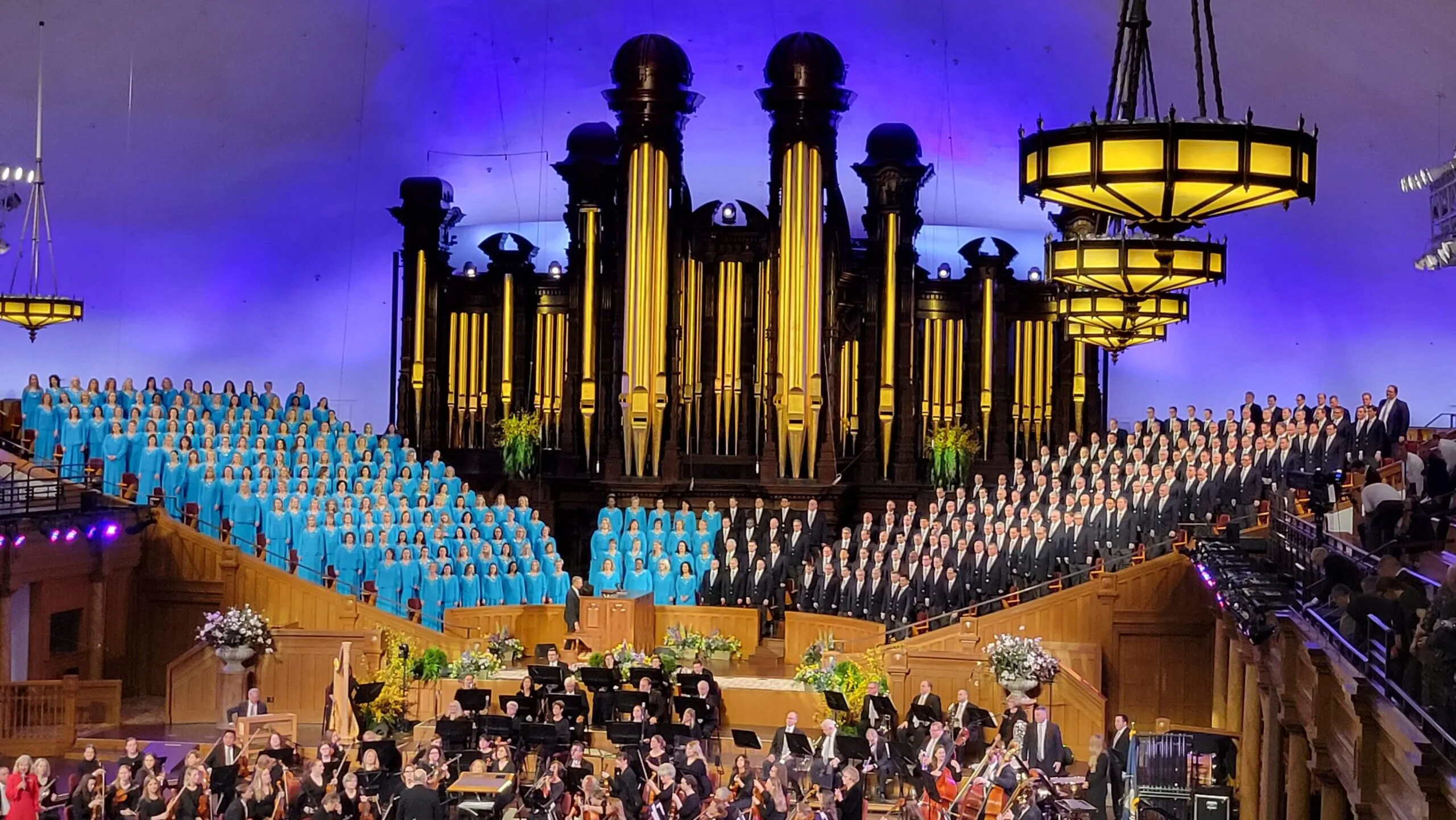
My mothers sang with a fairly famous choir back in 1964-65. They performed at the World’s Largest Fair in New York city they were called the Singing Mothers (all were mothers of Mormon faith. )The song was He Yhat Hath Clean Hands And a Pure Heart
The song was written by Crawford Gates I can still hear my mother singing it in her beautiful alto voice