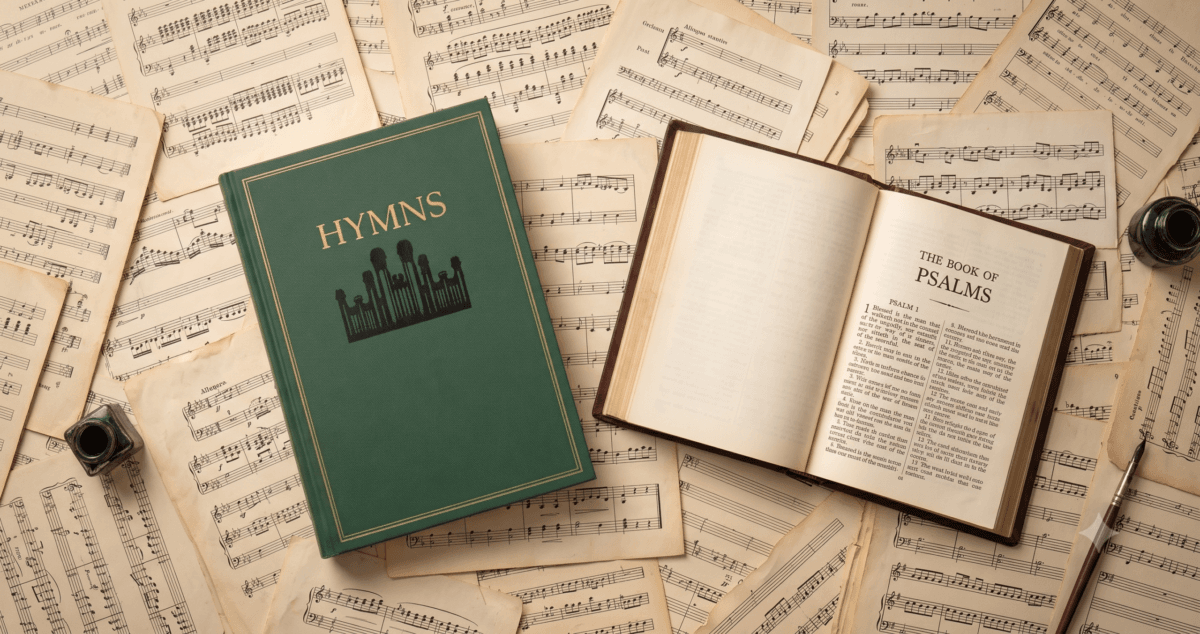
The book of Psalms has been my least favorite book of the Old Testament. I love the Old Testament, but I’ve always struggled to read Psalms. I think I’ve found it boring because I love the stories of the Bible, and the Psalms just seemed like a bunch of poems.
This time, I had a fantastic experience studying the Psalms. I made more of an effort, and I’ve learned things that I’ve found exciting. I think I enjoyed them more this time for a couple of reasons. First, my wife is in the Tabernacle Choir, and that has caused me to have a much greater interest in music as a form of worship. Second, I learned about the Levite singers, the topic of a previous post, and that study helped me realize there are stories behind the Psalms.
Because I learned things about the Psalms that I found interesting, I studied them more diligently. This additional effort helped me learn doctrines that I had never seen in previous attempts. This post walks through several of the things I’ve learned.
The Psalms are organized into five books
There are 150 psalms, and they are organized into five books:
In its present form, the book of Psalms consists of 150 poems divided into five books (1–41, 42–72, 73–89, 90–106, 107–150), the first four of which are marked off by concluding doxologies. Psalm 150 serves as a doxology for the entire collection. . . . . The fivefold division is perhaps meant to be an imitation of the Pentateuch (the first five books of the Old Testament), suggesting that the book reached its present form through liturgical use.1
There are a few words in that definition that require explanation. A “doxology” is simply an expression of praise to God.2 “Liturgical” is an adjective “relating to (a particular set of) the words, music, and actions used in ceremonies in some religions, especially Christianity.”3 The Pentateuch is “[a] Greek word . . . [for] the first five books of the Bible: Genesis, Exodus, Leviticus, Numbers, Deuteronomy.”4
Understanding those definitions, we can more clearly explain the organization of the Psalms. Each of the five books has an expression of praise at the end, and Psalm 150 has an expression of praise that concludes not only the fifth book, but the entire collection. Additionally, the five-book division implies that they were organized and patterned after the five books of Moses because of their use in worship services.
The King James Version doesn’t mention these five books. However, other English translations identify the beginning of the five books (see the English Standard Version of Psalm 1, Psalm 42, Psalm 73, Psalm 90, and Psalm 107).
Psalm 150, which concludes the fifth book and the entire collection, serves as a “doxology,” or an expression of praise to God, for the entire book of Psalms. The text is quite brief, but its praise of God is a powerful conclusion:
1 Praise ye the Lord. Praise God in his sanctuary: praise him in the firmament of his power.
2 Praise him for his mighty acts: praise him according to his excellent greatness.
3 Praise him with the sound of the trumpet: praise him with the psaltery and harp.
4 Praise him with the timbrel and dance: praise him with stringed instruments and organs.
5 Praise him upon the loud cymbals: praise him upon the high sounding cymbals.
6 Let every thing that hath breath praise the Lord. Praise ye the Lord.
This simple conclusion summarizes the entire collection of Psalms. Knowing the Psalms are intentionally organized, and knowing Psalm 150 is intended to conclude an entire collection, rather than just being a stand-alone Psalm, we can find much greater meaning and power in this doxology.
Knowing there is a specific and intentional organization tells me there is more to learn as I study the Psalms as an organized collection of works, rather than as individual poems.
The Psalms were used for worship
I previously wrote a post titled, “Praise the Lord with Singing: The Levite Singers and Music as Worship.” In that post, I talk about the Levites who were called as musicians to use music as part of their worship services. The three chief musicians appointed by David were Asaph, Heman, and Ethan (or Jeduthun). I found the story of these Levite singers fascinating because it demonstrates that music was not just for entertainment; it was an essential and vital part of their worship.
As I studied the Psalms (after learning and writing about the Levite singers), I noticed how many of the Psalms were either directed to or written by the Levite singers:
- To the chief Musician: 4, 5, 6, 8, 9, 11, 12, 13, 14, 18, 19, 20, 21, 22, 31, 36, 39, 40, 41, 42, 44, 45, 46, 47, 49, 51, 52, 53, 54, 55, 56, 57, 58, 59, 60, 61, 62, 64, 65, 66, 67, 68, 69, 70, 75, 76, 77, 80, 81, 84, 85, 88, 109, 139, and 140.
- To Jeduthun (or Ethan) (the notations seem to mean that Jeduthun is the chief Musician), 39, 62, and 77.
- For the sons of Korah, 42, 44, 45, 46, 47, 48, 49, 84, 85, 87, and 88.
- By Asaph, 50, 73, 74, 75, 76, 77, 78, 79, 80, 81, 82, and 83.
- By Heman, 88.
- By Ethan (or Jeduthun) (this category is expressly written by Ethan, rather than just “to” him), 89.
As mentioned in my post about the Levite singers, they are sometimes referred to as the “sons of Korah,” and Asaph, Heman, and Ethan (or Jeduthun) were the original three leaders of the singers. The “chief Musician” was the leader of the Levite singers. This is shown in Psalms 39, 62, and 77, which identify Jeduthun as the chief Musician.
These singers participated in the daily worship services. They performed music “every morning” and “likewise at even.”5 The fact that so many of the Psalms were directed to the “chief Musician,” “the sons of Korah,” and were written by Asaph, Heman, and Ethan, demonstrates that these Psalms were used by the Levite singers in their worship services.
Knowing that these particular Psalms were used in their worship can help us better understand the worship practices of the Israelites. This can also help us ponder how we use our hymns as part of our worship.
The Psalms contain musical notations
The Psalms are not just poems. They were intended to be performed with music, and there were notations in many of the Psalms that gave instructions on how they were supposed to be performed.
We have many musical notations in our hymns. A simple review of the sheet music for any hymn shows many musical notations, such as time signatures, the specific notes intended to be played or sung, tempo, expression, and many others. The Psalms had their own notations, even though many of them aren’t entirely clear (because the meanings of several Hebrew words are no longer known).
The following words are musical notations used in the Psalms, along with the psalm number in which they appear:
- Neginoth (or Neginah) (stringed instruments),6 4, 6, 54, 55, 61, 67, and 76.
- Nehiloth (pipe or flute),7 5.
- Sheminith (not clear, but related to the number 8, so either an 8-stringed instrument, or on the octave, or the 8th key),8 6, and 12.
- Shiggaion (not clear, but possibly a wild, passionate song, with rapid changes of rhythm),9 7.
- Gittith (not clear, but possibly a musical instrument used by the people of Gath, such as a lyre),10 8, 81, and 84.
- Muth-labben (not clear, but possibly the title of a popular song whose melody was to be used to sing the Psalm),11 9.
- Aijeleth Shahar (not clear, but possibly describes the melody to which the psalm was to be played or sung. The two words mean “deer” and “dawn,” so the ESV translates this phrase to “Doe of the Dawn”),12 22.
- Shoshannim (the word means “lily,” and likely refers to a trumpet with a shape similar to a lily),13 45, and 69.
- Alamoth (not clear, but likely calls for young women to sing this, or by boys in soprano or falsetto),14 46.
- Mahalath (not clear, but probably the title of a popular song whose melody was to be used),15 53.
- Jonath-elem-rechokim (this is comprised of three different words, which mean “dove,”16 “silent,”17 and “remote, far, [or] distant.”18 In the ESV, this is translated to “The Dove on Far-off Terebinths.”19 Together, this likely refers to the tune that was supposed to be used for this Psalm, and could refer to “the silent dove among foreigners,” or the people of Israel in exile. This makes sense, as the introduction to the Psalm says this was a Psalm of David when the Philistines took him in Gath.)20 56.
- Al-taschith (“do not destroy,” likely the title of a melody),21 57, 58, 59, and 75.
- Shushaneduth (or Shoshannim-Eduth) (“lilies,” possibly the title of a popular song, or refers to a trumpet in the shape of a lily),22 60, and 80.
- Mahalath Leannoth (the meaning of “Mahalath” is uncertain, but likely refers to the title of a popular song,23 but “Leannoth” means to depress, to abase, chasten oneself.)24 88.
I’ve researched these terms, and the meanings are not known. However, it seems they can be categorized as either an instrument to be used to perform the song (such as a stringed instrument or a horn), or the title of a song or melody that would have been well-known and used to sing the Psalm.
Even though the exact meanings and melodies are not known, I love the fact that there are instructions for how to perform the Psalms. It makes them feel more real to me. Our hymns contain many such notations. Not only does the music itself have notations, but we also have popular tunes that were used as hymn tunes:
Traditionally, a hymn tune is somewhat independent of any particular text; texts and tunes of the same meter may be interchanged (see “Meters”). For this reason, each tune in the hymnbook has its own name, separate from the title of the text. The tune name—usually a single word or short phrase—may come from a family name, a place, or a word relating to the text for which it was created. Knowing the tune name, organists are able to locate arrangements of hymn tunes in published sources outside of the hymnbook for use as prelude music or special hymn accompaniments.25
For example, the tune name for Ye Elders of Israel is “Babylon,” The Spirit of God is “Assembly,” and Nearer, My God, to Thee is “Bethany.”
The Israelites had trained musicians. They had instruments. They had common tune names that people knew and loved. And the Psalms contained instructions for how to sing them. Even though we don’t know what the tunes were, just knowing that they had this knowledge made the Psalms much more interesting to me. It made them more familiar, as it helped me think of them more like our hymns.
The Psalms contain familiar doctrines
The things I’ve discussed to this point have helped engage my interest in the Psalms, and so I studied them more thoroughly than I have before. As I studied them, I began to recognize many doctrines from the Book of Mormon and the Doctrine and Covenants.
One of the things I love to do as I study the scriptures is to make cross-references. I write in the margins of my scriptures, making notes about verses that I think relate to each other. As I have looked for scriptures with similar themes and messages, I have gained a greater understanding of what it means that “the course of the Lord is one eternal round.”26
The following verses are some of the cross-references that I made as I studied the Psalms. I love thinking about how they’re similar, what messages they both teach, and what we can learn by recognizing that the Lord teaches the same gospel to His children in every nation and during every dispensation.
Psalm 1:2, But his delight is in the law of the Lord; and in his law doth he meditate day and night.
2 Nephi 4:16, Behold, my soul delighteth in the things of the Lord; and my heart pondereth continually upon the things which I have seen and heard.
Psalm 2:9, Thou shalt break them with a rod of iron; thou shalt dash them in pieces like a potter’s vessel.
1 Nephi 15:23-24, And they said unto me: What meaneth the rod of iron which our father saw, that led to the tree? And I said unto them that it was the word of God; and whoso would hearken unto the word of God, and would hold fast unto it, they would never perish; neither could the temptations and the fiery darts of the adversary overpower them unto blindness, to lead them away to destruction.
1 Nephi 16:2, And it came to pass that I said unto them that I knew that I had spoken hard things against the wicked, according to the truth; and the righteous have I justified, and testified that they should be lifted up at the last day; wherefore, the guilty taketh the truth to be hard, for it cutteth them to the very center.
Psalm 32:9, Be ye not as the horse, or as the mule, which have no understanding: whose mouth must be held in with bit and bridle, lest they come near unto thee.
D&C 58:26-27, For behold, it is not meet that I should command in all things; for he that is compelled in all things, the same is a slothful and not a wise servant; wherefore he receiveth no reward. Verily I say, men should be anxiously engaged in a good cause, and do many things of their own free will, and bring to pass much righteousness.
Psalm 42:5, Why art thou cast down, O my soul? and why art thou disquieted in me? hope thou in God: for I shall yet praise him for the help of his countenance.
2 Nephi 4:28, Awake, my soul! No longer droop in sin. Rejoice, O my heart, and give place no more for the enemy of my soul.
Psalm 44:8, In God we boast all the day long, and praise thy name for ever.
Alma 26:12, Yea, I know that I am nothing; as to my strength I am weak; therefore I will not boast of myself, but I will boast of my God, for in his strength I can do all things; yea, behold, many mighty miracles we have wrought in this land, for which we will praise his name forever.
Psalm 69:2, I sink in deep mire, where there is no standing: I am come into deep waters, where the floods overflow me.
D&C 127:2, And as for the perils which I am called to pass through, they seem but a small thing to me, . . . But nevertheless, deep water is what I am wont to swim in. It all has become a second nature to me; and I feel, like Paul, to glory in tribulation; for to this day has the God of my fathers delivered me out of them all, and will deliver me from henceforth.
Psalm 82:6, I have said, Ye are gods; and all of you are children of the most High.
D&C 76:58, Wherefore, as it is written, they are gods, even the sons of God.
Psalm 109:17-18, As he loved cursing, so let it come unto him: as he delighted not in blessing, so let it be far from him. As he clothed himself with cursing like as with his garment, so let it come into his bowels like water, and like oil into his bones.
Alma 41:12-13, And now behold, is the meaning of the word restoration to take a thing of a natural state and place it in an unnatural state, or to place it in a state opposite to its nature? O, my son, this is not the case; but the meaning of the word restoration is to bring back again evil for evil, or carnal for carnal, or devilish for devilish—good for that which is good; righteous for that which is righteous; just for that which is just; merciful for that which is merciful.
There are many others that I noted in my scriptures as I studied the Psalms. A few additional examples include:
- Psalm 6:6; 2 Nephi 33:3.
- Psalms 8:4-5; Moses 1:10.
- Psalm 42:8; 2 Nephi 4:23.
- Psalm 42:11; 2 Nephi 4:30.
- Psalm 69:16; 1 Nephi 1:20.
- Psalm 78:5; Mosiah 4:14-15.
- Psalm 91:4; 3 Nephi 10:4-5.
- Psalm 94:20; Mosiah 29:27.
- Psalm 94:23; Mormon 4:5.
- Psalm 110:4; Alma 13:18.
- Psalm 112:1; D&C 59:4.
- Psalm 139:23-24; 2 Nephi 4:31.
- Psalm 144:15; 2 Nephi 5:27.
This is just a sample, and there are many others that relate to scriptures throughout all the standard works. The Psalms express the longing of our hearts, and by studying them in conjunction with other scriptures, we can better learn how the Lord inspires us to seek Him.
Why should we study the Psalms?
“No book of the Old Testament is more Christian in its inner sense or more fully attested as such by the use made of it than the Psalms. Out of a total of 283 direct citations from the Old Testament in the New, 116 have been counted from this one book.”27
The Savior Himself often quoted the Psalms, as we see in the moment of His greatest distress: “My God, my God, why hast thou forsaken me?” (Matthew 27:46, quoting Psalm 22:1). If the Savior knew, quoted, and found comfort in the Psalms, how much greater need have we to study and understand them?
Many of our hymns have texts taken from the Psalms, such as The Lord Is My Shepherd (Hymn 108, quoting Psalm 23), Cast Thy Burden upon the Lord (Hymn 110, quoting Psalm 55:22), Lead, Kindly Light (Hymn 97, quoting Psalm 43:3), and many others. The hymnbook has a list of scripture references found at the end of each hymn, and the great majority are found in the Psalms.28
The Psalms express joy, despair, hope, fear, and many other natural human emotions. Most significantly, the Psalms express praise to God. We can learn a great deal about how to worship the Lord as we study the Psalms.
I had to find my “hook,” something about the Psalms that made me want to study them. My wife (a musician and member of the Tabernacle Choir) loves the Psalms. We’ve often talked about why she loves them, and why I didn’t. But as I started studying them this time, I remember texting her and telling her that I’d found several reasons to study the Psalms.
This experience has helped me see that although there is value in studying the scriptures, it may take time for us to discover our own reasons to study. The Lord knows us. He knows what we love and what we find interesting, and if we will ask for help and put in the effort, He will help us find joy as we serve Him.
References
- Britannica Editors. “Psalms.” Encyclopedia Britannica, June 17, 2026. https://www.britannica.com/topic/Psalms. ↩︎
- Britannica Editors. “doxology.” Encyclopedia Britannica, July 20, 1998. https://www.britannica.com/topic/doxology. ↩︎
- Cambridge Dictionary Online, “liturgical,” https://dictionary.cambridge.org/us/dictionary/english/liturgical. ↩︎
- Bible Dictionary, “Pentateuch,” https://www.churchofjesuschrist.org/study/scriptures/bd/pentateuch?lang=eng&id=p1#p1. ↩︎
- 1 Chronicles 23:30. ↩︎
- Psalm 4 (ESV), “H5058 – nᵊḡînâ – Strong’s Hebrew Lexicon (KJV).” Blue Letter Bible. Accessed 25 Jul, 2026. https://www.blueletterbible.org/lexicon/h5058/kjv/wlc/0-1/. ↩︎
- Psalm 5 (ESV), “H5155 – nᵊḥîlâ – Strong’s Hebrew Lexicon (KJV).” Blue Letter Bible. Accessed 25 Jul, 2026. https://www.blueletterbible.org/lexicon/h5155/kjv/wlc/0-1/. ↩︎
- “H8067 – šᵊmînîṯ – Strong’s Hebrew Lexicon (KJV).” Blue Letter Bible. Accessed 25 Jul, 2026. https://www.blueletterbible.org/lexicon/h8067/kjv/wlc/0-1/. ↩︎
- “H7692 – šigāyôn – Strong’s Hebrew Lexicon (KJV).” Blue Letter Bible. Accessed 25 Jul, 2026. https://www.blueletterbible.org/lexicon/h7692/kjv/wlc/0-1/. ↩︎
- “H1665 – gitîṯ – Strong’s Hebrew Lexicon (KJV).” Blue Letter Bible. Accessed 25 Jul, 2026. https://www.blueletterbible.org/lexicon/h1665/kjv/wlc/0-1/. ↩︎
- “H4192 – mûṯ – Strong’s Hebrew Lexicon (KJV).” Blue Letter Bible. Accessed 25 Jul, 2026. https://www.blueletterbible.org/lexicon/h4192/kjv/wlc/0-1/. ↩︎
- Psalm 22 (ESV); “H365 – ‘ayyeleṯ – Strong’s Hebrew Lexicon (KJV).” Blue Letter Bible. Accessed 25 Jul, 2026. https://www.blueletterbible.org/lexicon/h365/kjv/wlc/0-1/; “H7837 – šaḥar – Strong’s Hebrew Lexicon (KJV).” Blue Letter Bible. Accessed 25 Jul, 2026. https://www.blueletterbible.org/lexicon/h7837/kjv/wlc/0-1/. ↩︎
- Psalm 45 (ESV), “H7799 – šûšan – Strong’s Hebrew Lexicon (KJV).” Blue Letter Bible. Accessed 25 Jul, 2026. https://www.blueletterbible.org/lexicon/h7799/kjv/wlc/0-1/. ↩︎
- “H5961 – ʿălāmôṯ – Strong’s Hebrew Lexicon (KJV).” Blue Letter Bible. Accessed 25 Jul, 2026. https://www.blueletterbible.org/lexicon/h5961/kjv/wlc/0-1/. ↩︎
- “H4257 – maḥălaṯ – Strong’s Hebrew Lexicon (KJV).” Blue Letter Bible. Accessed 25 Jul, 2026. https://www.blueletterbible.org/lexicon/h4257/kjv/wlc/0-1/. ↩︎
- “H3123 – yônâ – Strong’s Hebrew Lexicon (KJV).” Blue Letter Bible. Accessed 25 Jul, 2026. https://www.blueletterbible.org/lexicon/h3123/kjv/wlc/0-1/. ↩︎
- “H482 – ‘ēlem – Strong’s Hebrew Lexicon (KJV).” Blue Letter Bible. Accessed 25 Jul, 2026. https://www.blueletterbible.org/lexicon/h482/kjv/wlc/0-1/. ↩︎
- “H7350 – rāḥôq – Strong’s Hebrew Lexicon (KJV).” Blue Letter Bible. Accessed 25 Jul, 2026. https://www.blueletterbible.org/lexicon/h7350/kjv/wlc/0-1/. ↩︎
- Psalm 56 (ESV). ↩︎
- H482, Gesenius’ Hebrew-Chaldee Lexicon. ↩︎
- “H516 – ‘al-tašḥēṯ – Strong’s Hebrew Lexicon (KJV).” Blue Letter Bible. Accessed 25 Jul, 2026. https://www.blueletterbible.org/lexicon/h516/kjv/wlc/0-1/. ↩︎
- “H7802 – šûšan ʿēḏûṯ – Strong’s Hebrew Lexicon (KJV).” Blue Letter Bible. Accessed 25 Jul, 2026. https://www.blueletterbible.org/lexicon/h7802/kjv/wlc/0-1/. ↩︎
- “H4257 – maḥălaṯ – Strong’s Hebrew Lexicon (KJV).” Blue Letter Bible. Accessed 25 Jul, 2026. https://www.blueletterbible.org/lexicon/h4257/kjv/wlc/0-1/. ↩︎
- “H6031 – ʿānâ – Strong’s Hebrew Lexicon (KJV).” Blue Letter Bible. Accessed 25 Jul, 2026. https://www.blueletterbible.org/lexicon/h6031/kjv/wlc/0-1/. ↩︎
- Hymn Helps, Using the Hymnbook, “Tune Names,” https://www.churchofjesuschrist.org/study/manual/using-the-hymnbook/tune-names?lang=eng. ↩︎
- 1 Nephi 10:19. ↩︎
- Bible Dictionary, “Psalms,” https://www.churchofjesuschrist.org/study/scriptures/bd/psalms?lang=eng&id=p2#p2. ↩︎
- Hymn Helps, Using the Hymnbook, “Scriptures,” https://www.churchofjesuschrist.org/study/manual/using-the-hymnbook/scriptures?lang=eng&id=title12-p202#title12. ↩︎

Two thumbs up. ( 👍 👍