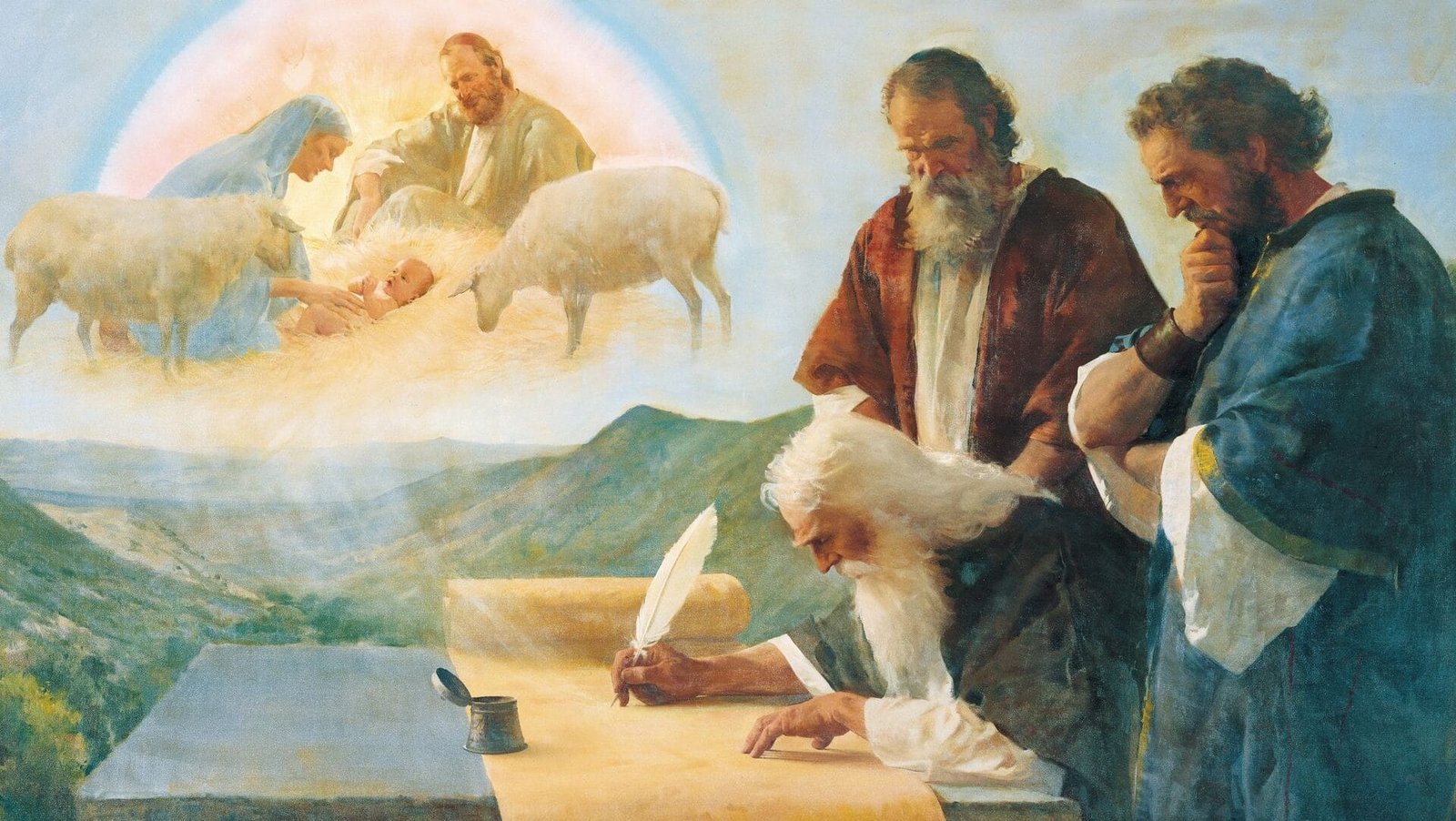
The story of 1 Samuel is significant in the history of Israel. It follows the period of the Judges, when the people were not led by prophets and frequently turned to the worship of false gods. The calling of the prophet Samuel shows the impact of a prophet.
The story of the rise of David is also told in 1 Samuel. As a messianic symbol, and as the ancestor of the messiah, David is a primary figure in Israel’s history. Subsequent books, such as Isaiah, frequently refer to places and events of David’s life. Knowing David’s story will not only help gain greater insight into the history of Israel, but will help understand other Old Testament writings.
This narrative is not intended to replace scripture study. Many details in the scriptures are vital to gaining a comprehensive knowledge of David’s story. But hopefully this post will help lift some of the confusion that often comes when we try and study the Old Testament.
The birth of Samuel (1 Samuel 1-2)
Elkanah, an Ephrathite1 from Ramah, worshipped yearly at the tabernacle in Shiloh, where Eli and his two sons (Hophni and Phineas) were priests.2 Elkanah’s wife Hannah had no children. One year at Shiloh, Hannah went to the temple, weeping bitterly, and promised God that if He would give her a son, she would give her son to the Lord as a Nazarite.3
Hannah conceived and had a son named Samuel, and took him to the temple in Shiloh to serve the Lord. The Lord blessed Samuel, and he grew “in favour both with the Lord, and also with men.”4
The sons of Eli, Hophni and Phineas, were sons of Belial.5 They took meat meant for sacrifice,6 but worse, they engaged in adulterous acts at the door of the tabernacle.7 The Lord told Eli that because of the wickedness of his sons, his house would be cut off. The Lord would raise up a faithful priest who would do what was in the Lord’s heart.
The calling of Samuel (1 Samuel 3)
The word of the Lord was rare in those days.8 One night, Samuel heard someone calling to him, so he ran to Eli and said, “Here am I.” Eli said he hadn’t called Samuel, and told him to go back to sleep. This happened a second and a third time, before Eli perceived that it was the Lord. Eli told Samuel that if the Lord called him again, to say, “Speak, Lord; for thy servant heareth.”
The Lord called Samuel the fourth time, and this time, Samuel answered, and the Lord said that He was about to do something notable in Israel. Samuel grew, and the Lord was with him. All Israel, from Dan to Beer-sheba,9 knew that Samuel was a prophet. The Lord was again in Shiloh at the tabernacle, as he was now revealing himself to Samuel.
The death of Eli and his sons, and the loss of the ark (1 Samuel 4-6)
Hophni and Phinehas were killed in a battle with the Philistines. Eli was 98 years old, and when he heard that his sons had been killed, he fell backward off his seat and died. Phinehas’ wife was pregnant at the time, and had a son named Ichabod.
The elders of Israel10 brought the ark of the covenant to the battle against the Philistines, but the Philistines defeated Israel and took the ark to Ashdod. The ark was with the Philistines for seven months, and plagues followed it. They moved it from Ashdod, to Gath, and to Ekron, and in each place many died of the plague. So they sent it back to Israel.
On its way back to Israel, it arrived at Beth-Shemesh, where even the Israelites suffered from the plague. So they sent messengers to Kirjath-jearim,11 saying they had the ark, and asking someone to come get it. The men of Kirjath-jearim retrieved the ark and brought it to Abinadab, who sanctified his son Eleazar to keep the ark.
The Israelites desire a king (1 Samuel 7-8)
Samuel told the Israelites to return unto the Lord with all their hearts and put away their strange gods. The Israelites put away Baalim12 and Ashtaroth,13 and served the Lord.
Samuel told them to gather at Mizpeh to fight the Philistines. The Israelites were afraid, so they asked Samuel to pray for them. Samuel cried unto the Lord for Israel, and the Lord heard him. As the Philistines drew near to battle against Israel, the Lord thundered with a great thunder, and discomfited the Philistines, and the Israelites defeated them. Samuel took a stone and set it between Mizpeh and Shen, and called it Ebenezer,14 saying, “Hitherto hath the Lord helped us.”
Samuel’s sons, Joel and Abiah, were judges over Israel. But they took bribes and perverted judgment. So the elders of Israel came to Samuel at Ramah, and told him that because his sons didn’t walk in his ways, they wanted a king to judge them like the other nations.
The Lord told Samuel to give them a king. He said, “They have not rejected thee, but they have rejected me, that I should reign over them.” The Lord instructed Samuel to tell the people the dangers of a king, so Samuel warned Israel, but the people wanted a king so they could be like other nations. They wanted their king to fight their battles.
The anointing of Saul (1 Samuel 9-12)
Saul was the son of Kish, a man of Benjamin, and of great wealth. Saul was a talented young man, more handsome and taller than any of the people. Samuel met Saul at Zuph, and the Lord told Samuel that Saul was the man to reign over His people.
Samuel took a vial of oil and poured it on Saul’s head, and said the Lord had anointed him to be captain over the Lord’s inheritance. God gave Saul another heart. When he came to Gibeah, he met a group of prophets, and the Spirit of God came upon Saul, and he prophesied.
Samuel called the people together to Mizpeh. He told them that they had rejected their God by wanting a king, but when Samuel said this was the man the Lord had chosen, all the people shouted and said, “God save the king.”
The Ammonites encamped against Jabesh-gilead, a chief city of Gilead.15 The men of Jabesh sent messengers to Gibeah, and the Spirit of God came upon Saul, and he led the people to defeat the Ammonites, saving the people of Jabesh-gilead.
All the people went to Gilgal, where Samuel presented Saul to the people. Samuel said if they would serve the Lord, then they and their king would be blessed; but if they would not obey the Lord, the hand of the Lord would be against them. Saul was made king over Israel at Gilgal.
Samuel said that although the people rejected the Lord and asked for a king, the Lord would not forsake His people for His great name’s sake, because it pleased the Lord to make them His people. Samuel also said that he would not cease praying for them, but he would teach them the good and the right way. Samuel told them to fear the Lord, and serve Him in truth with all their heart, and to remember what great things the Lord had done for them.
Saul offers sacrifices contrary to the Lord’s commandments (1 Samuel 13)
After Saul reigned two years over Israel, he went to war against the Philistines at Michmash and Beth-el. Jonathan, Saul’s son, defeated the Philistines in Gibeah of Benjamin, and Geba. At Michmash, the Israelites were afraid and hid in caves. Samuel had asked Saul to wait seven days in Gilgal, but Samuel didn’t come on time. So Saul offered a burnt offering.
When Samuel arrived, he asked why Saul had offered a burnt offering. Saul said that Samuel was late and the Philistines had gathered at Michmash, so he had no choice but to offer the burnt offering. Samuel told Saul that he was foolish, and had not kept the commandment of God, so Saul’s kingdom would not continue. The Lord had found another man after the Lord’s own heart.
Saul threatens to kill Jonathan (1 Samuel 14)
Jonathan and his armourbearer went to the Philistines’ garrison without telling Saul, and defeated the Philistines in their garrison.
After Jonathan had left, Saul told the people not to eat anything. But Jonathan hadn’t heard the order, so after the battle, he ate and was refreshed. Someone told Jonathan that his father had commanded them not to eat, but Jonathan said that was foolish, because if the people had eaten, they might have had more strength to fight.
The Lord did not answer when Saul asked God if they should go after the Philistines. Saul believed the Lord didn’t answer because Jonathan had eaten contrary to Saul’s commands, so Saul told Jonathan that he should die. But the people convinced Saul to spare Jonathan.
Saul’s sons were Jonathan, Ishui, and Melchi-shua. His daughters were Merab and Michal. Saul’s wife was Ahinoam, and the captain of his host was Abner, the son of Ner, Saul’s uncle.
The Lord rejects Saul (1 Samuel 15)
The Lord remembered what Amalek did to Israel after they came out of Egypt, so the Lord told Saul (through Samuel) to destroy the Amalekites. Saul destroyed the Amalekites, but he spared their king, Agag, as well as the sheep, oxen, cattle, and lambs, and all that was good. The Lord then told Samuel that he regretted making Saul king, because Saul had turned from following the Lord. This made Samuel grieve, and he cried unto the Lord all night.
Samuel went to Gilgal and asked Saul why he did not utterly destroy the Amalekites. Saul said that it was the people who took the spoil to offer sacrifices. Samuel said, “[T]o obey is better than sacrifice,” and because Saul rejected the word of the Lord, the Lord rejected Saul from being king.
Saul acknowledged that he had sinned, saying he had feared the people, and asked Samuel to forgive him. Samuel told Saul that the Lord had rejected him. When Samuel turned to leave, Saul grabbed Samuel’s robe and it tore. Samuel told Saul that the Lord had torn the kingdom of Israel from him, and given it to Saul’s neighbor.
Samuel told Saul to bring Agag to him, and Samuel killed Agag. Then Samuel went to Ramah, and Saul went to Gibeah. Samuel never again came to see Saul, but Samuel mourned for Saul.
Samuel anoints David (1 Samuel 16)
The Lord asked Samuel how long he would mourn for Saul, seeing the Lord had rejected him as king of Israel. He told Samuel to go to Jesse the Beth-lehemite, for the Lord would provide a king from among his sons.
So Samuel went to Beth-lehem, and called Jesse and his sons to the sacrifice. As Samuel looked upon Jesse’s sons, the Lord told him not to look on the countenance, or his height, because the Lord seeth not as a man seeth; for man looketh on the outward appearance, but the Lord looketh on the heart.
Jesse brought before Samuel seven of his sons, but Samuel told Jesse that the Lord had not chosen any of them. Jesse said the youngest was keeping the sheep, and Samuel told Jesse to send for him. He was healthy, had beautiful eyes, and was handsome. The Lord told Samuel to anoint him, so Samuel took the horn of oil and anointed him, and the Spirit of the Lord came upon David from that day forward.
At the same time, the Spirit of the Lord departed from Saul, and an evil spirit began to trouble him. Saul’s servants suggested that someone who played the harp well might help. One of the servants said he had heard a son of Jesse play the harp, so they sent for David. Saul loved David, and David became Saul’s armourbearer. When Saul was troubled by the evil spirit, David played his harp, and Saul was comforted, and the evil spirit departed.
David and Goliath (1 Samuel 17)
Saul and the armies of Israel gathered by the valley of Elah. The Philistines stood on a mountain on one side, and Israel stood on a mountain on the other side, and the valley of Elah was between them.
Goliath of Gath, a champion of the Philistines, was six cubits and a span.16 He had heavy armor, a large spear, and a shield. He shouted at the armies of Israel, telling them to choose a champion to fight him. He said, “I defy the armies of Israel.” Goliath did this morning and evening for forty days. Saul and the armies of Israel were afraid of Goliath.
The three oldest sons of Jesse, Eliab, Abinadab, and Shammah, followed Saul to the battle. David was the youngest. Jesse gave David food to take to his brothers at the battle, and he heard Goliath yelling his challenge. When David heard him, he said, “[W]ho is this uncircumcised Philistine, that he should defy the armies of the living God?” This made Eliab mad, believing that David was prideful, and thinking he just wanted to see the battle.
Some people told Saul what David had said, so Saul sent for David, and David told Saul that he would fight Goliath. Saul told him he couldn’t because he was just a youth, but Goliath was a man of war from his youth. David told Saul that he had protected his father’s sheep from a lion and a bear, and just as the Lord delivered him from the lion and the bear, the Lord would deliver him out of the hand of this Philistine.
Saul gave David his armor, but David couldn’t wear it. Instead, he took his staff and his sling, and chose five smooth stones out of the brook, put them in his shepherd’s bag, and went to the Philistines.
Goliath disdained David because he was young and handsome. Goliath cursed David, saying, “Am I a dog, that thou comest to me with staves?” David said, “Thou comest to me with a sword, and with a spear, and with a shield: but I come to thee in the name of the Lord of hosts, the God of the armies of Israel, whom thou hast defied.”
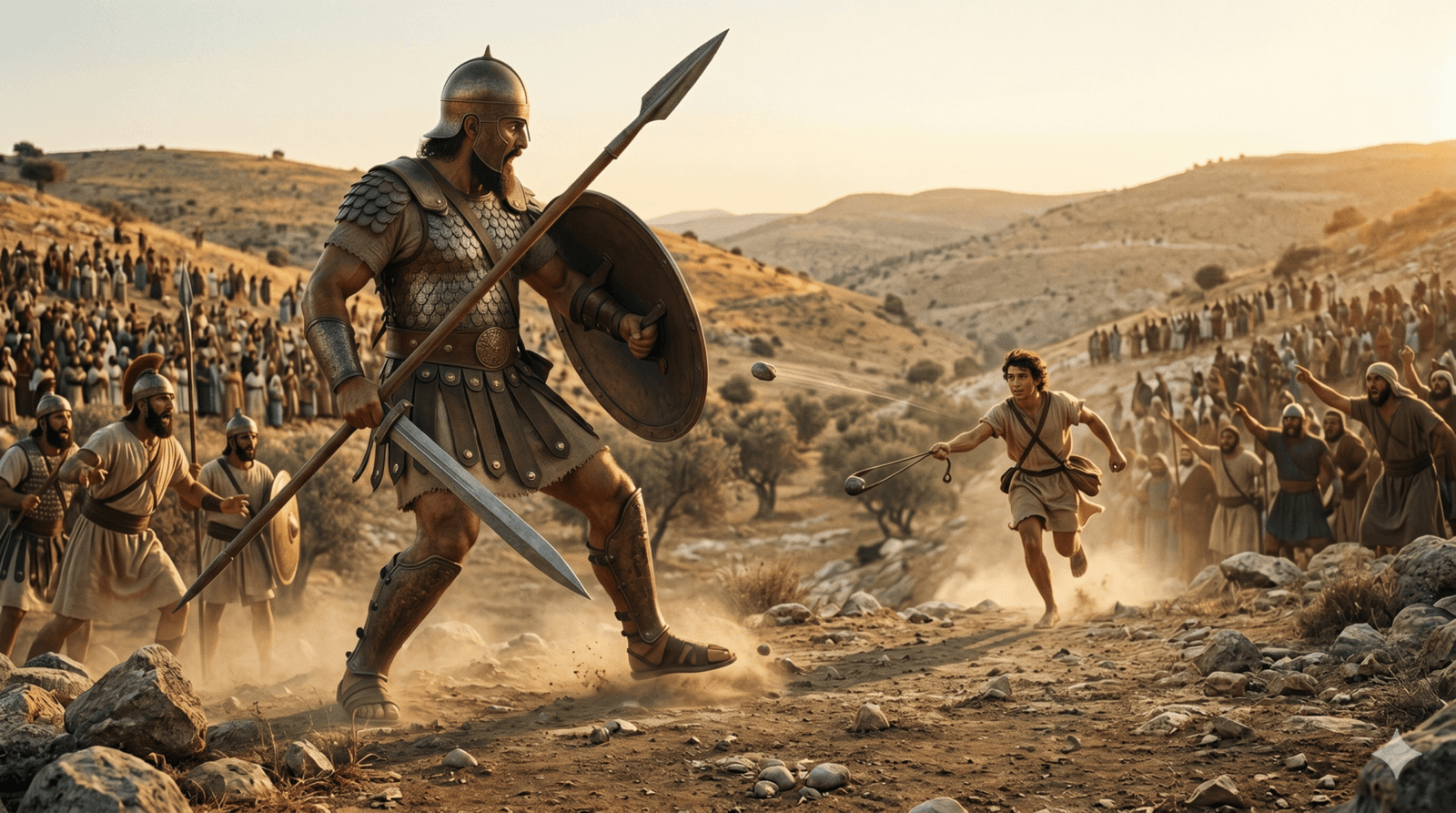
David ran toward the Philistine, took a stone, and slung it, and hit the Philistine in his forehead, and Goliath fell to the earth. David took Goliath’s sword and cut off his head. When the Philistines saw that their champion was dead, they fled. The men of Israel and of Judah followed them to the gates of Ekron. David brought the head of the Philistine to Jerusalem.
Saul seeks to kill David (1 Samuel 18-20)
Saul made David a leader over the armies, and he was accepted by all the people. As they returned from the victory over the Philistines, the people cheered, saying, “Saul hath slain his thousands, and David his ten thousands.” This made Saul angry, and David was afraid of Saul, and avoided him.
Saul told David that he would give him his eldest daughter, Merab, to marry, but she was given to Adriel instead. Michal, Saul’s daughter, loved David, and Saul took advantage of this and told David he could marry Michal if he killed one hundred Philistines. Saul thought this would get David killed, but David went with his men and killed two hundred Philistines, so Saul gave Michal to David as a wife. But Saul was even more afraid of David, because he knew the Lord was with him, so Saul became David’s enemy continually.
There was war again with the Philistines, and David beat them. The evil spirit was upon Saul, and even though David played for him, Saul sought to kill David, so David fled again. Saul sent messengers to David’s house, but Michal helped David escape through a window. Michal told Saul’s messengers that David was sick. Saul eventually found out that she had lied to him, so she told Saul that David had threatened to kill her if she didn’t let him escape.
David fled to Samuel in Ramah, and he and Samuel went to Naioth. Saul sent messengers to Naioth, and when they arrived, they saw prophets prophesying, and Samuel standing as appointed over the prophets. This happened with three groups of messengers.
David fled from Naioth and asked Jonathan what he had done that Saul wanted to kill him. Jonathan didn’t believe that Saul wanted to kill David. The next day, David was supposed to eat with Saul, but he asked Jonathan to tell Saul that he had gone to Beth-lehem for a yearly sacrifice with his family. Jonathan agreed to help David and let him know if Saul wanted to harm him. Jonathan made David promise that he would show Jonathan kindness and that David would not cut off his kindness from Jonathan’s house forever.
The next day, David hid himself in a field while Saul ate. Abner sat by Saul, but David’s seat was empty. David also didn’t come the next day, so Saul asked Jonathan where David was, and Jonathan said he had gone to Beth-lehem. Saul was angry with Jonathan and said that as long as David lived, Jonathan’s kingdom would not be established. Jonathan asked what David had done, and Saul threw a spear at Jonathan, so Jonathan knew that Saul wanted to kill David. Jonathan went to find David, and they wept together, and Jonathan told David to leave, and Jonathan went back to the city.
Saul kills the priests at Nob (1 Samuel 21-22)
David went to Ahimelech the priest at Nob and asked for food. Ahimelech said there wasn’t any common bread, but there was holy bread. David convinced Ahimelech to give him the shewbread. David also asked Ahimelech for a spear or sword, and the priest gave him the sword of Goliath. David took the sword and left Nob, and went to Achish, the king of Gath. David was worried that they would recognize him, so he feigned madness and even let spittle fall upon his beard.
David escaped to Adullam. Many gathered to David, such as those in distress, debt, or discontented, and David gathered an army of about four hundred men. The prophet Gad told David to leave Adullam and go to Judah, so he went to the forest of Hareth.
Saul was in Gibeah, standing under a tree with a spear in his hand, and he started yelling at his servants, accusing them of conspiring with David, not telling him that Jonathan had sided with David, and not feeling sympathy for him. Doeg the Edomite said he saw David in Nob, going to Ahimelech the son of Ahitub, and that Ahimelech gave him food, and the sword of Goliath.
Saul called to Ahimelech, and all the priests that were in Nob, and they all came to the king. Saul asked why they conspired against him with David. Ahimelech said that David was the king’s son-in-law, and was honorable, so he thought it was good to help him. Saul then told Ahimelech that he and all his father’s house would die.
Saul told all his servants to kill the priests, but they wouldn’t. So the king told Doeg the Edomite to kill the priests. Doeg then killed eighty-five people that day at Nob, including men, women, and children. But Abiathar, one of the sons of Ahimelech, escaped and fled after David.
David preserves Saul (1 Samuel 24)
Saul went after David at En-gedi. He went into a cave where David was also hiding, but he didn’t realize David was also there. David secretly cut off the hem or border of Saul’s robe (likely while Saul was sleeping). When they were both out of the cave, David showed Saul the hem of his robe that he cut off, letting him know that David could have killed him but didn’t. David promised that his hand would never be against Saul, and that the Lord would judge between them.
Saul wept and acknowledged that David was more righteous than he was, for David rewarded Saul good, whereas Saul rewarded David evil. He told David that he knew that the kingdom of Israel would be established in David’s hand. He asked David to swear that he wouldn’t cut off Saul’s seed, and David promised.
David marries Abigail and Ahinoam (1 Samuel 25)
Samuel died, and all Israel mourned for him. He was buried at Ramah.
There was a man in Maon named Nabal, of the house of Caleb, and his wife was Abigail. Abigail was wise, and beautiful, but Nabal was harsh and badly behaved.17 David sent messengers to Nabal and asked for help, including food. But Nabal refused. When the messengers told David, he gathered an army to go against Nabal.
One of David’s messengers told Abigail that her husband was such a worthless man that nobody could reason with him. So Abigail gathered a lot of food to give to David, but she didn’t tell her husband Nabal. David blessed the Lord for sending Abigail to him, accepted all the food she brought, and told her to go home in peace.
Abigail went home and in the morning told Nabal what had happened. He immediately suffered an illness and died about ten days later. When David heard that Nabal was dead, he sent for Abigail, and they were married. David also married Ahinoam of Jezreel. But Michal, Saul’s daughter that David had previously married, had been given as a wife to Phalti, the son of Laish, of Gallim.
David spares Saul the second time (1 Samuel 26-27)
The Ziphites came to Saul at Gibeah, to tell him that David was hiding in the hill of Hachilah. So Saul went to the wilderness of Ziph to find David. David sent spies to find where Saul was, and found the place where Saul was sleeping. He was with Abner, the captain of Saul’s armies. David took Abishai, Joab’s brother (the son of Zeruiah), and found Saul sleeping. They took Saul’s spear and water jar, and were able to get away because the Lord had caused Saul’s army to fall into a deep sleep.
David stood on a hill away from Saul’s camp and called to Abner, asking why Abner hadn’t prevented David from coming into the camp. Saul recognized David’s voice, and David again asked what he had done to cause Saul to pursue him. Saul acknowledged that he had sinned and asked David to return. David returned the spear, but wouldn’t go with Saul.
David realized that Saul would never give up chasing after him, so he escaped to Achish, the son of Maoch, king of Gath, of the Philistines. David asked Achish for a place where he and his people could live, and Achish gave him Ziklag. David lived there one year and four months.
David continued fighting for Israel, and attacked the Geshurites, the Gezrites, and the Amalekites. When Achish would ask where he had raided, David would tell him somewhere in Judah, or the Jerahmeelites, or the Kenites. Achish believed him, thinking that David was making his people Israel abhor him, so he believed that David would be his servant forever.
Saul seeks counsel from a woman with a familiar spirit (1 Samuel 28)
Saul had prohibited those who had familiar spirits (mediums) and wizards (necromancers).18 But when Saul inquired of the Lord, the Lord didn’t answer him, either by dreams, or by Urim, or by prophets. So Saul asked his servants to find a woman with a familiar spirit. They found a medium at En-dor.
Saul disguised himself and went to the woman at night, and asked her to divine a familiar spirit, or bring up whomever he should name. The woman said that Saul had prohibited mediums and necromancers, and asked why he was laying a trap for her. Saul swore that she would not be punished for this.
She asked Saul who she should bring up, and he said Samuel. She then recognized that it was Saul, but he told her not to be afraid. She said that she saw an old man coming up, covered with a mantle. Saul believed that it was Samuel, so Saul told him that the Philistines were coming against him, but God had departed from him, so he called Samuel to know what he should do.
Samuel (through the medium)19 told Saul that the Lord had torn the kingdom out of his hand and given it to David because Saul didn’t obey the Lord. The Lord would deliver Israel into the hands of the Philistines, and on the next day, Saul and his sons would die.
David destroys the Amalekites (1 Samuel 29-30)
The Philistines gathered at Aphek, and the Israelites were encamped by a spring in Jezreel. The leaders of the Philistines didn’t want David with them, so David returned home to Ziklag, and the Philistines went to Jezreel.
When David returned home to Ziklag, he found that the Amalekites had invaded and taken their families captive, including David’s two wives, Ahinoam and Abigail. David and his people wept until they had no more power to weep. David was greatly distressed, and everyone blamed David and talked about stoning him. But David strengthened himself in the Lord.
David asked the Lord whether he should pursue the Amalekites, and the Lord said he would overtake them and would recover everything. David found a servant of an Amalekite who had been left behind. This man brought David to the army of the Amalekites, and David fought them from twilight until the evening of the next day. David recovered everything that the Amalekites had carried away, including his two wives. They took the Amalekites’ flocks and herds and cattle for their spoil, and when David arrived back at Ziklag, he sent the spoil to the elders of Judah, his friends, as a present.
Saul and his sons die (1 Samuel 31)
The Philistines defeated the Israelites at a battle in mount Gilboa. Jonathan, Abinadab, and Malchi-shua, Saul’s sons, were killed. Saul was hit by archers, and he told his armourbearer to draw his sword and kill him so he wouldn’t be abused or killed by the uncircumcised Philistines. The armourbearer wouldn’t, so Saul took a sword and fell upon it. When the armourbearer saw that Saul was dead, he also fell upon his sword, and died with Saul.
So Saul, and his three sons, and his armourbearer, and all his men, died that same day.
When Israel saw that Saul and his sons were dead, they fled from their cities, and the Philistines came and dwelt in those cities. The Philistines found the bodies of Saul and his sons, and they cut off his head and stripped off his armour. They put his armour in the house of Ashtaroth, and hung his body to the wall of Beth-shan.
When the inhabitants of Jabesh-gilead heard what the Philistines had done to Saul, they went by night and took the bodies of Saul and his sons and brought them to Jabesh and burned them, then buried their bones under a tree.
References.
- “Ephrath” was an ancient name for Bethlehem. See Bible Dictionary, “Ephrath.” So Elkanah, Samuel’s father, was from Bethlehem. ↩︎
- Joshua 18:1. ↩︎
- Numbers 6:1-8. A “Nazarite” is not someone from Nazareth, where the Savior grew up, but was instead someone defined in the Law of Moses as a “consecrated man,” under a vow to serve the Lord. See Bible Dictionary, “Nazarite.” ↩︎
- Compare Luke 2:52. ↩︎
- “Belial” translates to “worthless.” See 1 Samuel 2:12, English Standard Version. See also Bible Dictionary, “Belial.” ↩︎
- See Old Testament Institute Student Manual, “1 Samuel 1-15: The Prophet Samuel and Saul, King of Israel.” ↩︎
- Ibid. ↩︎
- 1 Samuel 3:1, English Standard Version. ↩︎
- The phrase “Dan to Beer-sheba” was used to mean the entirety of Israel. Dan was at the northern end, and Beer-sheba was at the southern end. See Bible Dictionary, “Dan,” “Beersheba.” ↩︎
- In this context, the “elders of Israel” likely referred to older men who were entrusted with the governmental affairs. See Bible Dictionary, “Elders.” ↩︎
- Kirjath-jearim was a town on the boundary between Judah and Benjamin, 7.5 miles northwest of Jerusalem. The ark would remain here for 20 years. See Bible Dictionary, “Kirjath-jearim.” ↩︎
- Baalim is the plural for Baal, representing the various iterations worshiped by the people of the land. See Bible Dictionary, “Baal.” ↩︎
- Ashtaroth was an idol worshipped along with Baal. See Bible Dictionary, “Ashtaroth.” ↩︎
- In the hymn, “Come Thou Found of Every Blessing,” #1001, the second verse says, “Here I raise my Ebenezer; Higher by Thy help I’m come.” This verse is taken from this experience of Samuel, and is symbolic of offering gratitude to the Lord for His help. ↩︎
- Bible Dictionary, “Jabesh.” ↩︎
- The height of Goliath is disputed. A “cubit” was about the distance from the elbow to the tip of the fingers, which at the time of David was about 18 inches. See Bible Dictionary, “Cubit,” see also 1 Samuel 17:4 (ESV), footnote b (“a cubit was about 18 inches”). So, at six cubits, Goliath’s height would be about 9 feet. However, the earliest manuscripts disagree on his height. The Hebrew manuscript says 6 feet, but the Septuagint (the Greek manuscript), the Dead Sea Scrolls, and Josephus say his height was 4 cubits, or about 6 feet tall. See 1 Samuel 17:4 (ESV), footnote a. ↩︎
- 1 Samuel 25:3 (ESV). ↩︎
- 1 Samuel 28:3 (ESV). ↩︎
- “The Witch of Endor, … instead of being a prophetess of the Lord, was a woman who practiced necromancy; that is, communication or pretended communication with the spirits of the dead; but she was led by a familiar spirit. In other words, she was a spiritual medium, similar to those modern professors of the art, who claim to be under the control of some departed notable, and through him or her to be able to communicate with the dead. It should be observed that in the seance with the king of Israel, Saul did not see Samuel or anybody but the medium or witch. She declared that she saw an old man coming up and that he was covered with a mantle. It was she who told Saul what Samuel was purported to have said. Saul ‘perceived that it was Samuel’ through what the witch stated to him. The conversation that ensued between Samuel and Saul was conducted through the medium. All of this could have taken placed entirely without the presence of the prophet Samuel. The woman, under the influence of her familiar spirit, could have given to Saul the message supposed to have come from Samuel, in the same way that messages from the dead are pretended to be given to the living by spiritual mediums of the latter days, who, as in the case under consideration, perform their work at night or under cover of darkness.” Old Testament Institute Manual, “1 Samuel 16-31: King David’s Call to Lead Israel,” (quoting Smith, Answers to Gospel Questions), https://www.churchofjesuschrist.org/study/manual/old-testament-student-manual-genesis-2-samuel/1-samuel-16-31-king-davids-call-to-lead-israel?lang=eng&id=title_number1-p63#title_number1. ↩︎