The book of 2 Samuel tells the story of how David became king of Israel, but also how his sins led to rebellion and division. Other than Jesus Christ, King David is perhaps the central figure in the history of Israel. The Lord covenanted with David that his house would be established forever. This covenant is fulfilled in Jesus Christ:
[T]he angel Gabriel was sent from God unto a city of Galilee, named Nazareth, to a virgin espoused to a man whose name was Joseph, of the house of David; and the virgin’s name was Mary. . . .
And the angel said unto her, Fear not, Mary: for thou hast found favour with God. And, behold, thou shalt conceive in thy womb, and bring forth a son, and shalt call his name Jesus.
He shall be great, and shall be called the Son of the Highest: and the Lord God shall give unto him the throne of his father David: And he shall reign over the house of Jacob for ever; and of his kingdom there shall be no end.1
David’s is a story of triumph and tragedy. It is a story of covenant promises, but also an example of the consequences of sin.
This narrative is not intended to replace scripture study. Many details in the scriptures are vital to gaining a comprehensive knowledge of the full, complex story. But hopefully this post will help lift some of the confusion that often comes when we try to study the Old Testament.
David is anointed king over Judah (2 Samuel 1-2)
After David defeated the Amalekites,2 he returned to his home in Ziklag. After two days, an Amalekite came from the camp of Saul and told him that Israel had been defeated in battle, and Saul and Jonathan were both dead. He claimed that he saw Saul during the battle, and because of Saul’s mortal injuries, Saul asked him to kill him. David told one of his men to kill the Amalekite because he killed the Lord’s anointed.3 David mourned for Saul and Jonathan.
David went to Hebron, where the men of Judah anointed David king over the house of Judah. But Abner, captain of Saul’s host, took Ish-bosheth, the son of Saul, and brought him to Mahanaim and made him king over Gilead, and over Ephraim, and over Benjamin, and over all Israel.
Joab kills Abner (2 Samuel 2-4)
Abner and the servants of Ish-bosheth went to Gibeon to meet with Joab4 and the servants of David. Abner suggested that they select men to compete, and Joab agreed.5 So twelve of the house of Benjamin, and twelve servants of David, fought a fierce battle, and all of them died without a clear victor. Those who remained fought, and Abner and the men of Israel were defeated.
Abner fled, but Asahel, Joab’s brother, chased Abner. Abner told Asahel that he didn’t want to fight, but Asahel was faster than Abner and wouldn’t give up, so they fought, and Abner killed Asahel.
There was a long war between the house of Saul and the house of David. Abner became upset when Ish-bosheth accused him of having an affair with one of Saul’s concubines, so he sent a message to David offering to bring all Israel to David’s side. David agreed, so Abner met with David at Hebron.
Joab believed that Abner was lying, but he couldn’t convince David. Without David’s knowledge, Joab killed Abner in revenge for the death of Asahel. David didn’t punish Joab, but he mourned for Abner and held a funeral procession and buried him in Hebron.
David is anointed king of Israel and defeats the Philistines (2 Samuel 5)
When Abner died, all the Israelites were afraid. Two Benjamites, Baanah and Rechab (sons of Rimmon), killed Ish-bosheth, and all Israel came to David at Hebron and anointed him king over Israel. He was 39 years old when he began to reign, and he reigned 40 years, which included 7 years and 6 months as king of Judah, and 33 years over all Israel and Judah.
David and his men went to Jerusalem, where the Jebusites lived. They taunted him, saying the blind and the lame could defend Jerusalem.6 But David conquered Jerusalem, the stronghold of Zion, which is the city of David. He then built up the city, from the Millo7 and inward.
When the Philistines heard that David was anointed king of Israel, they fought against him in Raphaim and Baal-perazim, and David defeated them from Geba to Gezer.8
David recovers the ark (2 Samuel 6)
David went to Gibeah with a large army to bring the ark of God out of the house of Abinadab. Uzzah and Ahio, the sons of Abinadab, drove the cart. When they came to Nachon’s threshing floor, the oxen stumbled, so Uzzah put out his hand to steady the ark. The Lord was angry with Uzzah because of his error, so Uzzah died beside the ark of God.
David was angry with the Lord because of Uzzah’s death, but he was also afraid to bring the ark to the city of David. So it remained in the house of Obed-edom the Gittite for three months, and the Lord blessed Obed-edom and all his household. When David saw that the Lord was blessing Obed-edom, David retrieved the ark and brought it into the city of David with gladness. As they were bringing it into the city, David danced before the Lord with all his might. Michal (Saul’s daughter) saw David leaping and dancing, and accused him of immodesty because of the way he was dressed and how he was dancing. But David told her that he was doing it for the Lord, and if that offended her, he would do more to serve the Lord that would offend her.
The Lord covenants to establish David’s house (2 Samuel 7-8)
After David was established in Jerusalem and had rest from his enemies, he told Nathan the prophet that he wanted to build a place for the ark of God to dwell. Nathan told David to do all that was in his heart, for the Lord was with him.
However, that night, the word of the Lord came to Nathan, telling him to go to David, and say that David’s son, not David, would build a house for the Lord’s name. The Lord would appoint a place for His people Israel. The Lord would make David a house, and set up his seed after him, and establish his kingdom. The Lord will establish the kingdom of David’s son forever, and the Lord said, “I will be his father, and he shall be my son.” David’s house and his kingdom would be established forever, and his throne would be established forever. After Nathan told David this message from the Lord, David praised the Lord, saying that the Lord had confirmed Israel to be His people forever, and the Lord was their God.
The Lord preserved David wherever he went. As David defeated nations, they paid tribute to him. He took the tributes and spoils of silver, gold, and brass, and dedicated them to the Lord. He defeated the Philistines, Moabites, Hadadezer, king of Zobah, the Syrians (or Arameans)9 of Damascus, and the Edomites in the Valley of Salt.
David preserves Saul’s posterity (2 Samuel 9)
David wanted to show kindness to the house of Saul for Jonathan’s sake. Ziba, a former servant of Saul, told the king that Jonathan had a son, Mephibosheth. He was five years old when Saul and Jonathan died, and when his nurse took him to flee, he fell and became crippled.
David sent for Mephibosheth and told him that he would restore to him all of Saul’s lands. David also told him that he would be a part of David’s house and eat at David’s table. David asked Ziba to serve Mephibosheth and help him take care of the lands.
Bathsheba and Uriah (2 Samuel 10-12)
Neighboring nations continued to fight against Israel. The Ammonites hired Syrians as mercenaries, and David sent Joab to fight them, but David remained behind in Jerusalem.
One night, he walked along the roof of the king’s house, and he saw a beautiful woman washing herself. David asked about her and found out she was Bath-sheba, the wife of Uriah the Hittite, who was with Joab and the army. David sent for Bath-sheba, and he lay with her.
Bath-sheba told David that she had conceived, and so David sent for Uriah the Hittite so he could go home and lay with his wife, to try and hide that the child was David’s. However, Uriah slept at the door of the king’s house with the servants and didn’t go home. David tried a lot of different ways to get Uriah to go home, but he refused, saying the ark, Israel, and Judah were encamped in open fields, so why did he have the right to go home and sleep in his bed with his wife?
David sent Uriah back to the battle with a letter for Joab, which told Joab to put Uriah at the front of the hottest battle, then pull back the armies and let Uriah die. When the wife of Uriah found out that her husband was dead, she mourned. But David sent for her, and she became his wife and bore him a son.
The thing that David did displeased the Lord, and Nathan the prophet told David a parable. There were two men, one rich and the other poor. The rich man had many flocks and herds, but the poor man had nothing except one little lamb. The poor man nourished his lamb, and it grew up with him and his children, and was to him as a daughter. When a traveler came to the rich man, he took the poor man’s lamb and prepared it for the traveler instead of using his own flocks or herds.
David was angry at hearing this story and said the man who did this should die. Nathan said to David, “Thou art the man.” He told David that the Lord anointed him king over Israel, delivered him from Saul, gave him his master’s house, his master’s wives, and the house of Israel and Judah. If that wasn’t enough, the Lord would have given him much more. Nathan told David that because of what he had done, the sword would never depart from David’s house.
Nathan said that the child of Uriah’s wife would die. David sought God on behalf of the child and fasted. On the seventh day, the child died. David comforted Bath-sheba, and she conceived another son. David called him Solomon.
Absalom’s exile (2 Samuel 13-14)
Absalom, a son of David, had a sister (of the same mother, Maacah) named Tamar. Amnon (whose mother was Ahinoam), the firstborn son of David, was tormented because he was obsessed with Tamar. Jonadab, a friend of Amnon, told him to pretend to be sick and ask David to send for Tamar to care for him. When Tamar went to Amnon’s room, he grabbed her and said, “Come lie with me.” She refused him, but she said that if Amnon would talk to the king, the king would arrange for their marriage. But Amnon didn’t listen, and he forced himself on her. After that, Amnon hated Tamar, and his hatred was greater than his love had been.
Tamar left crying, and Absalom saw her. When she told him what had happened, Absalom hated Amnon and wouldn’t talk with him. After two years, Absalom had sheepshearers in Baal-hazor, near Ephraim, and he invited all the king’s sons. Absalom told his servants to watch Amnon, and when he was drunk, to kill him. After the servants killed Amnon, all the king’s sons fled. When David heard that Absalom had killed Amnon, he and all his sons who had witnessed it wept. Absalom fled to Talmai, the son of Ammihud, king of Geshur (who was Absalom’s grandfather, father of his mother Maacah).
Joab knew the king loved Absalom, so Joab convinced him to let Absalom come back. The king agreed, but said that Absalom should go to his own house and not see the king. Absalom lived in Jerusalem for two years without seeing the king. During that time, he had three sons and one daughter, who he named Tamar.
After two years, Absalom asked Joab to come see him, but Joab ignored him. So Absalom had his servants set Joab’s field on fire. Joab asked Absalom why he did that, and he said it was because Joab had ignored him. Absalom asked Joab why he brought him from Geshur if the king wasn’t going to see him. So Joab told the king, who then called for Absalom. When Absalom came to the king, he bowed to the ground before the king, and the king kissed him.
Absalom’s rebellion (2 Samuel 15-18)
Absalom began to gather men to support him, and he stole the hearts of the men of Israel. After four years,10 Absalom left to go to Hebron, and he sent secret messengers throughout all the tribes of Israel, saying Absalom would be crowned king in Hebron. Absalom even sent for Ahithophel, David’s counselor.
A messenger came to David, saying the hearts of Israel were with Absalom. So David fled Jerusalem to avoid war with Absalom. Zadok, Abiathar, and all the Levites went with him, bearing the ark of the covenant. But David told Zadok to take the ark back to the city, because if the Lord found favor with David, he would restore him as king; but if not, he would not resist the Lord’s will. David also told Zadok to return to the city with his son Ahimaaz, and with Jonathan, Abiathar’s son.
David passed over the brook Kidron, and ascended the Mount of Olives,11 and wept as he went up, with his head covered, and barefoot. All the people with him also went with their heads covered and weeping.
David was told that Ahithophel was among the conspirators, so David asked his servant Hushai to return and offer to be Absalom’s servant so he could counter the betrayal of Ahithophel. He asked Hushai to report whatever he heard to Zadok and Abiathar, and they would send messages to David through Ahimaaz and Jonathan.
As David traveled, he met Ziba, the servant of Mephibosheth, who told him that Mephibosheth believed Saul’s kingdom would be restored to him. When David came to Bahurim, a man named Shimei, also of the house of Saul, cursed David. He cast stones at David and the people with him, calling him a bloody man and a man of Belial (or, a worthless man).12 He told David that the Lord had avenged on him all the blood of the house of Saul.
When Absalom came to Jerusalem, he greeted Hushai and asked why he didn’t go with David. Hushai said that whoever the Lord and the people chose, he would serve. Absalom asked Ahithophel what he should do, and Ahithophel said he should take twelve thousand men and kill David, but preserve David’s people and bring them back. But Hushai disagreed. He said David and his men were mighty warriors, and as soon as David began to fight, even valiant men would melt with fear. So Hushai counseled Absalom to gather all Israel, from Dan to Beer-sheba, and not let David or any of the men with him live. Absalom agreed with Hushai.
When Ahithophel saw that his counsel was not followed, he went to his house in Giloh, put his household in order, and hanged himself.
David came to Mahanaim, and Absalom and the armies of Israel followed David and also crossed over the Jordan River. Absalom made Amasa captain of the army instead of Joab. Amasa and Joab were cousins.
Joab kills Absalom (2 Samuel 18)
David organized the men who were with him, and set Joab over a third, and Abishai (Joab’s brother) over a third, and Ittai over a third, and he asked them to deal gently with Absalom.
David’s army went to battle against Israel in the wood of Ephraim (near Mahanaim) and defeated the people of Israel. The forest devoured more people that day than the sword. Absalom was riding on a mule, and as he rode under thick branches of an oak tree, his head got caught, and he became stuck under the tree. One of David’s servants saw him and told Joab, and Joab went and killed Absalom. Then all Israel fled.
When David heard that Absalom was dead, David went up to the chamber over the gate and wept, and said, O my son Absalom, my son, my son Absalom! Would God I had died for thee, O Absalom, my son, my son!
Joab was told that the king was weeping for Absalom. The victory turned into mourning, because the people heard that David grieved for his son. Joab went to the king and said he had shamed his people, because he loved his enemies and hated his friends. It seemed to Joab that if Absalom had lived and all David’s army had died, that David would have been pleased.
David returns to Jerusalem (2 Samuel 19)
After the death of Absalom, the people throughout the tribes of Israel didn’t understand why David had not returned. So David sent to Zadok and Abiathar, asking why they hadn’t brought him back. David also sent to Amasa (whom Absalom had appointed captain of his army) and asked him to be captain of his army instead of Joab.
When the king returned, Shimei and Ziba were there to meet David. Shimei fell down before the king and asked him not to remember what Shimei had done. Abishai said that Shimei should be put to death because he cursed the Lord’s anointed. But David said nobody would be put to death that day.
Mephibosheth, the son of Saul, also came to meet David, and David asked why he hadn’t gone with him when he left. Mephibosheth said his servant (Ziba) deceived him, and that Ziba slandered him to David when he told David that Mephibosheth thought Saul’s kingdom would be restored to him.
When the king returned, all the people of Judah came with him, but only half the people of Israel. The men of Israel asked the king why Judah had stolen him away. The men of Judah answered, saying the king was near kin to them. The men of Israel said they had ten parts in the king, so they had more right in David than Judah did.
Sheba’s rebellion (2 Samuel 20)
A man of Belial (or, a worthless man),13 named Sheba, a Benjamite, convinced Israel that they had no part in David, or inheritance in the son of Jesse. So Israel left David and followed Sheba, but Judah clave unto their king, from Jordan to Jerusalem.
David told Amasa to assemble the men of Judah in three days, but Amasa delayed. David told Abishai that Sheba could do more harm than Absalom, and he told Abishai to pursue Sheba. Because of Amasa’s delay, Joab’s men left Jerusalem to pursue Sheba. When they reached Gibeon, Amasa was also there. Joab went to greet Amasa, but Amasa didn’t realize that Joab was holding his sword, and when they greeted each other, Joab stabbed Amasa in the stomach, and he died.14 After that, everyone followed Joab.
As Joab traveled through Israel, he continued to gather more men. They besieged Sheba at Abel of Beth-maachah. A woman in Abel asked to talk with Joab. She said she was peaceable and faithful, and asked why Joab wanted to destroy Abel. Joab said he didn’t want to, but Sheba had rebelled against David. He told her that if she would deliver Sheba, he would depart from the city. The women went to her people, and they killed Sheba. So Joab left and returned to Jerusalem.
David kills Saul’s sons (2 Samuel 21)
There was a famine that lasted for three years. David inquired of the Lord, and the Lord said the famine was because Saul killed the Gibeonites.15 So David asked the Gibeonites what they wanted to avenge what Saul had done. They said they wanted seven of Saul’s descendants delivered to them to hang. David spared Mephibosheth, the son of Jonathan, but he took two sons of Rizpah, and five sons of Merab,16 and he delivered them to the Gibeonites, and they hanged all seven.17 David took the bones of Saul and Jonathan, who were buried in Jabesh-gilead, and he gathered all those who were hanged, and he buried them in Benjamin in Zelah.
David sins and offers sacrifice (2 Samuel 24)
The Philistines went to war with Israel. David went down and fought with his armies, but he started to feel weak. Abishai helped him, but from then on, his men told him to no longer go to battle.
David told Joab to go through all Israel, from Dan to Beer-sheba, and number the people. Joab traveled through all the land and returned to Jerusalem after nine months and twenty days. He had counted eight hundred thousand men in Israel, and five hundred thousand men in Judah.
David recognized that he had sinned in counting the people. The word of the Lord came unto the prophet, Gad, David’s seer, saying that because of David’s sin in which he counted the people, the Lord would give him three options: seven years of famine, or be required to flee three months before his enemies, or three days of pestilence. David said he wouldn’t choose, but he would trust the mercies of the Lord.
So the Lord sent a pestilence upon Israel, and seventy thousand men died, from Dan to Beer-sheba. David prayed to the Lord and acknowledged his sin. He said that the people hadn’t sinned, so he asked the Lord to be against him rather than against the people.
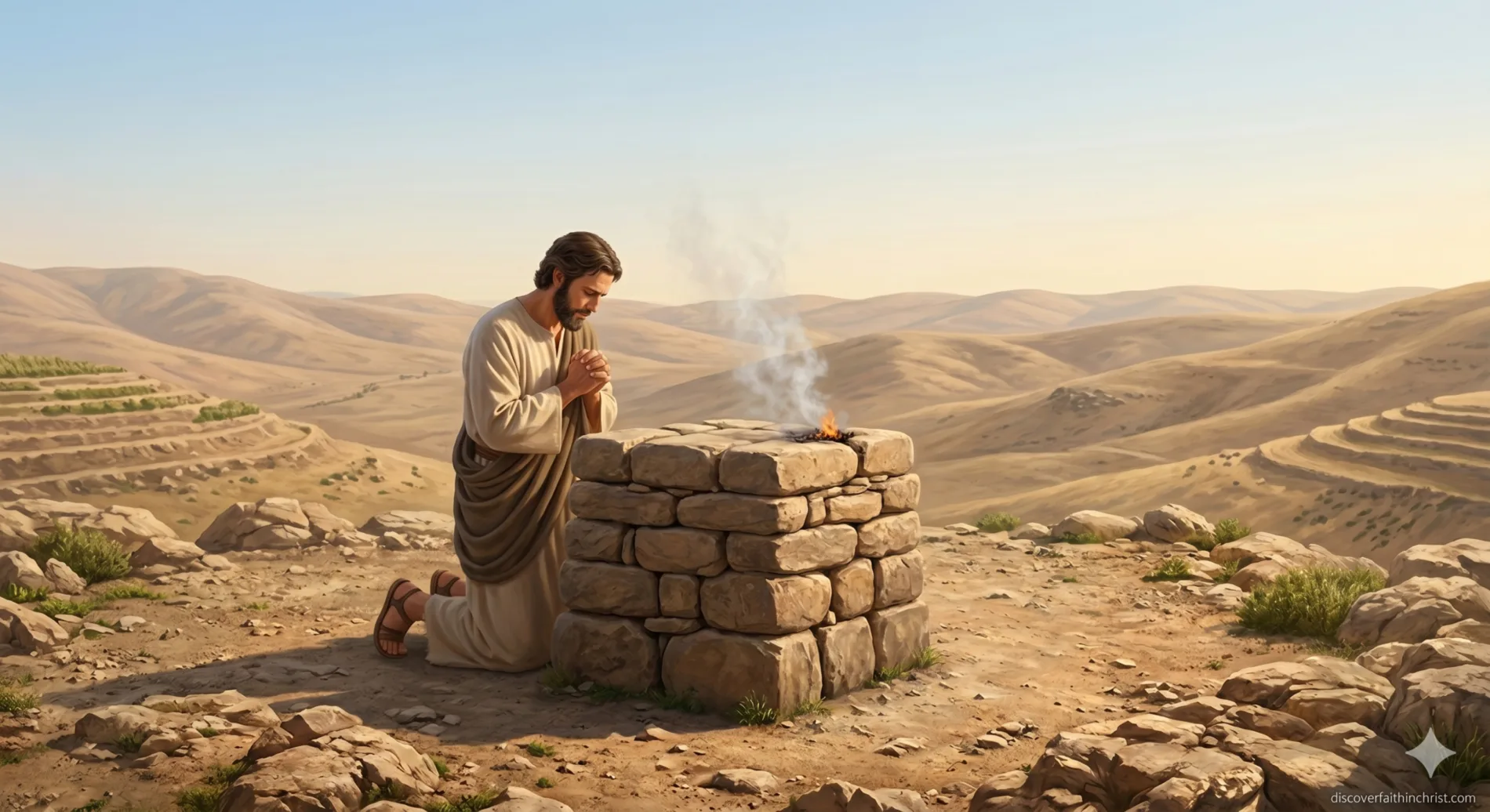
The prophet Gad came to David and told him to build an altar and offer sacrifice. Araunah the Jebusite offered to give David what he needed to offer sacrifices, but David said he would buy it, because he wouldn’t offer burnt offerings unto the Lord that cost him nothing. So David bought Araunah’s threshing floor and oxen for fifty shekels of silver. He built an altar and offered burnt offerings and peace offerings, and the Lord was entreated, and the plague was stayed from Israel.
References
- Luke 1:26-33. ↩︎
- This is a continuation of the story from 1 Samuel 30, which tells of David going to battle against the Amalekites after they had spoiled his home in Ziklag, and taken David’s wives captive. See “The Story of 1 Samuel.” ↩︎
- This is a conflicting story than what is told of the death of Saul in 1 Samuel 31:4-6. In that account, after Saul had been wounded, he asked his armourbearer to kill him, but he wouldn’t, so Saul killed himself. The Old Testament Institute Manual explains why David would kill this man who brought the news: “‘The whole account which this young man gives is a fabrication: in many of the particulars it is grossly self-contradictory. There is no fact in the case but the bringing of the crown, or diadem, and bracelets of Saul; which, as he appears to have been a plunderer of the slain, he found on the field of battle; and he brought them to David, and told the lie of having despatched Saul, merely to ingratiate himself with David.’ (Clarke, Bible Commentary, 2:308.) That David understood the Amalekite’s motives is clear from 2 Samuel 4:10.” [“When one told me, saying, Behold, Saul is dead, thinking to have brought good tidings, I took hold of him, and slew him in Ziklag, who thought that I would have given him a reward for his tidings.”] See Old Testament Institute Student Manual, “2 Samuel 1–12: The Fall of King David.” ↩︎
- Joab was the captain of David’s armies. See 2 Samuel 8:16. ↩︎
- This was likely a process where each side chose champions, similar to when David fought Goliath. See Old Testament Institute Manual, “2 Samuel 1–12: The Fall of King David.” ↩︎
- Jerusalem was the perfect capital city. It was right between the northern and southern tribes, and because it had been occupied by the Jebusites, it was a neutral location for David’s capital. Because of its location, it was easily defended, which is why the Jebusites were not afraid of him, and said the blind and the lame could defend the city. See Old Testament Student Manual, “2 Samuel 1–12: The Fall of King David.” See also Scripture Helps, “1 Samuel 17–18; 24–26; 2 Samuel 5–7.” ↩︎
- The “Millo” is generally understood to be a defensive structure. A website dedicated to explaining parts of the existing city of Jerusalem has some photos and explanations for what archeologists believe to be the remaining Millo. See https://www.generationword.com/jerusalem101/17-millo-jebusite-wall.html. ↩︎
- 2 Samuel 5:25 (ESV). ↩︎
- The nation called “Syria” in the King James Version is often called “Aram” in other renditions, such as the New International Version (“When the Arameans of Damascus came to help Hadadezer . . . .”) See 2 Samuel 8:5 (NIV). See Bible Dictionary, “Aram, Arameans,” and “Syria.” ↩︎
- 2 Samuel 15:7, n.a (ESV). ↩︎
- The Mount of Olives is where Jesus performed the atonement. See Matthew 26:30; Mark 14:26; Luke 22:39. The geography of the Holy Land is significant, and is often referenced in Old Testament writings. Jerusalem is located at the top of a hill, and Mount Olives is a hill east of Jerusalem. In between them is the Kidron Valley. See Bible Dictionary, “Olives, Mount of, or Olivet,” and “Kidron.” It is worth reviewing images and maps, such as Bible Map 12, “Jerusalem at the Time of Jesus.” Because of the international fame of Jerusalem and its historical significance, there are many resources that can show the relative elevations of Jerusalem, the Kidron Valley, and the Mount of Olives, like this video on YouTube: https://youtu.be/Neqcoih5jpo?si=OVTaNHoYjNDMBjAO. ↩︎
- 2 Samuel 16:7 (ESV). ↩︎
- 2 Samuel 20:1 (ESV). ↩︎
- See 2 Samuel 20:8-10 (ESV). This story is confusing, and it seems that even scholars disagree about whether Joab killed Amasa deliberately or whether it was an accident: “It appears that this was not a military garment; and that Joab had no arms but a short sword, which he had concealed in his girdle; and this sword, or knife, was so loose in its sheath that it could be easily drawn out. It is thought farther, that Joab, in passing to Amasa, stumbled, (for so some of the versions, and able critics, understand the words it fell out,) and that the sword fell down when he stumbled; that he took it up with his left hand as if he had no bad intention; and then, taking Amasa by the beard with his right hand, pretending to kiss him, he, with his sword in his left hand, ripped up his bowels. This seems to be the meaning of this very obscure verse.” Old Testament Institute Manual, 2 Samuel 13-24, “(27-21) 2 Samuel 20:4–13. The Assassination of Amasa.” ↩︎
- Joshua 9:3-17, “Joshua made peace with [the inhabitants of Gibeon], and made a league with them, to let them live: and the princes of the congregation sware unto them.” There is no other reference to Saul breaking this agreement. ↩︎
- 2 Samuel 21:8 (ESV). Most Hebrew manuscripts say Michal, but scholars believe this is a mistake, because Michal was David’s wife, and it says these were the sons of Adriel, who was Mirab’s husband. See 1 Samuel 18:19; see also Old Testament Institute Student Manual, (27-22) 2 Samuel 21:1-14. ↩︎
- This story likely shows David’s spiritual deterioration. It was contrary to the law to punish a son for the guilt of his father. See Deuteronomy 24:16, “The fathers shall not be put to death for the children, neither shall the children be put to death for the fathers: every man shall be put to death for his own sin.” So the Lord would not have instructed David to commit this act. See Old Testament Institute Student Manual, (27-22) 2 Samuel 21:1-14. ↩︎