When the Lord revealed the ten commandments to Moses, He warned Israel against idol worship:
And God spake all these words, saying,
I am the Lord thy God, which have brought thee out of the land of Egypt, out of the house of bondage.
Thou shalt have no other gods before me.
Thou shalt not make unto thee any graven image, or any likeness of any thing that is in heaven above, or that is in the earth beneath, or that is in the water under the earth:
Thou shalt not bow down thyself to them, nor serve them: for I the Lord thy God am a jealous God, visiting the iniquity of the fathers upon the children unto the third and fourth generation of them that hate me; And shewing mercy unto thousands of them that love me, and keep my commandments.1
If there is any one central lesson in 1 Kings, it is the consequences of turning to idol worship. It begins with Solomon, whom the Lord deemed worthy to construct the temple, but whose heart was drawn away to the worship of false gods. After Solomon’s death, the kingdom was divided, and Jeroboam, who was made king of the northern kingdom of Israel, introduced idol worship in his kingdom to prevent the people from worshipping at the temple, which was in Jerusalem in the southern kingdom of Judah. This is often referred to in the history of Israel as “Jeroboam’s sin.”
The division of the kingdom into the northern and southern kingdoms is a major event that pervades the writings of Isaiah, so it is vital to be familiar with the events in 1 Kings if we want to understand the writings of later prophets in the Old Testament, including Isaiah.
1 Kings teaches us to worship the Lord, and only Him.
David’s death and Solomon’s anointing (1 Kings 1-2)
When David was old, his servants found a young woman named Abishag to care for him.
Adonijah (David’s fourth son, whose mother was Haggith),2 wanted to be king, and Joab and Abiathar supported him. But Zadok the priest, Benaiah the son of Jehoiada, and Nathan the prophet, supported Solomon.
David had promised Bath-sheba that Solomon would be king, so he told Zadok, Nathan, and Benaiah to cause Solomon to ride David’s mule to Gihon, and there anoint him king over Israel. Zadok took a horn of oil out of the tabernacle and anointed Solomon. The people rejoiced, and the earth was filled with the noise.
Adonijah and the people with him heard it, and Joab asked why the city was in an uproar. Jonathan, the son of Abiathar, said that David had made Solomon king, and Zadok and Nathan had anointed him king. Adonijah was afraid, so he took hold of the horns of the altar.3 Solomon promised that Adonijah would not be harmed, so Adonijah submitted to Solomon, and Solomon let him live. However, Adonijah asked if he could marry Abishag, which showed he had not given up on becoming king.
When David was close to death, he charged Solomon to keep the charge of the Lord as it is written in the law of Moses. He also told Solomon what Joab had done to Abner and Amasa, and what Shimei had said to David. After David, Solomon quickly eliminated threats to his kingdom. He commanded Benaiah, the commander of the army, to kill Adonijah (for seeking the kingdom), Joab (for killing Abner and Amasa), and Shimei (who had cursed David). Although Abiathar was also worthy of death, Solomon would not put him to death because he bore the ark before David. However, Solomon expelled Abiathar to his home in Anathoth, and would not allow him to be a priest, fulfilling the word of the Lord to Eli in Shiloh.
Solomon seeks wisdom (1 Kings 3-4)
Solomon made an alliance with Pharaoh king of Egypt by marrying his daughter.
Solomon loved the Lord, walking in the statutes of David his father. He went to Gibeon to sacrifice at the tabernacle, and the Lord appeared to Solomon in a dream and said, “Ask what I shall give thee.” Solomon asked for an understanding heart. This pleased the Lord, so the Lord gave him a wise and understanding heart, as well as riches and honor. The Lord told him that if he would walk in the Lord’s ways, keeping His statutes and His commandments, then God would lengthen his days.
Two women4 who lived in the same house came to Solomon for judgment. Each had a baby, but one baby had died, and both claimed that the surviving baby was hers. Solomon said to divide the living child in two, and give one half to each woman. The first woman said to give the child to the other woman. The second woman said the baby should be divided. Solomon said to give the child to the first woman, for she is the mother. All Israel stood in awe5 of the king, for they saw that the wisdom of God was in him.
Solomon appointed Adoniram over forced labor, and he had twelve officers over all Israel, each assigned to a distinct area of the land and responsible for providing food for the king and his household one month out of the year. Judah and Israel dwelled safely, from Dan to Beer-sheba, all the days of Solomon.
God gave Solomon wisdom and understanding and largeness of heart. Solomon was wiser than all men, and his fame was in all nations. He spake three thousand proverbs, and a thousand and five songs. All people from all kings of the earth came to hear the wisdom of Solomon.
Solomon’s construction of the temple (1 Kings 5-7)
Hiram king of Tyre sent his servants to Solomon, hearing that he had been anointed king in place of David, for Hiram loved David. Solomon told Hiram that he intended to build a house unto the name of the Lord his God, and asked him to send cedar trees out of Lebanon, for there was no one who could hew timber like the Sidonians. Hiram rejoiced that the Lord gave David a wise son, and he agreed to do everything that Solomon asked concerning timbers of cedar and fir.6 Hiram gave Solomon as many cedar and fir trees as he desired. In exchange, Solomon gave Hiram twenty thousand measures of wheat, and twenty thousand measures of oil,7 year after year.
King Solomon drafted forced labor out of all Israel.8 He divided them into three groups, sending one group to Lebanon every month, so that each was in Lebanon for one month, then two months at home. Solomon also had burden-bearers and stone cutters in the hill country,9 and chief officers over the work. Workers brought stones and timber to build the temple.
Solomon started building the house of the Lord in the fourth year of his reign, and it was finished in the eleventh year of his reign. It was made of the finest materials, and the interior was overlaid with pure gold.
The Lord told Solomon that if he would walk in the Lord’s statutes, and execute his judgments, and keep all his commandments, then he would dwell among the children of Israel and would not forsake his people Israel.
Solomon also received help from Hiram to build the king’s house, and that work took thirteen years.
For the temple, Hiram made a molten sea which stood upon twelve oxen, three looking toward the north, three looking toward the west, three looking toward the south, and three looking toward the east. The sea was set upon them, and all their rear parts were inward.10
When the work on the temple was completed, Solomon brought in all the silver and gold that David had dedicated and he put them among the treasures of the house of the Lord.
Dedication of the temple (1 Kings 8)
Solomon assembled the priests and the Levites to bring the ark of the covenant of the Lord out of the city of David, which is Zion, and into the most holy place of the temple. The only things in the ark were the two tables of stone that Moses put there at Horeb, when the Lord made a covenant with the children of Israel, when they came out of the land of Egypt.
When the priests came out of the holy place, a cloud filled the house of the Lord, and the priests couldn’t minister because of the cloud, for the glory of the Lord had filled the house of the Lord. Solomon blessed all the congregation of Israel, and he offered a prayer dedicating the temple.
As part of the dedication, he acknowledged that the Lord God of Israel keeps covenants with his servants who walk before him with all their heart. He prayed that God would hear his people and forgive their sins when they turn again to him after sinning and being smitten before their enemies. He prayed that when there is a famine because his people sinned, if they pray and turn from their sin, God would hear them, forgive their sins, and give rain upon the land God gave them for an inheritance. He prayed that if the people sin against God and are carried away captive into the land of their enemies, then return to the Lord with all their heart, God would hear their prayer, forgive them, and grant them compassion from those who carried them captive. He acknowledged that God separated his people from among all the people of the earth to be God’s inheritance, as he spake by Moses when he brought them out of Egypt.
Solomon’s fame and prosperity (1 Kings 9-10)
When Solomon finished building the house of the Lord and the king’s house, the Lord appeared to him a second time. The Lord said he heard Solomon’s prayer, and he hallowed the house to put His name there forever. He said that if Solomon would walk before the Lord, then he would establish the throne of Solomon’s kingdom forever. But if he turned from following the Lord, to serve other gods and worship them, then the Lord would cut off Israel out of the land, and He would cast this house out of His sight, and Israel would be a proverb and a byword among all people.
Solomon raised a levy (or forced labor) to build the house of the Lord, and his own house, and Millo, and the wall of Jerusalem, and Hazor, and Megiddo, and Gezer. Solomon levied a tribute of bondservice (or, drafted to be slaves)11 against non-Israelites. Of the Israelites, Solomon levied soldiers, officials, commanders, captains, chariot commanders, and horsemen.12
Solomon made a navy of ships on the Red Sea in the land of Edom. Hiram sent shipmen with knowledge of the sea to serve in the navy with the servants of Solomon.
The queen of Sheba heard of the fame of Solomon, and she came to Jerusalem to test him with hard questions. She came with a great retinue, with camels, much gold, and precious stones. Solomon answered all her questions, and her breath was taken away at the sight of all of Solomon’s riches. She told Solomon that his wisdom and prosperity exceeded his fame.
She gave the king gold, spices, and precious stones. Hiram’s navy brought gold and precious stones from Ophir. He also received riches from the merchants, the kings of Arabia, and foreign rulers.
The king made a great throne of ivory and overlaid it with gold. The throne had six steps, armrests on either side of the seat, two lions beside the armrests, and twelve lions stood on either side of the six steps. There was nothing like it in any kingdom.
King Solomon exceeded all the kings of the earth for riches and wisdom, and all the earth wanted to hear Solomon’s wisdom. Everyone brought presents year by year. He made silver in Jerusalem as common as stones, and cedar as plentiful as the sycamore.
Solomon’s idolatry and Jeroboam’s rebellion (1 Kings 11)
But Solomon loved many foreign women, including the daughter of Pharaoh. He had seven hundred wives, and three hundred concubines, and his wives turned away his heart to serve other gods. He worshipped Ashtoreth and Milcom, and Solomon did evil in the sight of the Lord. He built a high place near Jerusalem for Chemosh and for Molech, the abomination of the children of Ammon.
The Lord was angry with Solomon, because his heart was turned from the Lord God of Israel, which had appeared unto him twice. The Lord told Solomon that because he had not kept the Lord’s covenant and statutes, he would rend the kingdom from him. For David’s sake, he wouldn’t do it during Solomon’s lifetime, but he would rend it out of the hand of his son. He wouldn’t take away all the kingdom, but would leave one tribe to Solomon’s son.
Jeroboam, the son of Nebat, an Ephrathite, Solomon’s servant, turned against Solomon. Jeroboam was a mighty man, and because he was industrious, Solomon put him in charge of all the forced labor of the house of Joseph.13
As Jeroboam was leaving Jerusalem, the prophet Ahijah the Shilonite met him on the road. Ahijah tore his garment into twelve pieces, and he gave ten of the pieces to Jeroboam and told him that the Lord would rend the kingdom out of the hand of Solomon, and give ten tribes to Jeroboam, because Solomon had forsaken the Lord and worshipped Ashtoreth (the goddess of the Zidonians), Chemosh (the god of the Moabites), and Milcom (the god of the Ammonites). Ahijah told Jeroboam that if he would hearken to the Lord’s commandments, walk in his ways, and keep his statutes and commandments, the Lord would be with him, and build him a sure house like he did for David.
Solomon sought to kill Jeroboam, so Jeroboam fled to Egypt and remained there until the death of Solomon.
The division of the kingdom and Jeroboam’s idolatry (1 Kings 12-13)
After Solomon’s death, his son Rehoboam went to Shechem to be made king by all Israel. Jeroboam heard that Solomon was dead and came back from Egypt. Jeroboam and all Israel asked Rehoboam to ease their burdens (of taxes and forced labor). Rehoboam consulted with the old men, who said he should listen to the people. But he ignored their counsel, and he consulted with the young men who had grown up with him. The young men said he should add to their burdens, telling them, “My father hath chastised you with whips, but I will chastise you with scorpions.”14
Rehoboam followed the counsel of the young men and told the people he would add to their burdens. So all Israel said, “What portion do we have in David? We have no inheritance in the son of Jesse.”15 Israel withdrew their allegiance from Rehoboam, so Rehoboam reigned over only Judah.
Rehoboam sent Adoram, who was over the tribute, but Israel stoned him to death. Rehoboam hurried to his chariot to flee to Jerusalem. Israel rebelled against the house of David and made Jeroboam king. There were none that followed the house of David, except for the tribe of Judah.
When Rehoboam returned to Jerusalem, he assembled all the house of Judah, with the tribe of Benjamin, to fight against Israel. But the word of God came to Shemaiah the man of God, to tell Rehoboam to not fight against Israel. They listened to him and did not fight.
Jeroboam built Shechem in mount Ephraim, and then built Penuel. Jeroboam believed that the kingdom would return to the house of David if they went to sacrifice at the house of the Lord in Jerusalem, so he told the people they had gone to Jerusalem long enough, and he made two calves of gold, telling the people that the calves were the gods of Israel who brought Israel out of the land of Egypt. He put one calf in Beth-el, and one in Dan. He also made temples on high places and appointed priests from among the people who were not Levites. He instituted feasts and made offerings to the calves.
A prophet went out of Judah to Beth-el, and prophesied of a child born unto the house of David named Josiah, who would destroy the altars in the high places, and would destroy the priests of the high places. Jeroboam reached out his hand to lay hold on him, but his hand withered. So he asked the prophet to plead to the Lord on his behalf, so his hand could be restored. The prophet did, and Jeroboam’s hand was restored.
God had told the prophet not to eat or drink, but an old prophet deceived him, saying he was also a prophet and that an angel had spoken to him, telling him that he should feed him. So the man of God listened to him and ate, but because the man of God disobeyed the Lord and ate bread and drank water, he was killed by a lion.
Jeroboam did not return from his evil ways, but made common people priests of the high places, and he ordained anyone to be priests of the high places. This became a sin unto the house of Jeroboam, even to cut it off and destroy it from the face of the earth.
Idolatry and conflict in Israel and Judah (1 Kings 14-15)
Abijah, the son of Jeroboam, became sick. Jeroboam asked his wife to go to Shiloh to Ahijah the prophet and ask for her son to be healed. When she arrived, Ahijah told her to tell Jeroboam that he provoked the Lord to anger by making other gods and molten images. Therefore, the Lord would cut off the house of Jeroboam, until all his male descendants were gone. Ahijah told Jeroboam’s wife that as soon as she arrived home, her child would die. He told her that the Lord would raise up a king over Israel who would cut off the house of Jeroboam, and the Lord would scatter Israel because they made groves. When Jeroboam’s wife arrived home, the child died, according to the word of the Lord.
Jeroboam reigned twenty years, and when he died, his son Nadab became king.
Rehoboam the son of Solomon reigned in Judah, and provoked the Lord to jealousy by building high places, and images, and groves on every high hill. In the fifth year of king Rehoboam, Shishak king of Egypt came against Jerusalem. He took away the treasures of the house of the Lord and the king’s house. There was war between Rehoboam and Jeroboam all their days. When Rehoboam died, his son Abijam reigned in his stead.
Abijam walked in all the sins of his father, but for David’s sake, the Lord did not cut him off, but allowed the Davidic line to continue. When Abijam died, his son Asa became king. Asa did that which was right in the eyes of the Lord by removing all the idols that his father made. He even removed his mother, Maachah, as queen, because she made an idol in a grove. Asa destroyed her idol and burned it by the brook Kidron. But Asa didn’t remove the high places.
Nadab reigned in Israel, and did evil in the sight of the Lord. Baasha the son of Ahijah, of the house of Issachar, conspired against him; and Baasha killed Nadab while Israel was fighting against the Philistines in Gibbethon. After Baasha killed Nadab, he reigned as king, and killed all the house of Jeroboam, bringing to pass the prophecy spoken by Ahijah the prophet.
Baasha, king of Israel, went to war against Judah, and he built a blockade in Ramah to prevent people from crossing between Israel and Judah. Asa paid Ben-hadad, king of Syria, in Damascus, to help him fight against Baasha king of Israel. Ben-hadad fought against Israel in Dan and Naphtali, causing Baasha to leave Ramah.
There was war between Asa and Baasha king of Israel all their days. Baasha did evil in the sight of the Lord, and walked in the way of Jeroboam, doing the same things that Jeroboam did to cause Israel to sin.
Rebellions in Israel, and the rise of Ahab (1 Kings 16)
Jehu the prophet prophesied to Baasha that because he caused Israel to sin, the Lord would take away the posterity of Baasha, and would make his house like the house of Jeroboam. When Baasha died, his son Elah reigned in Tirzah. Elah’s servant Zimri, captain of half his chariots, killed him. Zimri killed all the house of Baasha, leaving not one male heir alive, neither any of his kinsfolk or friends. Zimri fulfilled the word of the Lord, spoken by Jehu the prophet.
Zimri reigned seven days in Tirzah, while the armies of Israel were at war against the Philistines in Gibbethon. The troops16 heard that Zimri had conspired and killed the king, so they made Omri, captain of the armies, king over Israel. Omri left Gibbethon with the army and besieged Tirzah. When Zimri saw that the city was taken, he went into the king’s house and burned it down with himself in it.
The people of Israel were divided, half following Tibni the son of Ginath, and half following Omri. But those following Omri overcame the people who followed Tibni. Tibni was killed, and Omri became king.
Omri bought the hill Samaria and fortified it. But Omri did evil, and worse than all that were before him, walking in all the ways of Jeroboam. When Omri died, his son Ahab became king.
Ahab did evil in the sight of the Lord above all that were before him. Not only did he walk in the sins of Jeroboam, he married Jezebel, the daughter of Ethbaal, king of the Zidonians, and worshipped Baal. He built an altar for Baal in the house of Baal, which he built in Samaria. Ahab made a grove (or Asherah),17 and he did more to provoke the Lord to anger than all the kings of Israel before him.
Elijah and the widow of Zarephath (1 Kings 17)
Elijah the Tishbite of Gilead told Ahab that there would be a famine. The word of the Lord came to Elijah telling him to go east and hide by the brook Cherith, east of the Jordan; he would drink from the brook and ravens would feed him. When the brook dried up, the Lord told him to go to Zarephath, where a widow woman would sustain him.
When Elijah came to the gate of Zarephath, he saw the widow woman and asked her to bring him a little water and a morsel of bread. She told him she only had a handful of flour18 and a little oil, and she was gathering a couple of sticks to prepare it for herself and her son, so they could eat one last meal before they die. Elijah told her to not fear, but to make him a little cake first, and after that make for herself and her son. He promised her that the flour would not be spent, and the jug of oil would not be empty, until the Lord sends rain again. She did what Elijah asked, and the wheat was not spent, and the jug of oil didn’t become empty, according to the word of the Lord that he spoke by Elijah.
The son of the woman became sick and died. Elijah took her son and carried him to the upper chamber where he was sleeping, and laid him on his own bed. He prayed, then stretched himself upon the child three times. The Lord listened to Elijah, and the child revived. When the woman saw that her son lived, she knew that Elijah was a man of God.
The contest between Elijah and the prophets of Baal (1 Kings 18)
In the third year of the famine in Samaria, the word of the Lord came to Elijah telling him to go to Ahab, and the Lord would send rain.
Obadiah was the administrator of Ahab’s house. He feared the Lord, and when Jezebel killed the prophets of the Lord, Obadiah hid a hundred prophets in a cave and fed them. While Obadiah was traveling throughout the land to find grass to save the horses and mules of Ahab’s household, he came across Elijah, who told him to go tell Ahab that Elijah was there. Obadiah asked what he had done that Elijah would deliver him to Ahab to be killed, because Ahab had searched the land for Elijah, and Obadiah feared that if he told Ahab that Elijah was there, the Spirit of the Lord would carry Elijah away, and Ahab wouldn’t be able to find him, and would then kill Obadiah. But Elijah promised that he would show himself to Ahab. So Obadiah did as Elijah asked.
When Ahab saw Elijah, he said, “Art thou he that troubleth Israel?” Elijah said that he had not troubled Israel, but it was Ahab and his father’s house who had forsaken the commandments of the Lord and followed Baalim. Elijah told Ahab to gather all Israel to mount Carmel, including the prophets of Baal and the groves (or, the prophets of Asherah),19 which eat at Jezebel’s table.
When they were all gathered, Elijah said, “How long halt ye between two opinions? If the Lord be God, follow him; but if Baal, then follow him.” Elijah said he was the only prophet of the Lord, but there were four hundred fifty prophets of Baal. He told them to gather two bulls, and let the prophets of Baal choose one, he would take the other, and each would be placed on wood. He told them to call on their gods, and he would call on the name of the Lord, and the God that answered by fire would be God. The people agreed.
The prophets of Baal called on the name of Baal from morning until noon, but there was no voice, nor any that answered. At noon, Elijah mocked them, saying either he was talking, or on a journey, or maybe he was asleep and needed to be awakened. They cried louder and cut themselves, until blood gushed upon them. They continued until the evening sacrifice, but there was no voice, and no one answered.
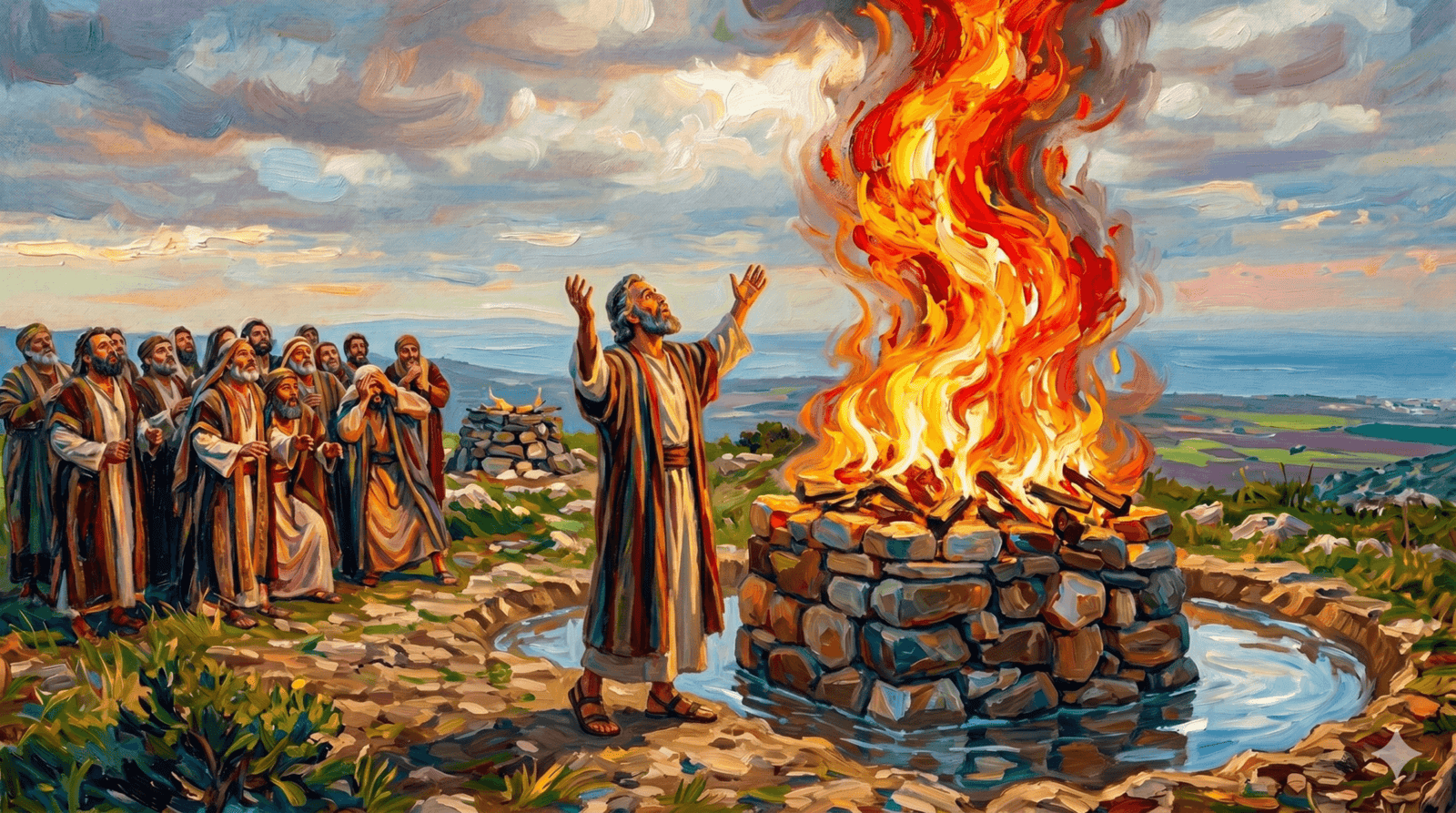
Elijah called to all the people, and they came to him. He repaired the altar of the Lord that was broken down, and he took twelve stones and built an altar, and made a trench around the altar. He told them to fill four barrels with water, and pour it on the sacrifice and the wood; then he told them to do it a second time, then a third, and the water ran around the altar, and the trench was also filled with water.
When it was time to offer the evening sacrifice, Elijah prayed, saying, “Lord God of Abraham, Isaac, and Israel, let it be known this day that thou art God in Israel, and that I am thy servant.” Then the fire of the Lord fell and consumed the burnt sacrifice, and the wood, and the stones, and the dust, and licked up the water that was in the trench. When all the people saw it, they fell on their faces, and said the Lord, he is God. Elijah told the people to take the prophets of Baal captive, and Elijah brought them down to the brook Kishon, and killed them.
Elijah told Ahab that it would rain. Elijah went to the top of Carmel, and he told his servant to look toward the sea. The servant looked but said there was nothing. Elijah told him to go and look seven times. The seventh time, the servant said, “there ariseth a little cloud out of the sea, like a man’s hand.” Elijah told the servant to tell Ahab to prepare his chariot and go, so the rain wouldn’t stop him.
The heaven became black with clouds and wind, and there was a great wind. Ahab rode and went to Jezreel. The hand of the Lord was on Elijah, and he gathered up his garment and ran before Ahab to the entrance of Jezreel.
The prophetic mantle passes to Elisha (1 Kings 19)
Ahab told Jezebel everything that Elijah had done and how he killed the prophets of Baal. Jezebel sent a messenger to Elijah saying she would do the same thing to him. Elijah ran for his life to Beer-sheba, which belonged to Judah, and left his servant there. But Elijah went a day’s journey into the wilderness and sat under a tree, and asked the Lord to take his life that he might die, saying, “It is enough.” As he slept under the tree, an angel told him to arise and eat. There was a cake baked on hot stones, and a jar of water, and he ate and drank and lay down again. The angel of the Lord came a second time, and told him to arise and eat again, and Elijah went in the strength of that food forty days and forty nights to Horeb, the mount of God.
Elijah came to a cave, and the Lord asked him what he was doing there. Elijah said he had been jealous for the Lord, and the children of Israel had forsaken the covenant and killed the prophets, and only Elijah was left, and they sought his life to kill him. The Lord told Elijah to stand upon the mount, and the Lord passed by, and a strong wind tore the mountains, but the Lord was not in the wind. After the wind, an earthquake, but the Lord was not in the earthquake, and after the earthquake a fire, but the Lord was not in the fire, and after the fire a still small voice.
The Lord told Elijah to go to the wilderness of Damascus, and anoint Hazael to be king over Syria; and to anoint Jehu the son of Nimshi to be king over Israel; and to anoint Elisha to take Elijah’s place as prophet.
Elijah found Elisha plowing with twelve yoke of oxen, and Elijah passed by him and cast his mantle upon him. Elisha left the oxen and ran after Elijah.
The Lord’s deliverance of Israel, and Ahab’s disobedience (1 Kings 20)
Ben-hadad the king of Syria besieged Samaria and went to war against it. A prophet told Ahab king of Israel that the Lord would deliver the Syrians into his hands. They battled the Syrians and prevailed, and the Syrians fled. The prophet told Ahab that the king of Syria would come again.
The servants of the king of Syria told him that Israel’s gods were gods of the hills, and they believed that was why Israel was stronger when they battled in the hills. They suggested that they fight in the plain, where the Syrians would be stronger. So Ben-hadad mustered the Syrians, and went to Aphek to fight against Israel. A man of God spoke to the king of Israel saying that the Lord would deliver the Syrians into his hand. The children of Israel prevailed against the Syrians, and they fled into the city. The servants of Ben-hadad went out to the king of Israel and asked that Ben-hadad be allowed to live. Ben-hadad came out of the city, and told Ahab that he would restore everything that his father had taken from Ahab’s father, and he would establish trading centers for Ahab in Damascus. So Ahab made a covenant with Ben-hadad and sent him away.
A prophet told king Ahab that because he had let Ben-hadad go, Ahab’s life would be for his life, and Ahab’s people for Ben-hadad’s people. And the king of Israel went to his house vexed and sullen.
Jezebel and the vineyard of Naboth (1 Kings 21)
Naboth the Jezreelite had a vineyard in Jezreel, next to the palace of Ahab king of Samaria. Ahab wanted the vineyard, and was willing to trade another vineyard or buy it. But Naboth refused to give him the inheritance of his fathers. Ahab was displeased, and Jezebel asked why he was so sad. When Ahab explained that Naboth refused to sell his vineyard, Jezebel said she would give him the vineyard. She caused two sons of Belial to bear witness against Naboth, accusing him of blaspheming God and the king, so Naboth was stoned to death.
Jezebel told Ahab to take possession of the vineyard, and after he did, the word of the Lord came to Elijah, telling him to meet Ahab king of Israel in Samaria. When Ahab saw Elijah, he said, “Hast thou found me, O mine enemy?” Elijah told him that the Lord would bring disaster upon him, and take away his posterity, and cut off all male descendants, and make his house like the house of Jeroboam, and like the house of Baasha. Elijah said there was none like Ahab, who sold himself to work wickedness in the sight of the Lord, and was stirred up by his wife Jezebel, and did abominably in following idols. When Ahab heard those words, he tore his clothes and put on sackcloth and fasted. The Lord told Elijah that because Ahab humbled himself, the Lord would not bring disaster in his days, but in the days of his son.
The death of Ahab (1 Kings 22)
There was no war between Syria and Israel for three years. In the third year, Ahab, the king of Israel, asked Jehoshaphat, the king of Judah, to go with him to battle the Syrians at Ramoth-gilead. Jehoshaphat agreed, but asked that the king of Israel seek the word of the Lord.
Ahab gathered the prophets together and asked if he should go to Ramoth-gilead. The prophets said to go up, for the Lord would deliver it into the hand of the king. Jehoshaphat asked whether there was a prophet of the Lord, that they might inquire of him. Ahab said there was one man, Micaiah the son of Imlah, but Ahab said he hated Micaiah, because he did not prophesy good concerning him. The king of Israel asked an officer to bring Micaiah. The king of Israel and Jehoshaphat each sat on his throne, arrayed in their robes, and all the prophets prophesied before them. All the prophets said, go up to Ramoth-gilead, and prosper, for the Lord will deliver it into the king’s hand.
The messenger who went to Micaiah told him that the prophets declared good things to the king, and asked that his word be like one of them, and speak that which is good. Micaiah said he would say whatever the Lord told him. Micaiah came to the king, and the king asked whether they should go against Ramoth-gilead to battle. Micaiah said that he saw all Israel scattered upon the hills, as sheep that have not a shepherd, and the Lord said these have no master, let them return every man to his house. The king of Israel said to Jehoshaphat, “Did I not tell thee that he would prophesy no good concerning me?”
The king of Israel and Jehoshaphat the king of Judah went to Ramoth-gilead. The king of Israel disguised himself, but the king of Syria commanded his captains to fight only with the king of Israel. A certain man drew his bow at random, and hit the king of Israel between the scale armor and the breastplate. The battle continued that day, and in the evening Ahab died. They brought him to Samaria, and buried him there. Ahaziah, Ahab’s son, became king.
Jehoshaphat, the son of Asa, walked in the ways of Asa his father, but the high places were not taken away, and the people offered and burned incense in the high places. Jehoshaphat made peace with the king of Israel. After Jehoshaphat’s death, Jehoram his son reigned in his place.
Ahaziah the son of Ahab did evil in the sight of the Lord, and walked in the way of his father, and his mother, and Jeroboam, who made Israel to sin. He served Baal, and worshipped him, and provoked the Lord to anger in every way that his father had done.
References
- Exodus 20:1-7. ↩︎
- 2 Samuel 3:4. ↩︎
- “[A]s soon as he learned of the enthroning of Solomon, Adonijah fled not to his home, but immediately to the heights of Mount Moriah just above the city of David. Here an altar of sacrifice had been set up by David. The horns of the altar of sacrifice were considered a sanctuary where a person could cling until his case was investigated and tried (see Exodus 21:13–14). There Adonijah waited, hoping for some indication of Solomon’s clemency toward him.” See Old Testament Institute Student Manual, 1 Kings 1-11 Solomon: Man of Wisdom, Man of Foolishness, “(1-2) 1 Kings 1. How Could Adonijah and Solomon Both Have Claim to the Throne of Israel?” ↩︎
- The King James Version says these two women were both harlots. (See 1 Kings 3:16). The English Standard Version simply says, “two prostitutes came to the king.” (See 1 Kings 3:16 (ESV)). ↩︎
- The King James Version uses the word “fear,” but the English Standard Version says “stood in awe of.” Compare 1 Kings 3:28 (KJV) and (ESV). ↩︎
- The English Standard Version refers to these as “cedar and cypress timber.” 1 Kings 5:8 (ESV). ↩︎
- The King James Version says “twenty” measures of oil, but the English Standard Version says twenty thousand. Compare 1 Kings 5:11 (KJV) and (ESV). ↩︎
- 1 Kings 5:13 (ESV). The King James Version uses “levy,” whereas the English Standard Version uses the term “forced labor” or “draft.” Compare 1 Kings 5:13-14 (KVJ) and (ESV). ↩︎
- Compare 1 Kings 5:15 (KJV) and (ESV). ↩︎
- The molten sea was a baptismal font: “In Solomon’s Temple a large molten sea of brass was placed on the backs of 12 brazen oxen, these oxen being symbolical of the 12 tribes of Israel. (1 Kings 7:23–26, 44; 2 Kings 16:17; 25:13; 1 Chron. 18:8.) This brazen sea was used for performing baptisms for the living. There were no baptisms for the dead until after the resurrection of Christ. It must be remembered that all direct and plain references to baptism have been deleted from the Old Testament (1 Ne. 13) and that the word baptize is of Greek origin. Some equivalent word, such as wash, would have been used by the Hebrew peoples. In describing the molten sea the Old Testament record says, ‘The sea was for the priests to wash in.’ (2 Chron. 4:2–6.) This is tantamount to saying that the priests performed baptisms in it. In this temple building dispensation the Brethren have been led by the spirit of inspiration to pattern the baptismal fonts placed in temples after the one in Solomon’s Temple.” See Old Testament Institute Manual, 1 Kings 1-11 Solomon: Man of Wisdom, Man of Foolishness, “(1-32) 1 Kings 7:23–26. What Was the Molten Sea and How Was It Used?” ↩︎
- 1 Kings 9:21 (ESV). ↩︎
- 1 Kings 9:22 (ESV). ↩︎
- 1 Kings 11:25 (ESV). ↩︎
- “The reference to scorpions (see 1 Kings 12:14) seems to be an allusion to scourges or whips made of several thongs of leather which had metal barbs embedded in the ends (see William Smith, A Dictionary of the Bible, s.v. “scorpion”). Rehoboam was simply announcing that he would deal even more sternly with the tribes of Israel than Solomon had.” Old Testament Institute Student Manual, 1 Kings 12–16: A Kingdom Divided against Itself, “(4-6) 1 Kings 12:4–14. Is It Folly to Reject the Counsel of the Aged?” ↩︎
- 1 Kings 12:16 (ESV). ↩︎
- 1 Kings 16:15 (ESV). ↩︎
- 1 Kings 16:33 (ESV). ↩︎
- 1 Kings 17:12 (ESV). ↩︎
- 1 Kings 18:19 (ESV). ↩︎