The story of the book of Ruth is simple, but significant. Through her faithfulness to her mother-in-law and her willingness to follow traditions not familiar to her, Ruth becomes the great-grandmother of David, the king of Israel. David’s importance in the history of Israel is not just because of his works as king, but also because the Messiah came from his family line.
This narrative is not intended to replace scripture study. Many details in the scriptures are vital to gaining a comprehensive knowledge of the full, complex story. But hopefully this post will help lift some of the confusion that often comes when we try to study the Old Testament.
Introduction: Jesus Christ is descended from David, who is descended from Ruth
Matthew1 and Luke2 both provide the genealogy of Jesus, showing he came through the Davidic line. There were many prophets who prophesied that the Messiah would arise from David’s family, but Isaiah’s prophecies are widely known:
For unto us a child is born, unto us a son is given: and the government shall be upon his shoulder: and his name shall be called Wonderful, Counsellor, The mighty God, The everlasting Father, The Prince of Peace. Of the increase of his government and peace there shall be no end, upon the throne of David, and upon his kingdom, to order it, and to establish it with judgment and with justice from henceforth even for ever.3
And there shall come forth a rod out of the stem of Jesse, and a Branch shall grow out of his roots: And the spirit of the Lord shall rest upon him, the spirit of wisdom and understanding, the spirit of counsel and might, the spirit of knowledge and of the fear of the Lord; . . . [W]ith righteousness shall he judge the poor, and reprove with equity for the meek of the earth: and he shall smite the earth with the rod of his mouth, and with the breath of his lips shall he slay the wicked.4
As a descendant of David, Jesus Christ was literally the rightful king of Israel:
Had Judah been a free and independent nation, ruled by her rightful sovereign, Joseph the carpenter would have been her crowned king; and his lawful successor to the throne would have been Jesus of Nazareth, the King of the Jews.5
The story of Ruth is simple, beautiful, and looks forward to the coming of Christ.
Ruth marries Naomi’s son, who dies, then Ruth and Naomi return to Bethlehem (Ruth 1)
During the time of the judges, there was a famine in Israel. Elimelech, a man of Bethlehem-judah, went to Moab with his wife, Naomi, and his two sons, Mahlon and Chilion. Elimelech died, then Mahlon married Ruth,6 and Chilion married Orpah. Both were women of Moab.
They lived together in Moab for about ten years, until Mahlon and Chilion died. Naomi heard that the famine had ended in Judah, so she planned to return home. She told Ruth and Orpah that they should return to their own lands. She kissed each of them, and they wept as they said goodbye. They both wanted to return with Naomi to Israel, but she told them that they had no future with her. Orpah decided to return to her family, but Ruth clung to Naomi.7
In one more attempt to convince Ruth to return home, Naomi told Ruth that Orpah had returned to her people and her gods, and Naomi should do the same. But Ruth said, “Entreat me not to leave thee, or to return from following after thee: for whither thou goest, I will go; and where thou lodgest, I will lodge: thy people shall be my people, and thy God my God.”
When Naomi saw that Ruth was determined to go with her, she stopped trying to convince Ruth to leave. When they arrived in Bethlehem, the people took note of their arrival and said, “Is this Naomi?” Naomi said, “Don’t call me Naomi, call me Mara,8 for the Almighty hath dealt very bitterly with me.” She said that she left Bethlehem full, but the Lord brought her home empty.
Ruth gathers grain in Boaz’s field (Ruth 2)
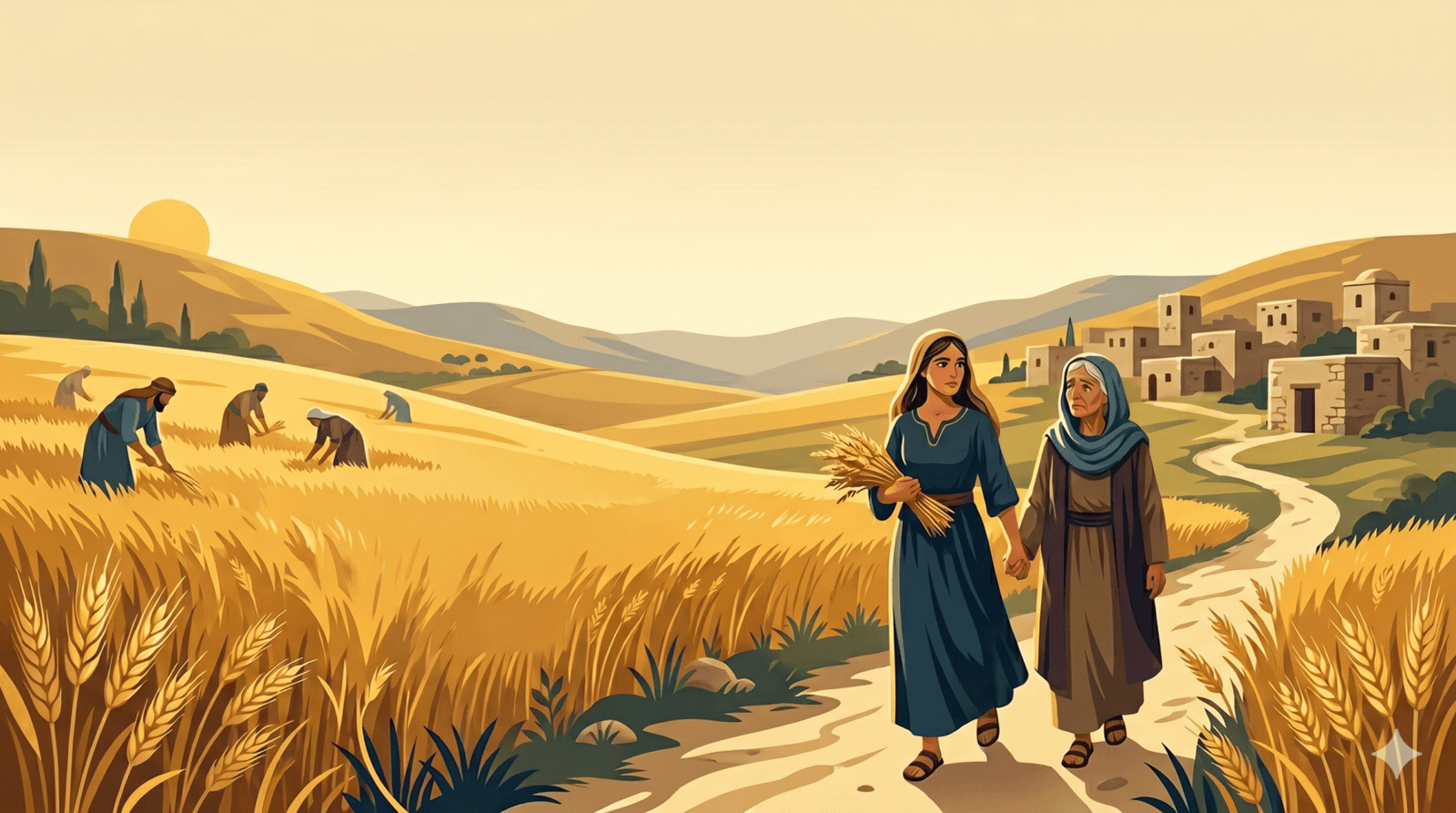
Naomi and Ruth arrived in Bethlehem at the beginning of the barley harvest. Ruth and Naomi were very poor, so Ruth went to the field to glean (or gather) grain that had fallen to the ground.9 It was her good fortune to go to the field that belonged to Boaz, a relative of Naomi’s deceased husband.
Boaz asked one of the servants about Ruth. The servant said she was a Moabitish woman who came with Naomi from Moab. Ruth had asked to glean after the reapers (the young men harvesting the barley), and she had been working since the morning, only taking a short rest.10
Boaz told Ruth to stay in his field, rather than going to other fields. He told the young men (the reapers) not to bother her and to let her drink from their water. Ruth fell to the ground and asked why he had taken notice of her, since she was a foreigner. Boaz said that he had seen everything that Ruth had done for Naomi since the death of Ruth’s husband, including leaving Ruth’s homeland to come to a people that she didn’t know.
She was grateful to him for comforting her and for being kind to her, even though she wasn’t one of his servants. At mealtime, Boaz invited her to eat with him. She ate until she was full and had some left over.
When she started gleaning again, Boaz told the reapers to let her glean whatever she wanted, and to even let some handfuls fall on purpose for her, so she could gather more. She gleaned until the evening, and gathered about an ephah of barley.11 When she took it home, Naomi was surprised at how much Ruth had gathered. Naomi asked Ruth where she had gleaned, and Ruth said it was in Boaz’s field. Naomi blessed the Lord who had shown kindness to them, and told Ruth that Boaz was one of their next kinsman, or one of their redeemers.12 Naomi told Ruth to continue gleaning in the field owned by Boaz.
Ruth proposes to Boaz (Ruth 3)
Naomi told Ruth that she wanted her to marry Boaz. She told Ruth to go to the threshing floor where Boaz would be eating and sleeping that evening, and once he was asleep, to lie down at his feet. Ruth followed those instructions, and when Boaz woke and saw Ruth, he asked why she was there.
She said, “Spread your wings over your servant, for you are a redeemer.”13 Boaz praised her for showing such kindness to him, even though he was much older, and she could have asked younger men to fulfill the responsibility of her redeemer. He said he would marry her as the near kinsman (or the redeemer), but there was a closer relative than him, so Boaz would talk to him first. Boaz gave her six measures of barley14 to take home, and he went to talk to the other near kinsman.
When Ruth went to Naomi, she said to wait patiently until they knew what would happen, because Boaz would be diligent until the matter was resolved.
Ruth marries Boaz (Ruth 4)
Boaz talked to the kinsman who had a closer relationship to Ruth’s deceased husband, and he also asked ten elders of the city to talk with them. He told them that Naomi had returned from Moab and was selling land owned by her deceased husband, Elimelech. Boaz asked the other near kinsman whether he wanted to redeem the land; if he did not, then Boaz would redeem it. Boaz also told him that if he chose to buy the land, he would have to buy it from Ruth the Moabitess, the wife of the deceased, and marry her, to raise children in the name of her deceased husband.
The other kinsman said he couldn’t redeem it, because it would impair his own inheritance. So he told Boaz to take the right of redemption himself. Boaz said to the elders that they were witnesses that he would buy from Naomi all that belonged to Elimelech, and to Chilion, and to Mahlon. He also asked them to witness that he would marry Ruth the Moabitess, the wife of Mahlon, to raise children in the name of her deceased husband. All the people and elders there confirmed that they were witnesses.
So Boaz married Ruth. She conceived and had a son that she named Obed. Obed was the father of Jesse, who was the father of David.
This is the lineage of David, beginning with Judah, a son of Israel: Pharez,15 Hezron, Ram, Amminadab, Nahshon, Salmon, Boaz, Obed, Jesse, and David.
References
- Matthew 1:1-16. ↩︎
- Luke 3:23-38. ↩︎
- Isaiah 9:6-7. ↩︎
- Isaiah 11:2-5, see also Doctrine and Covenants 113:1-2. ↩︎
- James E. Talmage, “Jesus the Christ,” Chapter 7, https://www.churchofjesuschrist.org/study/manual/jesus-the-christ/chapter-7?lang=eng&id=p25#p25. ↩︎
- Ruth 4:10. ↩︎
- Ruth 1:14 (ESV). ↩︎
- “Mara” means “bitter.” See Ruth 1:20, n.b, see also Ruth 1:20 (ESV) n.b. ↩︎
- When wheat was harvested, the workers would cut the stalks with sickles and gather them in bundles called sheaves. Random stalks would fall to the ground. The poor were allowed to “glean” those stalks, or, follow behind the workers and pick up any stalks that fell to the ground. See Old Testament Student Manual, “Judges 13–21; Ruth 1–4: The Reign of the Judges, Part 2,” https://www.churchofjesuschrist.org/study/manual/old-testament-student-manual-genesis-2-samuel/judges-13-21-ruth-1-4-the-reign-of-the-judges-part-2?lang=eng&id=p31-p32#p31. ↩︎
- Ruth 2:7 (ESV). ↩︎
- One “ephah” probably contained about eight gallons. See Bible Dictionary, “Ephah.” ↩︎
- Ruth 2:20 (ESV). This describes a “Levirate Marriage,” which made it possible for a widow to marry her dead husband’s brother. It protected a widow who might be left destitute. If there was no brother, a distant male relative could perform this duty. The first son born to the widow in the new marriage was considered a child of the dead husband and inherited his property. See Old Testament Student Manual, “Deuteronomy 17–33: An Exhortation to Obedience, Part 2,” https://www.churchofjesuschrist.org/study/manual/old-testament-student-manual-genesis-2-samuel/deuteronomy-17-33-an-exhortation-to-obedience-part-2?lang=eng&id=p72-p73#p72. ↩︎
- Ruth was asking Boaz to fulfill his obligation to marry her as a relative of her deceased husband. See Ruth 3:9 (ESV). See also Old Testament Student Manual, “Judges 13–21; Ruth 1–4: The Reign of the Judges, Part 2,” https://www.churchofjesuschrist.org/study/manual/old-testament-student-manual-genesis-2-samuel/judges-13-21-ruth-1-4-the-reign-of-the-judges-part-2?lang=eng&id=title22-p38#title22. ↩︎
- The amount of a “measure” is uncertain in this context, but it is evident that it is a great deal of food. See Bible Dictionary, “Weights and measures.” ↩︎
- Gen 38:26-29. ↩︎