When we enter into a covenant with God, He, “in His good pleasure fixes the terms,” which we can then accept or reject.1 In a prior post, “What Does It Mean to Keep My Covenants?,” I showed that keeping our covenants does not require perfection. However, God is perfect, and so He always keeps His promises. Therefore, even when we fail to keep our covenants, God continues to honor His commitment to us.
The books of Isaiah, Jeremiah, and Ezekiel are models of God’s perfect love and His commitment to honoring His covenants. Each of those books follows a similar pattern: the children of Israel turned away from their covenant by worshiping false gods; the Lord honored their agency and allowed them to seek help from their gods; when those false gods failed to protect them, the Israelites were scattered and brought into bondage; although Israel rejected the Lord, He did not abandon His covenant commitment; He was always with them, calling to them and encouraging them to turn back to Him.
As we study Isaiah, Jeremiah, and Ezekiel, we see the practical example of the Lord keeping His covenants even when His people don’t. He shows us mercy and offers us His grace because of the Atonement of Jesus Christ. As we keep our covenants, we satisfy the Lord’s conditions to bless us. Yes, He is still there when His people fail to honor their covenants, but there is safety and protection when we keep our covenants.
Isaiah, Jeremiah, and Ezekiel were eyewitnesses
Each of these prophets taught about the covenant that bound God to His people; each of them warned about the consequences of breaking the covenant; and each of them witnessed the reality of those consequences when the people failed to repent.
Isaiah’s ministry started in about 740 B.C. The nation of Assyria invaded the northern kingdom of Israel during Isaiah’s ministry, resulting in the scattering of the ten northern tribes.
- “The Lord shall bring upon thee, and upon thy people, and upon thy father’s house, days that have not come, from the day that Ephraim departed from Judah; even the king of Assyria.” Isaiah 7:17
- “In the ninth year of Hoshea the king of Assyria took Samaria, and carried Israel away into Assyria.” 2 Kings 17:6
Jeremiah’s ministry started in about 627 B.C. He was present in Jerusalem when Babylon conquered and carried away the Jews.
- “The words of Jeremiah . . . To whom the word of the Lord came in the days of Josiah . . . unto the end of the eleventh year of Zedekiah the son of Josiah king of Judah, unto the carrying away of Jerusalem captive in the fifth month.” Jeremiah 1:1-3
- “Then the Lord said unto me, Out of the north an evil shall break forth upon all the inhabitants of the land. . . . And I will utter my judgments against them touching all their wickedness, who have forsaken me, and have burned incense unto other gods, and worshipped the works of their own hands.” Jeremiah 1:14-16
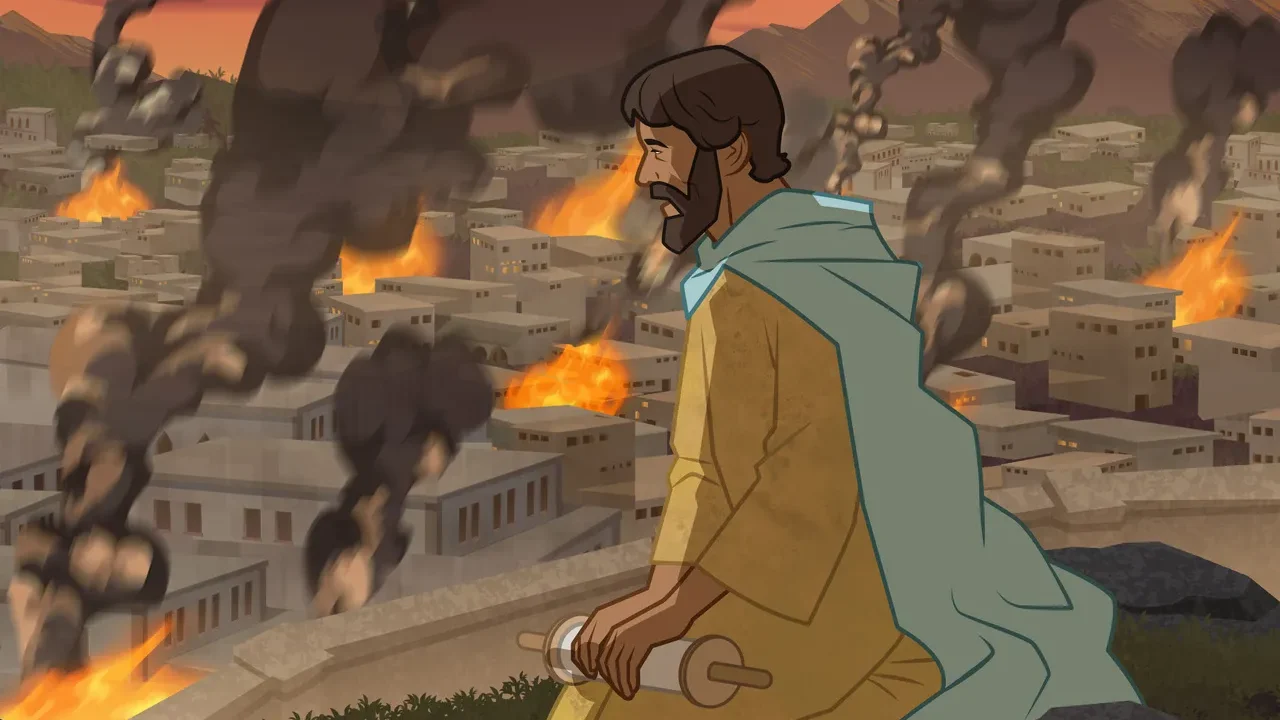
Ezekiel was one of the Jews carried away by Babylon in about 597 B.C., and his ministry started several years later as a captive in Babylon. The Jews in Babylon believed that they would return to Jerusalem, but Ezekiel prophesied that Jerusalem would be destroyed. Following that destruction in about 586 B.C., survivors from Jerusalem began arriving in Babylon, confirming that Jerusalem had been destroyed.
- “I was among the captives by the river of Chebar.” Ezekiel 1:1
- “[T]he prophets of Israel which prophesy concerning Jerusalem, and which see visions of peace for her, and there is no peace, saith the Lord God.” Ezekiel 13:16
- “And it came to pass in the twelfth year of our captivity, in the tenth month, in the fifth day of the month, that one that had escaped out of Jerusalem came unto me, saying, The city is smitten.” Ezekiel 33:21
Each of these prophets warned about the consequences of breaking the covenant, and each witnessed those consequences become a reality.
They explained that the destruction came because of breaking the covenant
All three prophets prophesied about the destruction that was to come, explaining that it was because the people had broken their covenant by turning away from the Lord.
- Isaiah: “Hear, O heavens, and give ear, O earth: for the Lord hath spoken, I have nourished and brought up children, and they have rebelled against me. The ox knoweth his owner, and the ass his master’s crib: but Israel doth not know, my people doth not consider. Ah sinful nation, a people laden with iniquity, a seed of evildoers, children that are corrupters: they have forsaken the Lord, they have provoked the Holy One of Israel unto anger, they are gone away backward.” Isaiah 1:2-4
- Jeremiah: “A conspiracy is found among the men of Judah, and among the inhabitants of Jerusalem. They are turned back to the iniquities of their forefathers, which refused to hear my words; and they went after other gods to serve them: the house of Israel and the house of Judah have broken my covenant which I made with their fathers.” Jeremiah 11:9-10
- Ezekiel: “Every man of the house of Israel that setteth up his idols in his heart, and putteth the stumblingblock of his iniquity before his face, and cometh to the prophet; I the Lord will answer him that cometh according to the multitude of his idols; That I may take the house of Israel in their own heart, because they are all estranged from me through their idols.” Ezekiel 14:4-5
The Lord did not force them to accept Him
A significant aspect of the plan of salvation is agency. In the writings of Isaiah, Jeremiah, and Ezekiel, we read about terrible things happening to the people of Israel. We often interpret this as “punishment,” but a careful reading shows that the Lord allows people to make their own choices and choose their own gods. If they don’t want Him to protect them, then He removes that protection. If they choose to worship idols or false gods, the Lord lets them look to their false gods for safety and protection.
Isaiah
- “I will tell you what I will do to my vineyard: I will take away the hedge thereof, and it shall be eaten up; and break down the wall thereof, and it shall be trodden down.” Isaiah 5:5
- “Who is among you that feareth the Lord, that obeyeth the voice of his servant, that walketh in darkness, and hath no light? let him trust in the name of the Lord, and stay upon his God. Behold, all ye that kindle a fire, that compass yourselves about with sparks: walk in the light of your fire, and in the sparks that ye have kindled. This shall ye have of mine hand; ye shall lie down in sorrow.” Isaiah 50:10-11
- “When thou criest, let thy companies deliver thee.” Isaiah 57:13
Jeremiah
- “But where are thy gods that thou hast made thee? let them arise, if they can save thee in the time of thy trouble: for according to the number of thy cities are thy gods, O Judah.” Jeremiah 2:28
- “Then shall the cities of Judah and inhabitants of Jerusalem go, and cry unto the gods unto whom they offer incense: but they shall not save them at all in the time of their trouble. For according to the number of thy cities were thy gods, O Judah; and according to the number of the streets of Jerusalem have ye set up altars to that shameful thing, even altars to burn incense unto Baal.” Jeremiah 11:12-13
Ezekiel
- “I the Lord will answer him that cometh according to the multitude of his idols; That I may take the house of Israel in their own heart, because they are all estranged from me through their idols.” Ezekiel 14:4-5
- “Go ye, serve ye every one his idols, and hereafter also, if ye will not hearken unto me.” Ezekiel 20:39
- “I sought for a man among them, that should make up the hedge, and stand in the gap before me for the land, that I should not destroy it: but I found none.” Ezekiel 22:30
The Lord continually calls them to return
Israel rejected the Lord and their covenant relationship with Him. And yet, the Lord did not turn His back on them. He may have told them to look to the false gods they had chosen, but He certainly did not abandon them. Throughout Isaiah, Jeremiah, and Ezekiel, we repeatedly see that the Lord remembered His people and was continually working with them to reclaim them.
Isaiah
- “But Zion said, The Lord hath forsaken me, and my Lord hath forgotten me. Can a woman forget her sucking child, that she should not have compassion on the son of her womb? yea, they may forget, yet will I not forget thee. Behold, I have graven thee upon the palms of my hands; thy walls are continually before me.” Isaiah 49:14-16
- “Wash you, make you clean; put away the evil of your doings from before mine eyes; cease to do evil; Learn to do well; seek judgment, relieve the oppressed, judge the fatherless, plead for the widow. Come now, and let us reason together, saith the Lord: though your sins be as scarlet, they shall be as white as snow; though they be red like crimson, they shall be as wool.” Isaiah 1:16-18
- “Let the wicked forsake his way, and the unrighteous man his thoughts: and let him return unto the Lord, and he will have mercy upon him; and to our God, for he will abundantly pardon.” Isaiah 55:7
Jeremiah
- “Yea, I have loved thee with an everlasting love: therefore with lovingkindness have I drawn thee.” Jeremiah 31:3
- “I have surely heard Ephraim bemoaning himself thus; Thou hast chastised me, and I was chastised, as a bullock unaccustomed to the yoke: turn thou me, and I shall be turned; for thou art the Lord my God. . . . Is Ephraim my dear son? is he a pleasant child? for since I spake against him, I do earnestly remember him still: therefore my bowels are troubled for him; I will surely have mercy upon him, saith the Lord.” Jeremiah 31:18-20
- “Return, thou backsliding Israel, saith the Lord; and I will not cause mine anger to fall upon you: for I am merciful, saith the Lord, and I will not keep anger for ever. Only acknowledge thine iniquity, that thou hast transgressed against the Lord thy God, and hast scattered thy ways to the strangers under every green tree, and ye have not obeyed my voice, saith the Lord.” Jeremiah 3:12-13
Ezekiel
- “For thus saith the Lord God; Behold, I, even I, will both search my sheep, and seek them out. As a shepherd seeketh out his flock in the day that he is among his sheep that are scattered; so will I seek out my sheep, and will deliver them out of all places where they have been scattered in the cloudy and dark day.” Ezekiel 34:11-12
- “I will seek that which was lost, and bring again that which was driven away, and will bind up that which was broken, and will strengthen that which was sick.” Ezekiel 34:16
- “Repent, and turn yourselves from all your transgressions; so iniquity shall not be your ruin. Cast away from you all your transgressions, whereby ye have transgressed; and make you a new heart and a new spirit: for why will ye die, O house of Israel? For I have no pleasure in the death of him that dieth, saith the Lord God: wherefore turn yourselves, and live ye.” Ezekiel 18:30-32
Through it all, the Lord does not abandon the covenant relationship
To me, the most remarkable passages in these books are those that show that even as Israel was rebelling, turning away from the Lord, breaking the covenant, and “backsliding” (as Jeremiah would put it), the Lord remained committed to them. He allowed them to make their own choices, but He was there, actively waiting and working to help them return to Him. As He was calling them to repent, He was ready to receive them again with open arms.
Isaiah
- “Fear thou not; for I am with thee: be not dismayed; for I am thy God: I will strengthen thee; yea, I will help thee; yea, I will uphold thee with the right hand of my righteousness.” Isaiah 41:10
- “When thou passest through the waters, I will be with thee; and through the rivers, they shall not overflow thee: when thou walkest through the fire, thou shalt not be burned; neither shall the flame kindle upon thee.” Isaiah 43:2
- “Then shalt thou call, and the Lord shall answer; thou shalt cry, and he shall say, Here I am.” Isaiah 58:9
Jeremiah
- “Therefore fear thou not, O my servant Jacob, saith the Lord; neither be dismayed, O Israel: for, lo, I will save thee from afar, and thy seed from the land of their captivity; . . . For I am with thee, saith the Lord, to save thee: though I make a full end of all nations whither I have scattered thee, yet will I not make a full end of thee: but I will correct thee in measure, and will not leave thee altogether unpunished.” Jeremiah 30:10-11
- “Be not afraid of the king of Babylon, of whom ye are afraid; be not afraid of him, saith the Lord: for I am with you to save you, and to deliver you from his hand. And I will shew mercies unto you, that he may have mercy upon you, and cause you to return to your own land.” Jeremiah 42:11-12
- “Fear thou not, O Jacob my servant, saith the Lord: for I am with thee; for I will make a full end of all the nations whither I have driven thee: but I will not make a full end of thee, but correct thee in measure; yet will I not leave thee wholly unpunished.” Jeremiah 46:28
Ezekiel
- “Thus shall they know that I the Lord their God am with them, and that they, even the house of Israel, are my people, saith the Lord God. And ye my flock, the flock of my pasture, are men, and I am your God, saith the Lord God.” Ezekiel 34:30-31
- “For, behold, I am for you, and I will turn unto you, and ye shall be tilled and sown: And I will multiply men upon you, all the house of Israel, even all of it: and the cities shall be inhabited, and the wastes shall be builded: . . . and will do better unto you than at your beginnings: and ye shall know that I am the Lord.” Ezekiel 36:9-11
The message I see in these passages is that once we enter into a covenant relationship with God, He will not abandon us. Even when we turn away from Him, He is still there calling to us, and He will be ready to receive us when we repent.
God keeps His covenants
Modern prophets and apostles teach the same message found in Isaiah, Jeremiah, and Ezekiel: God keeps His covenants and will not abandon His people, even when they turn away from Him. Russell M. Nelson taught this clearly in his talk, “The Eternal Covenant”:
Once we make a covenant with God, we leave neutral ground forever. God will not abandon His relationship with those who have forged such a bond with Him. . . .
. . . He will love them. He will continue to work with them and offer them opportunities to change. He will forgive them when they repent. And should they stray, He will help them find their way back to Him. . . .
When we enter a covenant with God, we have made a covenant with Him who will always keep His word. He will do everything He can, without infringing on our agency, to help us keep ours.2
The Savior’s Atonement is at the heart of our covenants
Perhaps we wonder why God is so faithful. If His people reject Him, why is He so patient with them? We find the answer by looking to the Savior. It is through the Atonement of Jesus Christ that we understand God’s infinite patience, mercy, and grace.
The Book of Mormon clearly teaches that it is only through “the merits, and mercy, and grace of the Holy Messiah”3 that we can dwell in the presence of God. Dale G. Renlund taught that “There is only one way to return to live with God, and it is designated as the covenant path.”4 Therefore, I believe it is safe to say that it is the Savior’s grace and mercy that make our covenant relationship with God possible.
It is because of the Savior’s Atonement that God can extend such patience and mercy to us: “There is no limit to the Savior’s capacity to help you. His incomprehensible suffering in Gethsemane and on Calvary was for you! His infinite Atonement is for you!”5
As I have studied Isaiah, Jeremiah, and Ezekiel, I have been amazed at the Lord’s continued willingness to honor His covenants even when His people reject Him. So consider how much more we will be blessed as we keep our covenants: “Covenants received and honored with integrity and ordinances performed by proper priesthood authority are necessary to receive all of the blessings made available through the Atonement of Jesus Christ.”6
As we work to keep our covenants, we will make mistakes. But when we do, we can take great comfort in the teachings of Isaiah, Jeremiah, and Ezekiel, and know that God will not abandon us. He will continue to work with us, call to us, and invite us to repent:
One of God’s greatest gifts to us is the joy of trying again, for no failure ever need be final.7
We have great hope in Christ, even when we fail. Because of Him, we can keep trying. We can rejoice in our testimony of Jesus Christ, especially because we are not perfect. If God remained with Israel when they turned away from their covenants, imagine the strength and power we will have as we keep our covenants.
References
- Bible Dictionary, “Covenant,” https://www.churchofjesuschrist.org/study/scriptures/bd/covenant?lang=eng&id=p1#p1. ↩︎
- Russell M. Nelson, “The Everlasting Covenant,” October 2022, https://www.churchofjesuschrist.org/study/liahona/2022/10/04-the-everlasting-covenant?lang=eng&id=p57#p57. ↩︎
- 2 Nephi 2:8. ↩︎
- Dale G. Renlund, “Stronger and Closer Connection to God Through Multiple Covenants,” BYU Speeches, March 5, 2024, https://speeches.byu.edu/talks/dale-g-renlund/stronger-and-closer-connection-to-god-through-multiple-covenants/. ↩︎
- Russell M. Nelson, “The Lord Jesus Christ Will Come Again,” October 2024, https://www.churchofjesuschrist.org/study/general-conference/2024/10/57nelson?lang=eng&id=p_qn3qk#p_qn3qk. ↩︎
- David A. Bednar, “Bear Up Their Burdens with Ease,” April 2014, https://www.churchofjesuschrist.org/study/general-conference/2014/04/bear-up-their-burdens-with-ease?lang=eng&id=p22#p22. ↩︎
- Dale G. Renlund, “Latter-day Saints Keep on Trying,” April 2015 (quoting Thomas S. Monson, “The Will Within,” April 1987), https://www.churchofjesuschrist.org/study/general-conference/2015/04/latter-day-saints-keep-on-trying?lang=eng&id=p14#p14. ↩︎
