As members of the Church of Jesus Christ of Latter-day Saints, we are taught about covenants and the importance of keeping our covenants. But what does it mean to “keep” our covenants?
The word “keep” seems to imply perfection and could make us think that we only keep our covenants if we live them flawlessly. But as we seek to understand our covenants, we learn that we covenant to repent, meaning that we keep our covenants as we repent. With that understanding, we can have greater peace that keeping our covenants does not demand flawless perfection.
We keep our covenants by learning what they are, being intentional in making decisions consistent with our covenants, and “living inside” our covenants. As we keep our covenants, repenting when we make mistakes, we draw closer to the Savior and receive the benefits of His redeeming power.
The temple recommend interview asks if we “keep” our covenants
We are required to have a temple recommend to enter the temple, and we have to renew that temple recommend every two years by having an interview with a member of our bishopric and a member of our stake presidency. There are several questions in that interview that have caused me to wonder what it means to “keep” our covenants:
5. Do you strive for moral cleanliness in your thoughts and behavior?
8. Do you strive to keep the Sabbath day holy?
9. Do you strive to be honest in all that you do?
13. Do you keep the covenants that you made in the temple?1
The different wording between these few questions is primarily the reason I started wondering what it means to “keep” our covenants. The first three questions ask whether we “strive,” but the question regarding covenants does not use the word “strive.” Instead, it directly asks if we “keep” our covenants. Does this distinction mean that effort isn’t enough when it comes to “keeping” our covenants?
I have been thinking about the discrepancy between “strive” and “keep” for quite some time, and it’s been more striking this year as I’ve read the Old Testament. The word “keep” is often used throughout the Old Testament, and so these passages can help us better understand what it means to “keep” our covenants.
The covenant relationship between God and His people is the foundation of the Old Testament
A covenant is defined as “an agreement between persons or nations; more often between God and man.”2 In a previous post, “A Covenant Relationship With God,” I attempted to provide some insight into what it means to be in a covenant relationship with God. The purpose of this post is not to define covenants, but to consider what it means to “keep” them.
We see throughout the Old Testament that God’s relationship with His people is defined by covenants. In the very beginning, God created the earth, placed Adam and Eve in the Garden of Eden, and promised them blessings contingent on them keeping commandments.3 Although this relationship is not called a “covenant” in the Bible, it certainly fits the nature of a covenant relationship: God promises us blessings, which are conditioned on us keeping our promises to Him.
The covenant with God is addressed in the accounts of Noah,4 Abraham,5 Moses,6 and many other prophets. As we read about the kings Saul, David, and Solomon, the covenant is a persistent undercurrent of the people’s relationship with their God. When Solomon dedicated the temple, he prayed, “Lord God of Israel, there is no God like thee, in heaven above, or on earth beneath, who keepest covenant and mercy with thy servants that walk before thee with all their heart: Who hast kept with thy servant David my father that thou promisedst him: thou spakest also with thy mouth, and hast fulfilled it with thine hand, as it is this day.”7
As stated in that prayer, God keeps His promises. Throughout the books of Samuel, Kings, and Chronicles, we read about Israel turning away from their covenants and worshipping idols. This resulted in the scattering of the tribes of Israel. But despite the people’s betrayal, prophets like Isaiah, Jeremiah, and Ezekiel promised that God keeps His covenants, so He would gather a remnant of scattered Israel: “I will make a covenant of peace with them; it shall be an everlasting covenant with them: and I will place them, and multiply them, and will set my sanctuary in the midst of them for evermore.”8
The story of the Old Testament shows the Lord’s efforts to reclaim His people even when they turn away from Him. I believe this shows us that even as we make mistakes, the Lord continues to offer His mercy and grace. In this context, “keeping” our covenants includes accepting the Lord as our God and letting Him prevail in all aspects of our lives.9
What does “keep” mean in the Old Testament?
After the Lord brought the children of Israel out of Egypt, He told Moses to say to them: “Ye have seen what I did unto the Egyptians, and how I bare you on eagles’ wings, and brought you unto myself. Now therefore, if ye will obey my voice indeed, and keep my covenant, then ye shall be a peculiar treasure unto me above all people.”10
Using Blue Letter Bible,11 we learn that the Hebrew word translated as “keep” means “guard; . . . protect, attend to, . . . be circumspect, take heed.”12 English definitions of the word “keep” can also give us a broader understanding: “to have or continue to have in your possession; . . . keep your promise/word; to do what you have told someone that you would do; . . . keep going; to continue to do something or to live normally in a difficult situation.”13
With these definitions in mind, it is helpful to see other contexts in which the word “keep” is used in the Old Testament:
- “And the Lord God took the man, and put him into the garden of Eden to dress it and to keep it.” Genesis 2:15
- “I am with thee, and will keep thee in all places whither thou goest.” Genesis 28:15
- “Behold, I send an Angel before thee, to keep thee in the way, and to bring thee into the place which I have prepared.” Exodus 23:20
- “The Lord is thy keeper.” Psalm 121:5
I think that when we hear the phrase “keep covenants,” we associate that with flawless compliance. So when we are asked if we “keep” our covenants, it’s natural to say, “Well, I try.” But the usage throughout the Old Testament helps us see that “keep” means deliberate, careful, and intentional focus. I think we can safely say that “keeping” our covenants means to focus on them, be intentional about them, and make choices consistent with them.
“Keep” does not mean perfection
It is helpful to realize that repentance is built into our covenant relationship with God. In the temple, we make sacred covenants. One of those covenants is the law of sacrifice, which is described as follows: “sacrificing to support the Lord’s work and repenting with a broken heart and contrite spirit.”14
One of the definitions of “keep” in English is to “take care of” or “tend,” as in the phrase “keep a garden.”15 There are many analogies to keeping our covenants and keeping a garden. To raise a healthy garden, we have to water, treat for bugs and other pests, fertilize, pull weeds, prune, and do many other things to make sure the plants grow. The appearance of a weed doesn’t mean the gardener has failed to keep the garden. Rather, keeping the garden means removing weeds when they appear.
Keeping a garden is an apt analogy for keeping our covenants. We’re not perfect, and we have to continually evaluate and watch over our daily choices to make sure we are living our covenants. We have to be watchful, careful, and intentional, and when we inevitably make mistakes (or when weeds appear), we repent.
In this context, the words of King Benjamin seem particularly relevant, even though he doesn’t mention covenants:
[I]f ye do not watch yourselves, and your thoughts, and your words, and your deeds, and observe the commandments of God, and continue in the faith of what ye have heard concerning the coming of our Lord, even unto the end of your lives, ye must perish.16
I think this admonition of King Benjamin is a remarkable description of what it means to keep our covenants. We watch and are careful, and then we repent when we make mistakes. President D. Todd Christofferson talked about repentance as part of walking the covenant path:
On the covenant path we also find the essential blessings of forgiveness and cleansing from sin. This is help that can come only through divine grace, administered by the Holy Ghost. “Now this is the commandment,” says the Lord, “Repent, all ye ends of the earth, and come unto me and be baptized in my name, that ye may be sanctified by the reception of the Holy Ghost, that ye may stand spotless before me at the last day.”17
When we realize that repentance is part of our covenants, it becomes easier to accept that “keep” does not mean we are free from mistakes. Part of keeping our covenants means that when we make mistakes, we repent.
“Keep” means being purposeful and intentional
As we consider the use of the word “keep,” and as we understand that keeping our covenants includes repenting when we make mistakes, perhaps the most reasonable meaning of “keep” is that we are purposeful and intentional in living our covenants.
In his talk, “The Powerful, Virtuous Cycle of the Doctrine of Christ,” given in April 2024 General Conference, Elder Dale G. Renlund emphasized the intentional nature of keeping our covenants:
[T]he elements of the doctrine of Christ—such as faith in the Lord Jesus Christ, repentance, entering a covenant relationship with the Lord through baptism, receiving the gift of the Holy Ghost, and enduring to the end—are not intended to be experienced as one-time, check-the-box events. . . .
Repeatedly means that we experience the elements of the doctrine of Christ over and over throughout our lives. Iteratively means that we build on and improve with each repetition. . . .
Through repentance, we can get back on top and continue, no matter how many times we have fallen off. The important part is that we do not give up. . . .
Multiple covenants draw us closer to Christ and connect us more strongly to Him. Through these covenants, we have greater access to His power. To be clear, baptismal and temple covenants are not, in and of themselves, the source of power. The source of power is the Lord Jesus Christ and our Heavenly Father. Making and keeping covenants create a conduit for Their power in our lives. As we live according to these covenants, we eventually become inheritors to all that Heavenly Father has. . . .
We keep our covenants when we purposefully and intentionally think about them and try to live them.
“Keep” means “living inside” our covenants
In October 2021, Russell M. Nelson mentioned the renovations being made to the Salt Lake Temple to protect it from earthquakes. He then said:
My dear brothers and sisters, when renovations on the Salt Lake Temple are completed, there will be no safer place during an earthquake in the Salt Lake Valley than inside that temple.
Likewise, whenever any kind of upheaval occurs in your life, the safest place to be spiritually is living inside your temple covenants!18
I believe that means we let our covenants guide our choices. When we have a decision to make, we consider our covenants and think about which choice helps us to live within our covenants.
We can’t “keep” our covenants unless we know them
When we consider that keeping our covenants means watching over them, guarding them, protecting them, being intentional about living them, and “living inside” them, all of those actions start by knowing them. We can’t keep our covenants unless we know what they are.
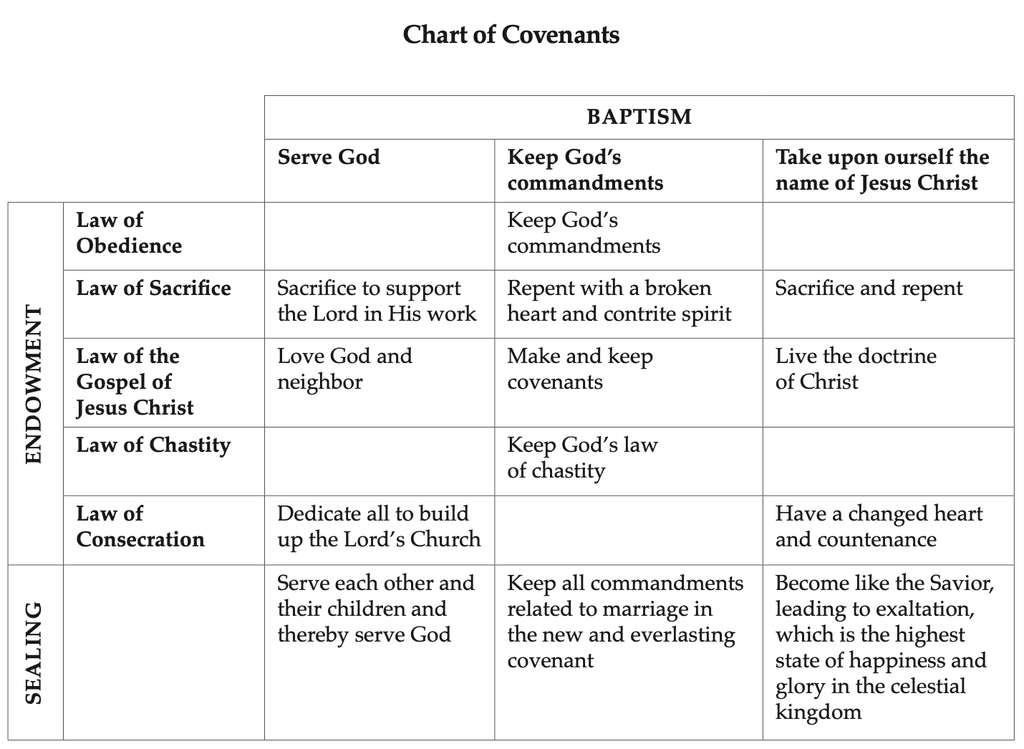
A great place to learn about our covenants is Dale G. Renlund’s BYU devotional address titled “Stronger and Closer Connection to God Through Multiple Covenants” (BYU Speeches, March 5, 2024). He discusses the covenants made at baptism and in the temple, and provides this amazing “Chart of Covenants”:
Do you keep your covenants?
In the temple recommend interview, there are a few questions that ask if we “strive,” but when asked about our covenants, we are simply asked if we “keep” our covenants. When we consider that question, we don’t have to wonder whether that should be qualified by striving, or trying, or doing our best, because keeping our covenants does not require perfection. It requires intentionality. As we study our covenants and intentionally make daily decisions based on our covenants, we keep our covenants. As imperfect beings, we will make mistakes, but keeping our covenants includes repentance and staying on the covenant path when we err.
References
- General Handbook: Serving in The Church of Jesus Christ of Latter-day Saints, 26.4.1. ↩︎
- Bible Dictionary, “Covenant.” ↩︎
- Moses 3:15-17. ↩︎
- Genesis 9:11. ↩︎
- Genesis 17:7. ↩︎
- Exodus 6:4-5. ↩︎
- 1 Kings 8:23-24. ↩︎
- Ezekiel 37:26. ↩︎
- Russell M. Nelson, “Let God Prevail,” October 2020, https://www.churchofjesuschrist.org/study/general-conference/2020/10/46nelson?lang=eng. ↩︎
- Exodus 19:4-5. ↩︎
- I have previously written about the website Blue Letter Bible, and how we can use it to better understand the meaning of words in their original Hebrew. See this explanation in my prior post, “If the Lord Be God, Follow Him.” ↩︎
- “H8104 – šāmar – Strong’s Hebrew Lexicon (KJV).” Blue Letter Bible. Accessed 7 Nov, 2026. https://www.blueletterbible.org/lexicon/h8104/kjv/wlc/0-1/. ↩︎
- Cambridge Dictionary, “keep,” accessed November 7, 2026, https://dictionary.cambridge.org/us/dictionary/english/keep. ↩︎
- “About the Temple Endowment,” accessed November 8, 2026, https://www.churchofjesuschrist.org/temples/what-is-temple-endowment?lang=eng. ↩︎
- Merriam-Webster.com Dictionary, s.v. “keep,” accessed November 9, 2026, https://www.merriam-webster.com/dictionary/keep. ↩︎
- Mosiah 4:30. ↩︎
- D. Todd Christofferson, “Why the Covenant Path,” April 2021, https://www.churchofjesuschrist.org/study/general-conference/2021/04/54christofferson?lang=eng&id=p20#p20. ↩︎
- Russell M. Nelson, “The Temple and Your Spiritual Foundation,” October 2021, https://www.churchofjesuschrist.org/study/general-conference/2021/10/47nelson?lang=eng&id=p34-p35#p34. ↩︎