There are a lot of strategies that can help us better understand Isaiah. I’ve written posts about finding an approach to studying Isaiah, learning how the organization of Isaiah corresponds to the history of Israel, and studying how Isaiah uses specific words. Another strategy is to look for major themes that run throughout his writings.
Looking for themes helps us as we study any book of scripture. But for a challenging book like Isaiah, looking for themes can help us get a much better sense of what he’s trying to teach.
How do themes help us understand the scriptures?
All books of scripture contain major themes. Elder David A. Bednar said:
Themes are overarching, recurring, and unifying qualities or ideas, like essential threads woven throughout a text. Generally, scriptural themes are broader and more comprehensive than patterns or connections. In fact, themes provide the background and context for understanding connections and patterns. The process of searching for and identifying scriptural themes leads us to the fundamental doctrines and principles of salvation.1
Of course, the focus of all scriptures is Jesus Christ. The Come, Follow Me manual for the Old Testament helps us recognize that we should be learning about Christ whenever we study the scriptures: “The aim of all gospel learning and teaching is to deepen our conversion and help us become more like Jesus Christ.”2
What are some themes in Isaiah?
The primary themes in Isaiah pertain to Jesus Christ and His covenant people:
1. Prophecies about Jesus Christ’s Mortal Ministry
“Therefore the Lord himself shall give you a sign; Behold, a virgin shall conceive, and bear a son, and shall call his name Immanuel” (Isaiah 7:14; see also 9:6; 11:1–2; 53; 61:1–3).2. Christ’s Second Coming and Millennial Reign
“Who is this that cometh … travelling in the greatness of his strength? … Wherefore art thou red in thine apparel, and thy garments like him that treadeth in the winefat? . . . I have trodden the winepress alone; and of the people there was none with me” (Isaiah 63:1–3; see also 12–14; 34; 63–66).3. Gathering of Israel
“The remnant of Israel, and such as are escaped of the house of Jacob, … shall stay upon the Lord, the Holy One of Israel, in truth. . . . The remnant shall return. … For though thy people Israel be as the sand of the sea, yet a remnant of them shall return” (Isaiah 10:20–22; see also 5:26; 11:11; 54:7).4. Restoration of the Gospel
“And it shall come to pass in the last days, that the mountain of the Lord’s house shall be established in the top of the mountains, and shall be exalted above the hills; and all nations shall flow unto it” (Isaiah 2:2; see also 11:12; 29:14; 49:20–22).3
The Savior Himself identified a major theme in Isaiah: “[G]reat are the words of Isaiah. For surely he spake as touching all things concerning my people which are of the house of Israel; therefore it must needs be that he must speak also to the Gentiles.”4
Our understanding of Isaiah will increase as we find his themes. The following is one example of a theme that I’ve noticed. It’s only one example, but it shows how finding major themes helps us better understand his overall message.
Example: do we worship our creator, or objects that we create?
One way to identify a theme is to follow repeated ideas and phrases throughout the book, and an example is Isaiah’s recurring contrast between the Lord as our Creator and our tendency to worship things we create.
The problem of idol worship is one of the major themes not just in Isaiah, but through the entirety of the Old Testament. The Ten Commandments prohibit the worship of false gods:
Thou shalt have no other gods before me.
Thou shalt not make unto thee any graven image, or any likeness of any thing that is in heaven above, or that is in the earth beneath, or that is in the water under the earth:
Thou shalt not bow down thyself to them, nor serve them.5
Despite this commandment, the Israelites turned to the gods of the people around them, and rejected the Lord. When the Assyrians took away the ten tribes, it was ascribed to their idol worship:
For so it was, that the children of Israel had sinned against the Lord their God, which had brought them up out of the land of Egypt, from under the hand of Pharaoh king of Egypt, and had feared other gods.6
Isaiah was the prophet in Judah when Assyria invaded, and he spoke often and critically of idol worship.
Isaiah’s story of the idol maker
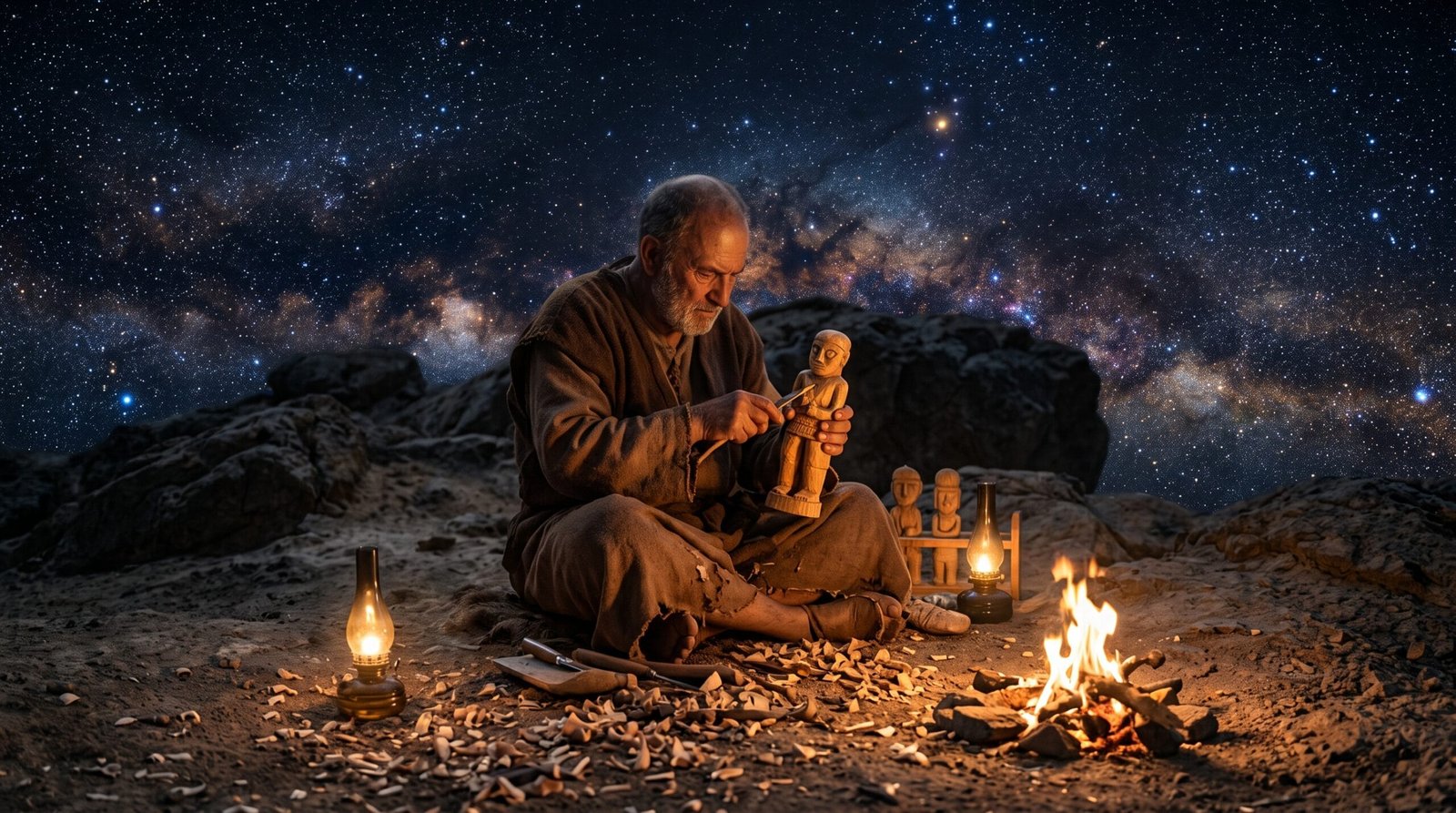
This theme runs throughout Isaiah, but perhaps it is most clearly stated in Isaiah 44:9-20. He tells the story of a man who works with wood. This man cuts down trees, burns the wood to warm himself and cook, then with the leftover wood he makes a god, “even his graven image: he falleth down unto it, and worshippeth it, and prayeth unto it, and saith, Deliver me; for thou art my god.”7
This restatement of the story doesn’t do it justice. I’d suggest you read it. Isaiah is extremely critical of people making idols. How could someone think they could “make” a god, when it’s made out of the same materials that they burn to keep warm and cook?
Other examples of Isaiah criticizing people worshipping something they made
Isaiah presents idol worship as foolishness. The Lord is the God of the Israelites. He created them. So why would anyone worship something that they created, rather than worship the Lord, their Creator? The Lord watches over and protects His people. Why would people worship idols that have no power to do anything for them? This theme is pervasive throughout Isaiah:
- Isaiah 2:8 “Their land also is full of idols; they worship the work of their own hands, that which their own fingers have made.”
- Isaiah 10:15 “Shall the axe boast itself against him that heweth therewith? or shall the saw magnify itself against him that shaketh it? as if the rod should shake itself against them that lift it up, or as if the staff should lift up itself, as if it were no wood.”
- Isaiah 29:16 “Surely your turning of things upside down shall be esteemed as the potter’s clay: for shall the work say of him that made it, He made me not? or shall the thing framed say of him that framed it, He had no understanding?”
- Isaiah 37:19 “And have cast their gods into the fire: for they were no gods, but the work of men’s hands, wood and stone: therefore they have destroyed them.”
- Isaiah 40:19 “The workman melteth a graven image, and the goldsmith spreadeth it over with gold, and casteth silver chains.”
- Isaiah 42:17 “They shall be turned back, they shall be greatly ashamed, that trust in graven images, that say to the molten images, Ye are our gods.”
- Isaiah 45:9 “Woe unto him that striveth with his Maker! Let the potsherd strive with the potsherds of the earth. Shall the clay say to him that fashioneth it, What makest thou? or thy work, He hath no hands?”
- Isaiah 54:16 “Behold, I have created the smith that bloweth the coals in the fire, and that bringeth forth an instrument for his work; and I have created the waster to destroy.”
- Isaiah 64:8 “But now, O Lord, thou art our father; we are the clay, and thou our potter; and we all are the work of thy hand.”
These are only a few examples, but they show this theme running throughout the book of Isaiah.
Themes help us see Isaiah’s message
Themes are major threads running throughout the book. One way to study Isaiah is to look for those themes. As we find themes, we get a better sense of what Isaiah is trying to teach us. Recognizing themes helps us to identify what is most important to Isaiah, and so it gives us focus as we try to decipher his difficult writings.
In the example presented in this post, we see that one of Isaiah’s major themes is the absurdity of people worshipping the work of their hands and rejecting the Lord who created them. But it is only one example. As we look for and find major themes in Isaiah, we can gain a better understanding of his writings.
References
- David A. Bednar, “A Reservoir of Living Water,” Scripture Study Skills Teacher Manual, https://www.churchofjesuschrist.org/study/manual/scripture-study-skills/analyzing-skills/15-finding-themes?lang=eng&id=p2#p2. ↩︎
- Come, Follow Me, Old Testament 2026, “Conversion Is Our Goal,” https://www.churchofjesuschrist.org/study/manual/come-follow-me-for-home-and-church-old-testament-2026/001-conversion?lang=eng&id=p1#p1. ↩︎
- LaRene Porter Gaunt, “Technicolor Isaiah,” Ensigh, August 2014 ↩︎
- 3 Nephi 23:1-2. ↩︎
- Exodus 20:3-5. ↩︎
- 2 Kings 17:7. ↩︎
- Isaiah 44:17. ↩︎