One of the heroes of the Old Testament is Caleb. When all the children of Israel feared, Caleb expressed faith and trust in the Lord. He is an example of how we can exercise faith in Christ to overcome fear and face our challenges.
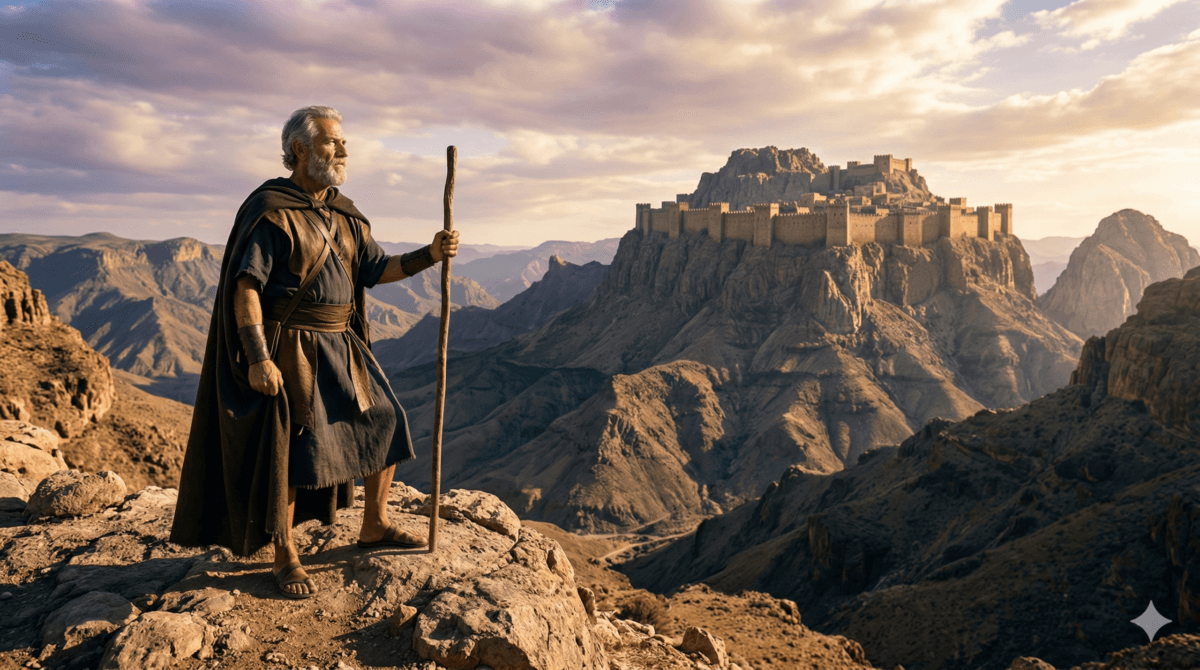
Caleb expressed his faith by saying, “Give me this mountain.”1 He was making a powerful statement that he could do anything with the Lord’s help. I believe that Nephi was following the example of Caleb when he said, “If God had commanded me to do all things I could do them.”2 Exercising faith in Christ “propels us to do things we otherwise would not do. Faith that motivates us to action gives us more access to His power.”3
Caleb’s faith set him apart from the Israelites
After the Israelites left Egypt, the Lord commanded Moses to send twelve men to “search the land” or “spy out the land” and see “the people that dwelleth therein, whether they be strong or weak,” and whether the land was “fat or lean, whether there be wood therein, or not.”4
One man from each tribe was chosen to search the land, including Caleb from the tribe of Judah (Numbers 13:6), and Joshua from the tribe of Ephraim (Numbers 13:8, 16). They spent forty days searching,5 and came back with a mixed report. They brought back grapes, pomegranates, and figs, and told Moses and Aaron, “surely it floweth with milk and honey; and this is the fruit of it.”6
However, despite their positive report of the land itself, the 10 (other than Caleb or Joshua) had a very negative report about the people:
Nevertheless the people be strong that dwell in the land, and the cities are walled, and very great: and moreover we saw the children of Anak there. . . .
We be not able to go up against the people; for they are stronger than we. . . . The land, through which we have gone to search it, is a land that eateth up the inhabitants thereof; and all the people that we saw in it are men of a great stature.
And there we saw the giants, the sons of Anak, which come of the giants: and we were in our own sight as grasshoppers, and so we were in their sight.7
Caleb and Joshua were much more optimistic and faithful. As they were giving their report to Moses and Aaron, “Caleb stilled the people before Moses, and said, Let us go up at once, and possess it; for we are well able to overcome it.”8 Despite Caleb’s efforts, the children of Israel heard the “evil report,” and started to murmur and complain: “Would God that we had died in the land of Egypt! or would God we had died in this wilderness! And wherefore hath the Lord brought us unto this land, to fall by the sword, that our wives and our children should be a prey? were it not better for us to return into Egypt?”9
Caleb and Joshua made every effort to convince the people not to fear:
And Joshua the son of Nun, and Caleb the son of Jephunneh, which were of them that searched the land, rent their clothes:
And they spake unto all the company of the children of Israel, saying, The land, which we passed through to search it, is an exceeding good land.
If the Lord delight in us, then he will bring us into this land, and give it us; a land which floweth with milk and honey.
Only rebel not ye against the Lord, neither fear ye the people of the land; for they are bread for us: their defence is departed from them, and the Lord is with us: fear them not.10
The Lord is with us. Fear not. This testimony from Joshua and Caleb, though powerful, had little effect, and the children of Israel tried to stone them.11 The Lord had enough of Israel’s rebellion, and decreed that only Joshua and Caleb would enter the promised land: “Surely they shall not see the land which I sware unto their fathers, neither shall any of them that provoked me see it: But my servant Caleb, because he had another spirit with him, and hath followed me fully, him will I bring into the land whereinto he went; and his seed shall possess it. . . . Doubtless ye shall not come into the land, concerning which I sware to make you dwell therein, save Caleb the son of Jephunneh, and Joshua the son of Nun.”12
Caleb “had another spirit,” and followed the Lord “fully.” Caleb and Joshua were both willing to face challenges, believing God’s promises, and trusting that God would be with them.
The fear was not without justification
We can look at this story and discount the Israelites’ fear, but it may have been well-founded. The spies who gave the evil report referenced “giants,” and next to those “giants,” they compared themselves to grasshoppers. These “giants” are mentioned quite often throughout Israel’s conquest of the promised land, often being referred to as the “sons of Anak,” or the “Anakim.”13 The following scriptures demonstrate the size, strength, and capabilities of these “giants”:
- Numbers 13:32–33 “The land, through which we have gone to search it, is a land that eateth up the inhabitants thereof; and all the people that we saw in it are men of a great stature. And there we saw the giants, the sons of Anak, which come of the giants: and we were in our own sight as grasshoppers, and so we were in their sight.”
- Deuteronomy 1:28 “Whither shall we go up? our brethren have discouraged our heart, saying, The people is greater and taller than we; the cities are great and walled up to heaven; and moreover we have seen the sons of the Anakims there.”
- Deuteronomy 2:10–11, 21 “The Emims dwelt therein in times past, a people great, and many, and tall, as the Anakims; Which also were accounted giants, as the Anakims; but the Moabites call them Emims. . . . A people great, and many, and tall, as the Anakims.”
- Deuteronomy 9:1–2 “Hear, O Israel: Thou art to pass over Jordan this day, to go in to possess nations greater and mightier than thyself, cities great and fenced up to heaven, A people great and tall, the children of the Anakims, whom thou knowest, and of whom thou hast heard say, Who can stand before the children of Anak!”
The “Anakims” were feared, and as the Israelites faced various enemies, they would often compare them to the Anakims. There is a correlation that can help us better understand the fear that the Israelites might have faced when thinking about facing the Anakims in war.
Was Goliath a descendant of the Anakims?
As the Israelites marched through the promised land, they defeated a portion of the Anakims, but not all of them: “There was none of the Anakims left in the land of the children of Israel: only in Gaza, in Gath, and in Ashdod, there remained.”14
As we are introduced to Goliath, he is described as “a champion out of the camp of the Philistines, named Goliath, of Gath, whose height was six cubits and a span.”15 The record specifically mentions that Goliath was of Gath, where the Anakims remained. Is it possible that Goliath was a descendant of the Anakims? And can we make any assumptions about the Anakims based on what we know of Goliath?
The student manual for the Old Testament institute class states the following: “The most widely accepted opinion of the length of a cubit is about eighteen inches or, roughly, the distance from the elbow to the tip of the extended middle finger. A span is said to be one-half the distance from the thumb to the end of the little finger when the fingers are spread as wide as possible. These measurements would make the height of Goliath approximately nine feet, nine inches!”16
Nine feet, nine inches? Is that real, or exaggerated? I have no idea. But even if it is exaggerated, the emphasis is likely given to impress upon the reader his size, strength, and ability as a warrior. In asking the question about whether 9 feet, 9 inches was real, the Institute Manual states the following, which is relevant to discussing the Israelites’ fear of the giants:
It is unusual that anyone today is over seven feet tall, but it is commonly believed there were men in ancient times whose height far exceeded seven feet. There are references in the scriptures to giants in the earlier periods of history: in the time of Enoch (see Moses 7:15), in the days of Noah (see Moses 8:18; Genesis 6:4), and in the time of the Israelites (see Numbers 13:33; Deuteronomy 2:10–11; Joshua 15:8). Called Anakim (meaning “long-necked” or “tall” in Hebrew) by the Israelites, this race of giants seems to have been virtually destroyed in the conquest of Canaan under Joshua (see Joshua 11:21). In fact, it is recorded that none of the Anakim were left except in Gaza, Ashdod, and Gath (see Joshua 11:22), which was Goliath’s hometown (see 1 Samuel 17:4).
If we think of the Anakims as the ancestors of Goliath, consider how the Israelites felt about facing Goliath all on his own: “When Saul and all Israel heard those words of the Philistine, they were dismayed, and greatly afraid.”17 In Saul’s and David’s day, the Israelites were filled with fear at the thought of facing Goliath by himself. Imagine facing an entire army of people like Goliath. The fear that the Israelites felt at facing the “giants” was not unreasonable. This makes Caleb’s faith even greater.
Give me this mountain
After spending about 40 years in the wilderness, when only Caleb and Joshua remained of those who were numbered “in the wilderness of Sinai,”18 Joshua was called of the Lord to lead the people into the promised land.19 The book of Joshua details their march through the land of Israel and their wars, and identifies the parts of the land that each tribe received as an inheritance.
Some of the tribes were not happy with their inheritance. For example, the tribe of Joseph (apparently both Ephraim and Manasseh) went to Joshua and said, “The hill is not enough for us: and all the Canaanites that dwell in the land of the valley have chariots of iron.”20 Joshua told them, “the mountain shall be thine; . . . for thou shalt drive out the Canaanites, though they have iron chariots, and though they be strong.”21
Unlike the tribe of Joseph, Caleb and the tribe of Judah had no fear, trusting that the Lord would be with them:
Then the children of Judah came unto Joshua in Gilgal: and Caleb the son of Jephunneh the Kenezite said unto him, . . . Forty years old was I when Moses the servant of the Lord sent me from Kadesh-barnea to espy out the land; . . . the Lord hath kept me alive, as he said, these forty and five years, even since the Lord spake this word unto Moses, while the children of Israel wandered in the wilderness: and now, lo, I am this day fourscore and five years old.
As yet I am as strong this day as I was in the day that Moses sent me: as my strength was then, even so is my strength now, for war, both to go out, and to come in.
Now therefore give me this mountain, whereof the Lord spake in that day; for thou heardest in that day how the Anakims were there, and that the cities were great and fenced: if so be the Lord will be with me, then I shall be able to drive them out, as the Lord said.
And Joshua blessed him, and gave unto Caleb the son of Jephunneh Hebron for an inheritance.
Hebron therefore became the inheritance of Caleb the son of Jephunneh the Kenezite unto this day, because that he wholly followed the Lord God of Israel.
And the name of Hebron before was Kirjath-arba; which Arba was a great man among the Anakims. And the land had rest from war.22
Caleb wanted the challenge. He didn’t complain. He was willing to take on the most difficult task. Not only was it filled with the Anakims, but Hebron was a great, fenced city. The Bible Dictionary describes Hebron as “[a]n ancient city of Judah, 3040 feet above the Mediterranean, 20 miles south of Jerusalem.”23 It had a higher elevation, and would have been very difficult to conquer.
Caleb was willing to take on the most difficult challenge, knowing that the Lord was with him.
We need to learn to face our challenges
This story of Caleb was used by Spencer W. Kimball to teach that “[t]here are great challenges ahead of us, giant opportunities to be met,” and to “welcome that exciting prospect and feel to say to the Lord, humbly, ‘Give me this mountain,’ give me these challenges.”24
Facing challenges is not limited to scriptural or prophetic teachings. There are many studies that demonstrate that we should face, rather than avoid, our trials. Turning away from difficulties is sometimes called “avoidance coping,” and has been shown to increase, rather than decrease, anxiety:
Ironically, panic doesn’t usually occur when we directly confront something frightening. Panic more often results from consistently avoiding the things we fear . . . . Initially, avoidance feels comforting, but it eventually backfires, intensifying anxiety. . . . [T]rying to avoid or control anxiety typically makes it worse. . . . People struggling with anxiety or panic disorders naturally want to avoid what frightens them—crowds, driving alone, public speaking, or even physical sensations like dizziness or a racing heart. On the surface, avoidance seems logical: If you never face your fear, you won’t experience anxiety. But there’s a hidden cost. Each avoidance sends the wrong message to your brain. Instead of teaching yourself, This is safe, your mind learns, I narrowly escaped danger. With each escape, your anxiety grows stronger, creating a vicious cycle. Soon, even minor concerns trigger panic attacks—intense episodes of fear that seem to appear without warning at the very anticipation of having to confront a situation.25
Using avoidance as a coping mechanism instead of facing our trials will lead to more problems: “Avoiding things can seem easier in the short term and even bring a temporary sense of relief in the moment. Long-term avoidance, however, can actually increase anxiety and reinforce fears. Avoidance behaviors can negatively impact a person’s quality of life. For instance, avoiding necessary trips to the dentist or meeting financial responsibilities can have real-world consequences. In severe cases, anxiety can lead to a reliance on some sort of crutch to cope with the emotional pain, such as alcohol, food, drugs, or sex.”26
The example of Caleb shows us that as we exercise faith in the Lord, we can have the courage to face our trials. Caleb knew that with the Lord’s help, he could face any challenge.
Many scriptures teach us that the Lord will support us as we face our trials:
- Matthew 28:20 – “I am with you alway, even unto the end of the world.”
- Isaiah 41:10 – “Fear thou not; for I am with thee: be not dismayed; for I am thy God: I will strengthen thee; yea, I will help thee; yea, I will uphold thee with the right hand of my righteousness.”
- John 16:33 – “In the world ye shall have tribulation: but be of good cheer; I have overcome the world.”
- Alma 36:3 – “[W]hosoever shall put their trust in God shall be supported in their trials, and their troubles, and their afflictions, and shall be lifted up at the last day.”
Russell M. Nelson taught that Jesus Christ performed the atonement so that we can have godly help to overcome our trials:
God so loved the world that He sent His Only Begotten Son to help us. And His Son, Jesus Christ, gave His life for us. All so that we could have access to godly power—power sufficient to deal with the burdens, obstacles, and temptations of our day.27
We don’t need to be afraid of challenges. We have access to godly power so that we can overcome our trials. As we face difficulties, rather than avoid them, we receive God’s help, and we will gain greater strength as we trust in God.
Give me this mountain
This phrase, “give me this mountain,” is a symbolic declaration that with God’s help, we can accomplish all things. It can be something of a mantra to help us face, rather than avoid, challenges. As we exercise faith in Christ, we will feel the love and support of our Savior, who offers His power to help us deal with our burdens, obstacles, and temptations. His power is real, and facing our trials with His help will give us a greater capacity to accomplish great things.
References
- Joshua 14:12. ↩︎
- 1 Nephi 17:50. ↩︎
- Russell M. Nelson, “Drawing the Power of Jesus Christ into Our Lives,” April 2017, https://www.churchofjesuschrist.org/study/general-conference/2017/04/drawing-the-power-of-jesus-christ-into-our-lives?lang=eng&id=p22#p22. ↩︎
- Numbers 13:1-2, 17-20. ↩︎
- Numbers 13:25. ↩︎
- Numbers 13:23-27. ↩︎
- Numbers 13:28-33. ↩︎
- Numbers 13:30. ↩︎
- Numbers 14:2-3. ↩︎
- Numbers 14:6-9. ↩︎
- Numbers 14:10, “But all the congregation bade stone them with stones. And the glory of the Lord appeared in the tabernacle of the congregation before all the children of Israel.” ↩︎
- Numbers 14:23-24, 30. ↩︎
- Bible Dictionary, “Anak, Anakim.” ↩︎
- Joshua 11:22. ↩︎
- 1 Samuel 17:4. ↩︎
- Old Testament Student Manual Genesis-2 Samuel, “1 Samuel 16-31: King David’s Call to Lead Israel,” 278, https://www.churchofjesuschrist.org/study/manual/old-testament-student-manual-genesis-2-samuel/1-samuel-16-31-king-davids-call-to-lead-israel?lang=eng&id=p18#p18. ↩︎
- 1 Samuel 17:11. ↩︎
- Numbers 26:64-65. ↩︎
- Joshua 1:1-3. ↩︎
- Joshua 17:16. ↩︎
- Joshua 17:18. ↩︎
- Joshua 14:6-15. ↩︎
- Bible Dictionary, “Hebron,” https://www.churchofjesuschrist.org/study/scriptures/bd/hebron?lang=eng&id=p1#p1. Hebron has a great history. Abraham, Isaac, Jacob, and their wives were buried in Hebron. David was anointed king of Israel there, and he made it his capital for about seven years until he conquered Jerusalem. Britannica Editors. “Hebron.” Encyclopedia Britannica, December 23, 2025. https://www.britannica.com/place/Hebron-city-West-Bank. ↩︎
- Spencer W. Kimball, “Give Me This Mountain,” October 1979, https://www.churchofjesuschrist.org/study/general-conference/1979/10/give-me-this-mountain?lang=eng&id=p23#p23. ↩︎
- Padraic Gibson, D.Psych, “How Can Facing Your Worst Fears Ease Anxiety and Panic?” Psychology Today Website, April 15, 2025, https://www.psychologytoday.com/us/blog/escaping-our-mental-traps/202504/how-can-facing-your-worst-fears-ease-anxiety-and-panic. ↩︎
- Karen Stoliznow, Ph.D., “Avoiding Avoidance,” Psychology Today Website, March 19, 2025, https://www.psychologytoday.com/us/blog/speaking-in-tongues/202503/avoiding-avoidance. ↩︎
- Russell M. Nelson, “Drawing the Power of Jesus Christ into Our Lives,” April 2017, https://www.churchofjesuschrist.org/study/general-conference/2017/04/drawing-the-power-of-jesus-christ-into-our-lives?lang=eng&id=p4#p4. ↩︎