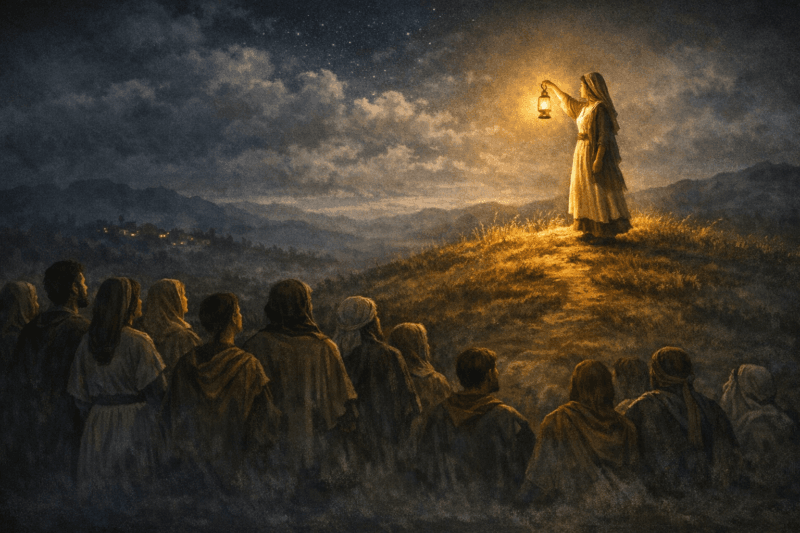
President Russell M. Nelson taught that as members of the Church of Jesus Christ of Latter-day Saints, we are meant to stand out:
“[S]tand out; be different from the world. . . . [Y]ou are to be a light to the world. Therefore, the Lord needs you to look like, sound like, act like, and dress like a true disciple of Jesus Christ. Yes, you are living in the world, but you have very different standards from the world. . . . Set a standard for the rest of the world! Embrace being different!”1
The Lord has always wanted His people to be different from the rest of the world. The Lord said the children of Israel would be a “peculiar treasure” if they kept His covenant.2 During the Savior’s ministry, he taught that we are “the light of the world,” and we should “let [our] light shine before men.”3 He told the early Saints to “[a]rise and shine forth, that thy light may be a standard for the nations.”4
One way that the Lord helps His people stand out is with dietary laws. Whether it’s the Word of Wisdom found in Doctrine and Covenants 89, or kosher laws in Leviticus 11, the Lord’s dietary laws can seem strange, but they certainly make the Lord’s people stand out. When revealing the kosher laws as part of the Law of Moses, the Lord clearly stated that one purpose was for His people to be different. And there is no question that by following the Lord’s dietary laws, we are different.
The Lord’s peculiar treasure
Soon after the Lord brought the children of Israel out of Egypt, He said to them, “[I]f ye will obey my voice indeed, and keep my covenant, then ye shall be a peculiar treasure unto me above all people: for all the earth is mine.”5 The phrase “peculiar treasure” has many implications. Significantly, it means our Heavenly Father loves us and claims us as His.
What is the meaning of “peculiar”?
The original word in both Hebrew and Greek that is translated to “peculiar” means, “property, wealth, private property, which is laid up or reserved; the leading idea is that of select, precious, endeared; something exceedingly prized and [diligently] preserved.”6
This term “peculiar treasure” is translated differently in other Bible translations, helping us see that “peculiar” means “treasured” or “special”:7
- English Standard Version: “[I]f you will indeed obey my voice and keep my covenant, you shall be my treasured possession among all peoples.”
- New International Version: “[I]f you obey me fully and keep my covenant, then out of all nations you will be my treasured possession.”
- New Living Translation: “[I]f you will obey me and keep my covenant, you will be my own special treasure from among all the peoples on earth.”
- New International Reader’s Version: “Now obey me completely. Keep my covenant. If you do, then out of all the nations you will be my special treasure.”
This phrase has been used by many of God’s prophets. Peter said, “[Y]e are a chosen generation, a royal priesthood, an holy nation, a peculiar people.” (1 Peter 2:9). There is definitely a correlation between “chosen” and “peculiar.” Russell M. Nelson taught what it means to be a “peculiar people”:
“The adjectives chosen, royal, and holy we recognize as elevating. But what about peculiar? . . . In the Old Testament, the Hebrew term from which peculiar was translated is segullah, which means ‘valued property’ or ‘treasure.’ In the New Testament, the Greek term from which peculiar was translated is peripoiesis, which means ‘possession’ or ‘an obtaining.’ Thus we see that the scriptural term peculiar signifies ‘valued treasure,’ ‘made’ or ‘selected by God.’ For us to be identified by servants of the Lord as his peculiar people is a compliment of the highest order.”8
The Lord claims, or owns, His people
In the Abrahamic Covenant, the Lord established His covenant “to be a God unto” Abraham and his posterity.9 In Abraham’s day, people worshipped many different gods.10 By establishing His covenant, the Lord was saying He would be their only God, and they would be His people. This was emphasized to the children of Israel before they came out of Egypt: “And I will take you to me for a people, and I will be to you a God: and ye shall know that I am the Lord your God, which bringeth you out from under the burdens of the Egyptians.”11
In our day, the Lord has said that he will “own” us: “I, the Lord, have suffered the affliction to come upon them, wherewith they have been afflicted, in consequence of their transgressions; Yet I will own them, and they shall be mine in that day when I shall come to make up my jewels.”12
What does it mean that He will “own” us? Because of the gift of agency, I believe He will only “own” us if we let Him.13 Russell M. Nelson encouraged us to let God prevail in our lives:
“Are you willing to let God prevail in your life? Are you willing to let God be the most important influence in your life? Will you allow His words, His commandments, and His covenants to influence what you do each day? Will you allow His voice to take priority over any other? Are you willing to let whatever He needs you to do take precedence over every other ambition? Are you willing to have your will swallowed up in His?”14
Are we willing to let Him own us? Even when it comes to obeying dietary laws that might seem strange or unreasonable?
What are the kosher laws in Leviticus 11?
The object of the book of Leviticus is to “teach the moral precepts and religious truths of the law of Moses by means of ritual.”15 Leviticus 11 classifies animals into two groups, clean and unclean, “to make a difference between the unclean and the clean, and between the beast that may be eaten and the beast that may not be eaten.”16
The institute manual for the Old Testament contains the following simple explanation of the dietary laws found in Leviticus 11:
“Two conditions determined the cleanliness of animals. They had to be cloven-footed (that is, the hooves had to be separated into two parts), and they had to chew their cud (see Leviticus 11:3). Seafood was limited to those that had scales and fins. This requirement eliminated all shellfish, such as lobster and shrimp, and fish such as sharks and dolphins, as well as other sea creatures such as the eel (see Leviticus 11:9–12). Birds forbidden were generally birds of prey that lived on carrion, or, as in the case of the stork and heron, those that may have eaten other unclean creatures (see Leviticus 11:13–20). The ossifrage is thought to be a species of vulture, as is the gier eagle. Most flying insects were also forbidden. The phrase ‘going upon all four’ (see Leviticus 11:21) indicates insects that have four short legs and two long legs used for hopping. Of these, four are suitable for food. All are members of the locust family.”17
When considering what it means to be “clean” or “unclean,” one Orthodox Jewish author noted that these terms didn’t just relate to dietary implications:
“A hog could be raised in an incubator on antibiotics, bathed daily, slaughtered in a hospital operating room, and its carcass sterilized by ultra-violet rays, without rendering kosher the pork chops that it yields. ‘Unclean’ in Leviticus is a ceremonial word. That is why the Torah says of camels and rabbits, ‘They are unclean for you,’ limiting the definition and the discipline to Israel. Chickens and goats, which we can eat, are scarcely cleaner by nature than eagles and lions, but the latter are in the class of the unclean.”18
In other words, the significance of the dietary laws was that God declared what was “clean” and “unclean,” whether or not those specific animals were beneficial or harmful to the health of the people.
What were the reasons for the dietary laws?
Although the dietary laws didn’t always make sense as they pertained to health, the Lord explained why He was giving them these dietary laws:
“[T]hat ye may put difference between holy and unholy, and between unclean and clean.19
When the Lord referred to “holy and unholy,” and “unclean and clean,” could it be that He was talking about the people, and whether they would humble themselves and follow those laws? Could it be that the primary reason for these dietary laws was for the Lord to “prove” His people, and see if they would do what He commanded?20
These laws would cause them to think about Him every time they prepared a meal. And, these laws would set them apart from those who did not know or would not obey. The Church’s institute manual explains this reasoning:
“There were practical reasons for these laws related to health and sanitation. The flesh of swine is highly susceptible to trichinosis, a malady easily transmitted to man. Shellfish can develop a deadly poison if they are not killed and handled properly, and so on. But the Hebrew word for clean used in the dietary law means more than just physically clean. It carries the connotation of being ‘clean from all pollution or defilement … and implying that purity which religion requires, and is necessary for communion with God.'”
[However,] “God was using the diet as a teaching tool. People may forget or neglect prayer, play, work, or worship, but they seldom forget a meal. By voluntarily abstaining from certain foods or by cooking them in a special way, one made a daily, personal commitment to act in one’s faith. At every meal a formal choice was made, generating quiet self-discipline. Strength comes from living such a law, vision from understanding it. Further, the law served to separate the Hebrews from their Canaanite neighbors. Each time they got hungry they were forcibly reminded of personal identity and community bond. Indeed, they belonged to a people set apart. The law therefore acted as a social instrument for keeping the Hebrew nation intact, a psychological instrument for preserving the identity of the individual, and a religious instrument for keeping the people in remembrance of Jehovah.21
There were dietary reasons, but it seems that these laws were intended to help people constantly think about their relationship with God. Each time they prepared or ate a meal, they had to think about their covenants and God’s commandments. And, it gave them an identity as God’s chosen people, separate and apart from others who didn’t accept the Lord as their god.
Does the Word of Wisdom have the same purpose?
The Word of Wisdom, found in Doctrine and Covenants 89, contains the Lord’s dietary laws given to us today. And the Lord’s reasons for giving us those laws are very similar to why the Lord gave dietary laws to the Israelites. President Ezra Taft Benson taught:
“God, our Heavenly Father, governs His children by law. He has instituted laws for our perfection. If we obey His laws, we receive the blessings pertaining to those laws. If we do not obey, we receive the consequences.
“The Word of Wisdom is a law—a principle with promise. If we obey the provisions of the law, we receive the promises. If we do not, there will be both temporal and spiritual consequences. . . .
“I have always felt, however, that the greater blessing of obedience to the Word of Wisdom and all other commandments is spiritual. . . . [W]e must walk in obedience to all the commandments. Then we shall receive specific spiritual promises. This means we must obey the law of tithing, keep the Sabbath day holy, keep morally clean and chaste, and obey all other commandments. . . .
“May we as Saints of God keep all His commandments. May we be pure and holy so we can have the constant companionship of the Holy Ghost. Let us be distinctive as a people because of our obedience to God’s laws.”22
We are blessed when we obey God’s commandments. Is it possible that God gives us laws simply to be able to bless us? Are God’s dietary laws as much about proving our obedience as they are about benefiting our health?
We have evidence that the Word of Wisdom is designed to help us avoid dangerous substances. It is common knowledge that tobacco causes significant health problems. In this, Joseph Smith has been proven to be a seer: the Word of Wisdom was given more than a century before medical science recognized the dangers of tobacco.23
Even though we have evidence that the Word of Wisdom was years ahead of its time in its warnings regarding tobacco use, there are other aspects that may not be as clear. As I have researched these issues, I have found many articles, including articles written by healthcare professionals, that promote the health benefits of tea and coffee.24 It is the current position of the Church that tea and coffee are “hot drinks” that are prohibited by the Word of Wisdom.25 I am not a medical professional, and the purpose of this article isn’t to address the health benefits of the Word of Wisdom. So, this article doesn’t try and determine whether the potential harms of tea and coffee are sufficient to justify their prohibition under the Word of Wisdom. Instead, I would like to consider whether one aspect of this and God’s other laws is simply for us to obey.
So, who will we believe? Do we have the faith to obey God’s laws, even when they don’t seem to make sense? It seems to me that one purpose of God’s dietary laws is to set us apart, to make us different, so it makes sense that there might be some aspects of the law that don’t seem to have any purpose other than to set us apart.
Think about how many conversations about the Church have been started because a faithful member of the Church of Jesus Christ of Latter-day Saints has had to explain that they don’t drink coffee, tea, or alcohol. Even if there is some medical evidence that might contradict the Word of Wisdom’s prohibition of tea and coffee, do we have the faith to obey that law? At the very least, we can see that obeying God’s dietary laws will set us apart and make us different from the rest of the world.
Will we let God prevail in our lives?
As I have read about the dietary laws in Leviticus 11 and Doctrine and Covenants 89, I have seen reports that question some of the prohibitions in the Word of Wisdom. But it is absolutely clear that at least one reason for those laws is to make us different and to set us apart from the rest of the world.
Are we willing to obey even if we don’t understand? God clearly wants us to be different. The Savior said, “Ye are the light of the world. A city that is set on an hill cannot be hid. . . . Let your light so shine before men, that they may see your good works, and glorify your Father which is in heaven.”26 We are meant to be seen as we live the gospel of Jesus Christ. This does not mean that we do things simply “to be seen,”27 but we are meant to live as disciples of Jesus Christ in every situation.
Our willingness to live the Word of Wisdom means that we will be different. We will likely have opportunities to tell people why we don’t drink tea, coffee, or alcohol. In those moments, we can let our light shine, and testify of our belief in Jesus Christ. In those moments, the Lord’s dietary laws are accomplishing at least one purpose: we will certainly be different and set apart from the rest of the world.
References
- Russell M. Nelson, “Hope of Israel,” June 3, 2018, https://www.churchofjesuschrist.org/study/broadcasts/worldwide-devotional-for-young-adults/2018/06/hope-of-israel?lang=eng&id=p108#p108. ↩︎
- Exodus 19:5. ↩︎
- Matthew 5:14-16. ↩︎
- Doctrine and Covenants 115:5. ↩︎
- Exodus 19:5. ↩︎
- Old Testament Student Manual Genesis-2 Samuel, “Exodus 11-19: The Passover and the Exodus,” 124, https://www.churchofjesuschrist.org/study/manual/old-testament-student-manual-genesis-2-samuel/exodus-11-19-the-passover-and-the-exodus?lang=eng&id=p62#p62. ↩︎
- For different translations of the Bible recommended by the Church, see the news release from the Church Newsroom, “New Guidance on Bible Translations for Latter-day Saints,” December 16, 2025; see also General Handbook, 38.4.40.1, “Editions and translations of the Holy Bible,” (referencing the “Holy Bible List,”) and the “Holy Bible List” under the “Translations and Formas” section of the “Scriputres and Study Resources” of the Gospel Library. ↩︎
- Russell M. Nelson, “Children of the Covenant,” April 1995, https://www.churchofjesuschrist.org/study/general-conference/1995/04/children-of-the-covenant?lang=eng&id=p38-p40#p38. ↩︎
- Genesis 17:7. ↩︎
- See Abraham 1:5-7, “My fathers, having turned from their righteousness, and from the holy commandments which the Lord their God had given unto them, unto the worshiping of the gods of the heathen, utterly refused to hearken to my voice; For their hearts were set to do evil, and were wholly turned to the god of Elkenah, and the god of Libnah, and the god of Mahmackrah, and the god of Korash, and the god of Pharaoh, king of Egypt; Therefore they turned their hearts to the sacrifice of the heathen in offering up their children unto these dumb idols, and hearkened not unto my voice, but endeavored to take away my life by the hand of the priest of Elkenah. The priest of Elkenah was also the priest of Pharaoh.” ↩︎
- Exodus 6:7. ↩︎
- Doctrine and Covenants 101:2-3. ↩︎
- Dale G. Renlund, “Choose You This Day,” October 2018, “Our Heavenly Father wants to help and bless us, but we do not always let Him. Sometimes, we even act as if we already know everything.” https://www.churchofjesuschrist.org/study/general-conference/2018/10/choose-you-this-day?lang=eng&id=p8#p8. ↩︎
- Russell M. Nelson, “Let God Prevail,” October 2020, https://www.churchofjesuschrist.org/study/general-conference/2020/10/46nelson?lang=eng&id=p24#p24. ↩︎
- Guide to the Scriptures, “Leviticus,” https://www.churchofjesuschrist.org/study/scriptures/gs/leviticus?lang=eng. ↩︎
- Leviticus 11:47. ↩︎
- Old Testament Student Manual Genesis-2 Samuel, “Leviticus 11–18: A Law of Performances and Ordinances, Part 2: The Clean and the Unclean,” 173-174, https://www.churchofjesuschrist.org/study/manual/old-testament-student-manual-genesis-2-samuel/leviticus-11-18-a-law-of-performances-and-ordinances-part-2-the-clean-and-the-unclean?lang=eng&id=p6#p6. ↩︎
- Old Testament Student Manual Genesis-2 Samuel, “Leviticus 11–18: A Law of Performances and Ordinances, Part 2: The Clean and the Unclean,” 174 (quoting Wouk, This Is My God, pp. 100-101), https://www.churchofjesuschrist.org/study/manual/old-testament-student-manual-genesis-2-samuel/leviticus-11-18-a-law-of-performances-and-ordinances-part-2-the-clean-and-the-unclean?lang=eng&id=p4#p4. ↩︎
- Leviticus 11:10. ↩︎
- Abraham 3:25. ↩︎
- Old Testament Student Manual Genesis-2 Samuel, “Leviticus 11–18: A Law of Performances and Ordinances, Part 2: The Clean and the Unclean,” 173, https://www.churchofjesuschrist.org/study/manual/old-testament-student-manual-genesis-2-samuel/leviticus-11-18-a-law-of-performances-and-ordinances-part-2-the-clean-and-the-unclean?lang=eng&id=p5#p5. ↩︎
- Ezra Taft Benson, “A Principle with a Promise,” April 1983, https://www.churchofjesuschrist.org/study/general-conference/1983/04/a-principle-with-a-promise?lang=eng. ↩︎
- The Word of Wisdom was given in February 1833 (see Doctrine and Covenants 89). It wasn’t until January 1964 that the Surgeon General of the United States released the first report of the Surgeon General’s Advisory Committee on Smoking and Health, concluding that cigarette smoking was “a cause of lung cancer,” and “the most important cause of chronic bronchitis.” See “A History of the Surgeon General’s Reports on Smoking and Health,” May 15, 2024, https://www.cdc.gov/tobacco-surgeon-general-reports/about/history.html. ↩︎
- See WebMD, “Health Benefits of Coffee and Tea,” June 23, 2025, https://www.webmd.com/food-recipes/ss/slideshow-coffee-tea-benefits. ↩︎
- See General Handbook, 38.7.14, “Word of Wisdom and Healthy Practices,” Prophets have clarified that the teachings in Doctrine and Covenants 89 include abstinence from tobacco, strong drinks (alcohol), and hot drinks (tea and coffee).” https://www.churchofjesuschrist.org/study/manual/general-handbook/38-church-policies-and-guidelines?lang=eng&id=p2378#p2378. ↩︎
- Matthew 5:14-16. ↩︎
- Matthew 6:1-8. ↩︎