There are a lot of things in the Old Testament that can be confusing and even frustrating. Something I’ve noticed during my recent study (2026) is the apparent acceptance of slavery – not only by God’s people, but by God himself. Did God really condone slavery?
This is not an easy question to answer, and like most questions I have when I read the Old Testament, it requires exercising faith to trust that God knows all things. So even though I don’t understand, I am committed to exercising faith in Jesus Christ.
God is the same yesterday, today, and forever
One way I approach my questions as I study the Old Testament is to start with the basic premise that God is the same yesterday, today, and forever:
- Malachi 3:6 “For I am the Lord, I change not.”
- Hebrews 13:8 “Jesus Christ the same yesterday, and to day, and for ever.”
- James 1:17 “Every good gift and every perfect gift is from above, and cometh down from the Father of lights, with whom is no variableness, neither shadow of turning.”
- 1 Nephi 10:18 “For he is the same yesterday, today, and forever; and the way is prepared for all men from the foundation of the world, if it so be that they repent and come unto him.”
- 2 Nephi 27:23 “I am God; and I am a God of miracles; and I will show unto the world that I am the same yesterday, today, and forever.”
- Moroni 8:18 “God is not a partial God, neither a changeable being; but he is unchangeable from all eternity to all eternity.”
This nature of God is supported by what I believe to be the fundamental, underlying truth that forms the basis of all of God’s works: “[T]his is my work and my glory—to bring to pass the immortality and eternal life of man.” (Moses 1:39). The entire purpose of all God’s creations, all His teachings, everything He does, is to help us, His children,1 gain immortality and eternal life. That work will be the same for us as it was for Adam and Eve, Abraham, Moses and the children of Israel, and all prior and future dispensations.2
As I confront challenging questions in the scriptures, I use the knowledge of God’s teachings today to understand the basic, fundamental principles of the gospel, and trust that those same principles applied in Old Testament times.
God loves all His children
The building block of all truth is that we are the children of a loving Heavenly Father.3 Because we are all His children, He is no respecter of persons: “[H]e doeth that which is good among the children of men; and he doeth nothing save it be plain unto the children of men; and he inviteth them all to come unto him and partake of his goodness; and he denieth none that come unto him, black and white, bond and free, male and female; and he remembereth the heathen; and all are alike unto God, both Jew and Gentile.” (2 Nephi 26:33).
In the gospel topics essay “Racial and Cultural Prejudice,” we read that because we are all children of God, and part of His divine family, God “does not love one race or culture more than any other.”4 Because of that, our leaders have clearly and unequivocally denounced all forms of racism:
- “As citizens and as members of The Church of Jesus Christ of Latter-day Saints, we must do better to help root out racism. . . . This country should be better in eliminating racism not only against Black Americans, who were most visible in the recent protests, but also against Latinos, Asians, and other groups. This nation’s history of racism is not a happy one, and we must do better. . . . Knowing that we are all children of God gives us a divine vision of the worth of all others and the will and ability to rise above prejudice and racism.” Dallin H. Oaks, “Love Your Enemies,” October 2020 General Conference.
- “I grieve that our Black brothers and sisters the world over are enduring the pains of racism and prejudice. Today I call upon our members everywhere to lead out in abandoning attitudes and actions of prejudice. I plead with you to promote respect for all of God’s children.” Russell M. Nelson, “Let God Prevail,” October 2020 General Conference.
These teachings of modern prophets and apostles help me to have confidence that God loves all His children, and that He has loved all His children since the beginning of time.
Joseph Smith’s anti-slavery position
In February 1844, Joseph Smith declared his candidacy for president of the United States.5 As part of that campaign, he “called for the abolition of slavery in the United States by the government using revenues generated from the sale of federal lands in the western United States to purchase the freedom of enslaved men and women.”6
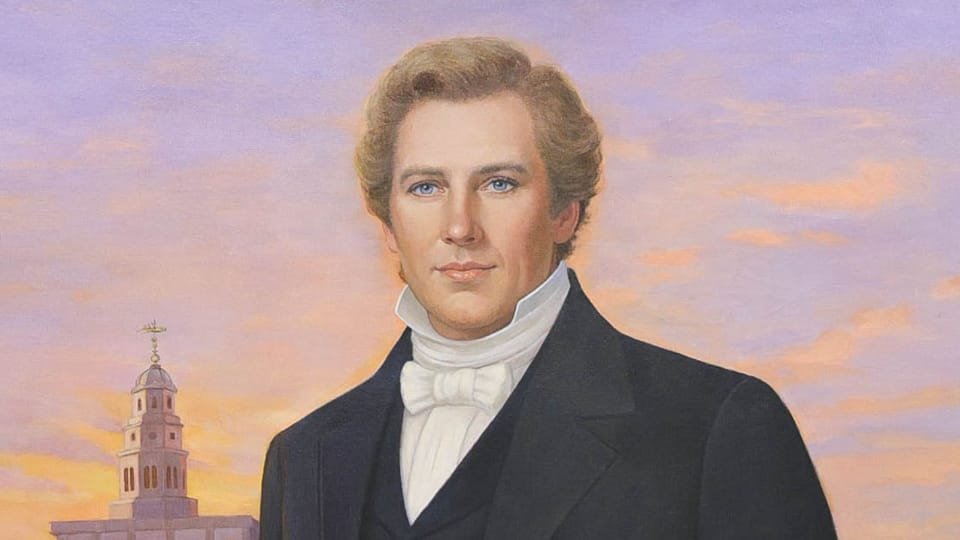
Recently, Joseph’s campaign promise to abolish slavery has been referred to as “among the most morally ambitious proposals of the antebellum era.”7 On February 1, 2026, a portrait of Joseph Smith was added to the International Hall of Honor in Morehouse College’s Martin Luther King Jr. International Chapel in Atlanta, Georgia.8 (Morehouse College was founded in 1867 and is the nation’s only historically black private liberal arts college for men.)9 That portrait is the featured image for this post. During the unveiling ceremony, the Rev. Dr. Lawrence Edward Carter Sr., dean of the Martin Luther King Jr. International Chapel, praised Joseph Smith’s “‘moral courage’ in the pursuit of the presidency, noting that what he did was essentially a ‘death warrant.'”10
“We were not ready, as Lincoln said, to be guided by our better angels, to do what Christ said we should do. Joseph Smith Jr. was Lincoln before Lincoln.” -Rev. Dr. Carter11
The history of the Church of Jesus Christ of Latter-day Saints does not have the cleanest record when it comes to racism. However, I believe that history must be considered in the context of the society in which the Church was growing. A fascinating article on the Church’s website, “Slavery and Abolition,”12 explains that during the Church’s stay in Missouri, there was significant conflict between the Saints and their pro-slavery neighbors.13 But after the Saints were driven from Missouri and settled in Illinois, “Joseph Smith gradually became more outspoken in his opposition to slavery. He asked how the United States could claim that ‘all men are created equal’ while ‘two or three millions of people are held as slaves for life, because the spirit in them is covered with a darker skin than ours.'”14
For some of our past practices, we have no documented revelation to explain why decisions were made, or why practices continued.15 However, it is clear that Joseph Smith believed that slavery should be abolished, based on his understanding of the revealed gospel of Jesus Christ.
As we confront slavery in the Old Testament, these principles can help us consider how our Father in Heaven feels (and has always felt) about slavery.
Slavery in the Old Testament
As I have read the Old Testament this year (2026), I have noticed several references to slavery. Not only do these references acknowledge the practice, but they make it seem like God condoned it.
In Genesis 17, the Lord made His covenant with Abraham, and introduced the practice of circumcision. He said to Abraham:
“And he that is eight days old shall be circumcised among you, every man child in your generations, he that is born in the house, or bought with money of any stranger, which is not of thy seed. He that is born in thy house, and he that is bought with thy money, must needs be circumcised: and my covenant shall be in your flesh for an everlasting covenant.” (Genesis 17:12-13).
Certainly, that refers to someone who is “bought” with money. God does not necessarily condone the practice, but He also does not condemn it. Rather, He tells Abraham that anyone “bought with money” also needs to be circumcised.
Perhaps the most challenging reference to slavery is contained within the law of Moses:
“If thou buy an Hebrew servant, six years he shall serve: and in the seventh he shall go out free for nothing. If he came in by himself, he shall go out by himself: if he were married, then his wife shall go out with him.
“If his master have given him a wife, and she have born him sons or daughters; the wife and her children shall be her master’s, and he shall go out by himself. And if the servant shall plainly say, I love my master, my wife, and my children; I will not go out free: Then his master shall bring him unto the judges; he shall also bring him to the door, or unto the door post; and his master shall bore his ear through with an awl; and he shall serve him for ever.
“And if a man sell his daughter to be a maidservant, she shall not go out as the menservants do. If she please not her master, who hath betrothed her to himself, then shall he let her be redeemed: to sell her unto a strange nation he shall have no power, seeing he hath dealt deceitfully with her. And if he have betrothed her unto his son, he shall deal with her after the manner of daughters. If he take him another wife; her food, her raiment, and her duty of marriage, shall he not diminish. And if he do not these three unto her, then shall she go out free without money.”
Exodus 21:2-11. This passage can be better understood by reading an alternate translation:
“When you buy a Hebrew slave, he shall serve six years, and in the seventh he shall go out free, for nothing. If he comes in single, he shall go out single; if he comes in married, then his wife shall go out with him. If his master gives him a wife and she bears him sons or daughters, the wife and her children shall be her master’s, and he shall go out alone. But if the slave plainly says, ‘I love my master, my wife, and my children; I will not go out free,’ then his master shall bring him to God, and he shall bring him to the door or the doorpost. And his master shall bore his ear through with an awl, and he shall be his slave forever.
“When a man sells his daughter as a slave, she shall not go out as the male slaves do. If she does not please her master, who has designated her for himself, then he shall let her be redeemed. He shall have no right to sell her to a foreign people, since he has broken faith with her. If he designates her for his son, he shall deal with her as with a daughter. If he takes another wife to himself, he shall not diminish her food, her clothing, or her marital rights. And if he does not do these three things for her, she shall go out for nothing, without payment of money.
Exodus 21:2-11 (English Standard Version).
So what is happening in these verses? Is God authorizing slavery?
Is it slavery, or a different type of service?
When studying the Old Testament, it is vital to recognize that we live in a starkly different culture. Despite the use of common words, it could be that what is happening in the Old Testament is different than what it sounds like to us.
In an article in the BYU publication “Studia Antiqua,”16 we are taught that “Language is not static but, in fact, changes over time. Culture, demography, and historical circumstance all influence how societies define the words they use. Thus, for a proper reading of ancient texts, it is imperative for modern readers to take into account the way in which a given term was defined in the ancient context.”17
The author of that article, Nathan Andersen, continues, “The word ‘slave,’ as used in Old Testament text, is a term often misunderstood by contemporary readers of the Bible because contemporary readers seek to understand the biblical slave system by overlaying a modern definition upon it. . . . Modern notions of slavery are complicated by the fact that in many ancient societies, the term ‘slave’ was used to refer to many different forms of servile conditions, not just the chattel slave familiar to modern readers of the Bible.”18
In the ancient Middle East, there were many forms of service that were referred to as “slavery.” For example, Exodus 21:5 states, “And if the servant shall plainly say, I love my master, my wife, and my children; I will not go out free.” This arrangement was “voluntary servitude.” There could be many reasons why a person would be willing to subject themselves to voluntary servitude, despite the fact that in our society, it seems absurd: “Such a concept would be completely ludicrous today. Nevertheless, voluntary servitude was practiced in Old Testament times. A person lacking any rights of inheritance may have voluntarily given himself to a master who, in the absence of legal heirs, would gift inheritance rights to the trusted slave. Such a symbiotic relationship most likely benefited both parties, the master and the slave. The master received a legal heir and someone to take care of him in his old age. The slave received an inheritance upon the death of the master. Additionally, individuals in extreme poverty were able to voluntarily give themselves into slavery (Lev. 25:39–40). Such individuals would be held as a ‘hired servant’ rather than a ‘bondservant’ and would be subject to [] release.”19
That is not the only way that the use of the term “slavery” in the Old Testament could be different from how we understand it to be; it is just one example of how vital it is for us to think about how that term could differ from our modern understanding.
The Church’s institute manual contains the following explanation for these verses in Exodus 21:
“[P]ermanent ownership of slaves was not allowed unless the individual himself chose to be a slave for life (see vv. 5–6). As illustrated here, the slave in Israel was really more like a servant. By law he had to be freed after seven years unless he voluntarily chose to remain in servitude.
“Although a father could arrange for the marriage of his daughter (that is the meaning of the phrase ‘to sell her as a maidservant’ in verse 7, as is evident from the betrothal mentioned in verses 8 and 9), she too maintained certain rights. The prospective husband could not use her as a slave (‘she shall not go out as the menservants do’). If the prospective husband was not pleased with the new bride, the law guaranteed her rights. This legal guarantee was in sharp contrast to the practice of most other people whose women were viewed as property to be bargained away at the whim of men.”20
The laws were complicated and quite different from today’s society. It is important to realize that the Law of Moses gave more rights to these “slaves” or “servants” than they previously had before the law was introduced. And perhaps it not only gave them more rights, but maybe it actually improved their lives by giving them something equivalent to employment. In that respect, God’s law regarding slavery could be seen as merciful.
Why didn’t God abolish slavery?
But regardless, why didn’t God abolish the practice? There is no doubt that the Old Testament provides for people being purchased with money, so even if it provided them more rights, it’s still slavery, right? We see from the example of Joseph Smith that God’s chosen prophet did in fact desire to abolish slavery in the pre-Civil War United States, so why wouldn’t God teach the children of Israel that slavery was an abomination?
I believe the answer to that question lies in the principle of agency, which is defined as “[t]he ability and privilege God gives people to choose and to act for themselves.”21 I think that our agency is more significant than we often understand, and because of agency, God teaches us principles line upon line, and lets us choose for ourselves. For example, as an introduction to the “Topics and Questions” section of the Church’s website, we are taught that “revelation is a process”:
“This is a living Church. While essential gospel truths are unchanging, the Church’s policies, programs, organizations, and teachings have been revealed line upon line over months, years, and decades. . . . All human beings are shaped by culture: the beliefs, customs, languages, and values we share. Cultures vary greatly from place to place and over time. God’s willingness to deliver revelation that speaks to us within our cultures and according to our understanding is a beautiful truth of the Restoration. Remembering this can help us approach the scriptures and the words of past prophets with humility. God spoke to the ancient Israelites according to their ancient near-Eastern understanding. He spoke to Joseph Smith using symbols and language from his 1800s American culture. And God communicates to us today according to our own limited capacity in ways we can understand.”22
Richard Neitzel Holzapfel, a BYU religion professor, has written that “the Lord also speaks in the cultural context of the life and time of a person or people. He communicates according to their understanding. . . . Even though God’s children are limited in their language (no language is perfect) and limited in their cultural understanding (cultures adapt, borrow, and change over time), the Lord kindly condescends to communicate His will in their language and culture so He can instruct and succor them.”23
We understand “slavery” as a despicable practice. If we want to understand ancient practices (and difficult passages in the Old Testament), we have to try to put aside our modern understanding, and instead learn about the cultural practices of the time. For me, it is enough to realize that the children of Israel understood “slavery” in quite a different way than how we understand it today.
So what? It’s still slavery, shouldn’t it have been abolished?
I know that this can be hard to accept. Even though “slavery” in the Old Testament might mean different things, there were still situations where people were “bought with money.” So, isn’t it still a despicable practice that God should have abolished? Exercising faith in God means that we have to trust that He wants what’s best for us, and that He always does what’s best for us, even if we don’t understand it.
King Benjamin taught that we should “believe that man doth not comprehend all the things which the Lord can comprehend.” (Mosiah 4:9). Isaiah criticized his people for being rebellious, and for metaphorically saying to the seers, “see not,” and to the prophets, “prophesy not,” wanting them to speak “smooth things.” (Isaiah 30:9-11). Of this, Jeffrey R. Holland taught, “[I]t is a characteristic of our age that if people want any gods at all, they want them to be gods who do not demand much, comfortable gods, smooth gods who not only don’t rock the boat but don’t even row it, gods who pat us on the head, make us giggle, then tell us to run along and pick marigolds.”24
Living the gospel of Jesus Christ, and being a member of the Church of Jesus Christ of Latter-day Saints, inherently means that we will have to deal with difficult things. We can’t just brush them aside and pretend they don’t exist. But we also can’t become so offended that we decide to leave. Instead, we need to follow the process of revelation, which includes studying it out.25 And if we can’t find answers, then we must exercise faith, continuing to live the gospel line upon line, trusting that we will eventually say, “It must needs be that this is a good seed, or that the word is good, for it beginneth to enlarge my soul; yea, it beginneth to enlighten my understanding, yea, it beginneth to be delicious to me.” (Alma 32:28).
I don’t know the answer
I don’t know the answer. It certainly seems to me that the Law of Moses contained laws that provided for and condoned slavery. However, based on my study of the scriptures, modern revelation, and my own experiences, I am convinced that God loves all His children, and he does everything for our benefit. Like Nephi, “I know that he loveth his children; nevertheless, I do not know the meaning of all things.” (1 Nephi 11:17). Also like Nephi, I know that “[God] doeth not anything save it be for the benefit of the world; for he loveth the world.” (2 Nephi 26:24). So even though I don’t know the answer, I am content in my faith that God loves us, that the plan of salvation is designed for the salvation of all God’s children, and that at some point (likely in the next life), I will gain an understanding that will justify my faith.
References
- Acts 17:28-29 “For in him we live, and move, and have our being; as certain also of your own poets have said, For we are also his offspring. Forasmuch then as we are the offspring of God, we ought not to think that the Godhead is like unto gold, or silver, or stone, graven by art and man’s device.” ↩︎
- Bible Dictionary, “Dispensations.” “A dispensation of the gospel is a period of time in which the Lord has at least one authorized servant on the earth who bears the holy priesthood and the keys, and who has a divine commission to dispense the gospel to the inhabitants of the earth. . . . The plan of salvation, which is older than the earth, has been revealed and taught in every dispensation beginning with Adam and is the same in every age of the world.” https://www.churchofjesuschrist.org/study/scriptures/bd/dispensations?lang=eng. ↩︎
- Russell M. Nelson, “Choices for Eternity,” “[Y]ou are literally spirit children of God. You have sung this truth since you learned the words to ‘I Am a Child of God.’ . . . [T]he way you think about who you really are affects almost every decision you will ever make.” https://www.churchofjesuschrist.org/study/broadcasts/worldwide-devotional-for-young-adults/2022/05/12nelson?lang=eng. ↩︎
- Topics and Essays, “Racial and Cultural Prejudice,” https://www.churchofjesuschrist.org/study/manual/gospel-topics/racial-prejudice?lang=eng. ↩︎
- Church History Topics, “Joseph Smith’s 1844 Campaign for United States President,” https://www.churchofjesuschrist.org/study/history/topics/joseph-smiths-1844-campaign-for-united-states-president?lang=eng. ↩︎
- Ibid. ↩︎
- Church Newsroom, “Portrait of Joseph Smith Unveiled at Morehouse College,” https://newsroom.churchofjesuschrist.org/article/portrait-joseph-smith-morehouse-college. ↩︎
- Ibid. ↩︎
- morehouse.edu, “Our History.” ↩︎
- Ibid. ↩︎
- Ibid. ↩︎
- Church History Topics, “Slavery and Abolition,” https://www.churchofjesuschrist.org/study/history/topics/slavery-and-abolition?lang=eng. ↩︎
- Ibid. ↩︎
- Ibid. ↩︎
- See Gospel Topics and Questions, “Race and The Church of Jesus Christ of Latter-day Saints,” “There is no documented revelation related to the origin of the priesthood and temple restriction. Church Presidents after Brigham Young maintained the restriction, in spite of increasing social pressure, because they felt they needed a revelation from God to end it. Church leaders today counsel against speculating about the origins of the restriction.” ↩︎
- “Studia Antiqua” is a faculty-reviewed student publication for the study of the ancient Near East and Mediterranean. https://studiaantiqua.byu.edu/. ↩︎
- Nathan Andersen, “Slave Systems of the Old Testament and the American South: A Study In Contrasts,” Studia Antiqua, Vol. 3 No. 1, Winter 2003, https://scholarsarchive.byu.edu/cgi/viewcontent.cgi?article=1146&context=studiaantiqua. ↩︎
- Ibid. ↩︎
- Ibid. ↩︎
- Old Testament Student Manual Genesis-2 Samuel, “Exodus 21-24; 31-35: The Mosaic Law: A Preparatory Gospel,” 12-2, Exodus 21:2–11. The Rights of Freedom under the Law, https://www.churchofjesuschrist.org/study/manual/old-testament-student-manual-genesis-2-samuel/exodus-21-24-31-35-the-mosaic-law-a-preparatory-gospel?lang=eng&id=title10-p20#title10. ↩︎
- Guide to the Scriptures, “Agency,” https://www.churchofjesuschrist.org/study/scriptures/gs/agency?lang=eng&id=p1#p1. ↩︎
- Topics and Questions, “Recognize that Revelation is a Process,” https://www.churchofjesuschrist.org/study/manual/gospel-topics/seeking-answers/04-recognize-revelation-is-a-process?lang=eng&id=p5#p5. ↩︎
- Richard Neitzel Holzapfel, “The Lord Guides His Church According to Our Language and Understanding,” Liahona, August 2022 (digital only), https://www.churchofjesuschrist.org/study/liahona/2022/08/digital-only/the-lord-guides-his-church-according-to-our-language-and-understanding?lang=eng. ↩︎
- Jeffrey R. Holland, “The Cost-and Blessings-of Discipleship,” April 2014 General Conference, https://www.churchofjesuschrist.org/study/general-conference/2014/04/the-cost-and-blessings-of-discipleship?lang=eng&id=p26#p26. ↩︎
- See Doctrine and Covenants 9:7-9d. ↩︎