There is a close relationship between imagination, faith in Jesus Christ, and revelation. Imagination allows our minds to conceive of ideas beyond our physical senses, and we can then work to make those ideas a reality. This is the essence of faith.
Imagination is often associated with something fictional or “made up,” but imagination is “the act or power of forming a mental image of something not present to the senses.”1 This is vital to the exercise of faith and trusting revelation. If we can recognize that imagination is involved in faith and revelation, it can help us to open our minds to possibilities beyond mortal capabilities, but within God’s power.
What is imagination?
Imagination can mean various things. One definition combines fantasy and reality: “the ability to imagine things that are not real: the ability to form a picture in your mind of something that you have not seen or experienced.”2 Although these two definitions may sound similar, the first pertains to things that are “not real,” whereas the second is something “not seen or experienced,” but which may be real or may become real. The examples in the definition show this distinction: “His plans to build a new stadium are the product of pure imagination. [=they are not based on reality; they are not likely to happen].”3 Compare that with the next example, “You can find a solution if you use a little imagination,”4 which shows that imagination can be a precursor to reality.
One writer has tried to explain imagination by distinguishing it from perception: “In perception, one takes information from the outside world, such as light, or sound waves, and finds meaning in it, using memory and perceptual processes. In imagination, it works in reverse. Imagery is created from the memory.”5 Said another way, “Unlike perception, imagination is not dependent on external sensory information taken from what a person can see, hear, feel, taste, or touch in the moment. Rather, it’s generated from within and often unconsciously influenced by memories and feelings.”6
Imagination is not limited to thoughts that are pure fantasy. Although thoughts are generated from within rather than from our perceptions, those thoughts can give us ideas of what we can accomplish through our efforts: “[W]e have the ability to harness the power of our imagination, and use it for more than just slaying dragons, fighting pirates, or saving the world. As adults, we can still utilize this aspect of our minds to help reduce anxiety and stress, solve problems, and encourage certain characteristics or qualities within ourselves to meet life’s challenges as they come.”7
How should we use our imagination?
Imagination is vital for us to solve problems and accomplish tasks that seem difficult: “If imagination lets us feel at home in the world, it also enables us to get things done in the world. Science advances by hypothesis, which is a function of imagination . . . . More than that, imagination enables us to form associations and connections, and thereby to apply our knowledge to real life situations. It opens up alternatives and possibilities and guides our decision-making by playing them out in our mind. So many of our failures—and, dare I say, a few of our successes—are in fact failures of the imagination.”8
There is a direct correlation between imagination, goal setting, and accomplishing those goals: “If you want to achieve success, you need to use your imagination. Successful people build mental images of their goals. A clear mental image of what they want to achieve helps them see their goal, and the way toward it, clearly and with detail. This helps them know what steps they need to take. Inventions, buildings, cars, shopping malls, and any kind of business, started as an idea, and then as a mental image in the mind of their creators. All successful people create in their minds, what they want to do, before setting out to do it.”9
Obviously, the benefit of our imagination entirely depends on how we use it. If someone were to sit on a chair all day just “imagining” life without doing anything about it, such fantasizing would do more harm than good. However, a positive use of imagination is seen in people who can imagine a certain outcome, then use that visualization to determine the necessary steps to make that imagined outcome a reality.
With our imagination, we can form a picture in our mind of something we have not seen or experienced, and we can use those imagined ideas to form goals that will allow us to turn those ideas into reality.
What is the relationship between imagination and faith in Jesus Christ?
“[F]aith is the substance of things hoped for, the evidence of things not seen,” or “[F]aith is things which are hoped for and not seen.”10 This definition of faith is practically identical to the definition that describes imagination as “the ability to form a picture in your mind of something that you have not seen or experienced.”
Just as imagination without action is nothing more than fantasy, “faith without works is dead.”11
Just as imagination can help us work toward a result that we have not previously seen or experienced, faith can allow us to work toward a result that is “not seen,” but only if we will allow that faith to motivate us to act: “if ye will awake and arouse your faculties, even to an experiment upon my words, and exercise a particle of faith, yea, even if ye can no more than desire to believe, let this desire work in you, even until ye believe in a manner that ye can give place for a portion of my words.”12
Although imagination and faith are very similar, in a religious context, faith must be rooted in Jesus Christ: “All true faith must be based upon correct knowledge or it cannot produce the desired results. Faith in Jesus Christ is the first principle of the gospel and is more than belief, since true faith always moves its possessor to some kind of physical and mental action; it carries an assurance of the fulfillment of the things hoped for.”13
The exercise of faith in Christ is accompanied by promised blessings, but those blessings are not necessarily immediate and can be difficult to imagine: “In my Father’s house are many mansions: if it were not so, I would have told you. I go to prepare a place for you. And if I go and prepare a place for you, I will come again, and receive you unto myself; that where I am, there ye may be also.”14 What does that mean? What are those mansions? What rewards has the Savior prepared? It requires faith and imagination to try and conceive of those blessings. Imagination is required to contemplate the blessings, but faith is required to believe that they can be real and work toward obtaining those blessings.
What is the relationship between imagination and revelation?
Revelation requires effort, and is essentially a form of problem-solving: “[Y]ou must study it out in your mind; then you must ask me if it be right, and if it is right I will cause that your bosom shall burn within you; therefore, you shall feel that it is right. But if it be not right you shall have no such feelings, but you shall have a stupor of thought that shall cause you to forget the thing which is wrong.”15
Part of our purpose in this life is to be tested, “And there stood one among them that was like unto God, and he said unto those who were with him: We will go down, for there is space there, and we will take of these materials, and we will make an earth whereon these may dwell; And we will prove them herewith, to see if they will do all things whatsoever the Lord their God shall command them.”16 And so God wants us to use our agency. He wants us thinking, learning, pondering, recognizing right from wrong, and making our own decisions: “it is not meet that I should command in all things; for he that is compelled in all things, the same is a slothful and not a wise servant; wherefore he receiveth no reward. Verily I say, men should be anxiously engaged in a good cause, and do many things of their own free will, and bring to pass much righteousness; For the power is in them, wherein they are agents unto themselves. And inasmuch as men do good they shall in nowise lose their reward.”17
As we seek revelation, we study, research, and seek to do good of our own free will. And so, we look for solutions to the problems we encounter in this mortal, fallen world. Often, as we exercise faith in Jesus Christ, those solutions are things that cannot be seen, but must be imagined: “[I]t is by faith that miracles are wrought; and it is by faith that angels appear and minister unto men; wherefore, if these things have ceased wo be unto the children of men, for it is because of unbelief, and all is vain.”18 The whisperings of the Holy Ghost may cause us to think of things that seem impossible.
Example: the Brother of Jared
Consider the Brother of Jared, who was given a problem that he had to solve. The Lord had commanded him to construct boats and cross the ocean, but due to the unique design of the boats, they wouldn’t have any light, so the Lord said to him, “[W]hat will ye that I should prepare for you that ye may have light when ye are swallowed up in the depths of the sea?”19 He came up with a truly imaginative solution, something that could only be conceived through his imagination, and by exercising faith in Jesus Christ: “touch these stones, O Lord, with thy finger, and prepare them that they may shine forth in darkness; and they shall shine forth unto us in the vessels which we have prepared, that we may have light while we shall cross the sea. Behold, O Lord, thou canst do this. We know that thou art able to show forth great power, which looks small unto the understanding of men.”20
If we think of revelation as problem-solving, then imagination is often required to consider solutions to problems that can only be accomplished by the power of God. Those solutions would certainly be something we have never before seen or experienced, but which can be made real as we exercise faith in Christ.
Example: the parting of the Red Sea
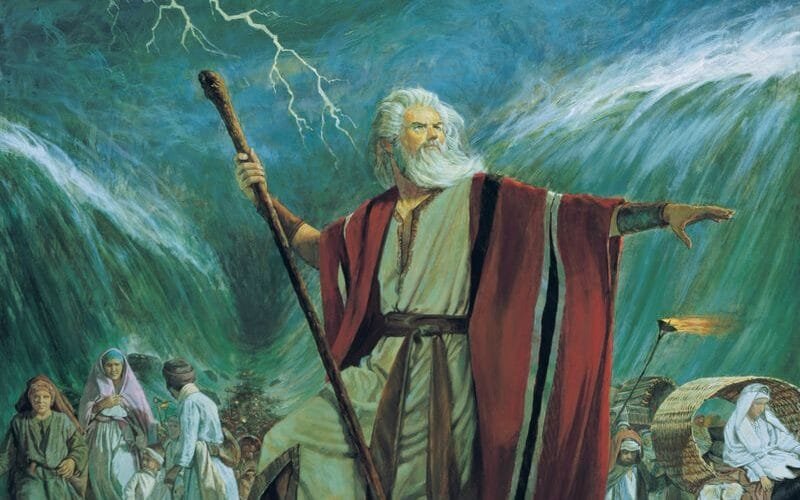
A remarkable example of how imagination and revelation work together is shown in the miracle of the parting of the Red Sea. The Lord himself used the parting of the Red Sea as an example of the spirit of revelation: “[T]his is the spirit of revelation; behold, this is the spirit by which Moses brought the children of Israel through the Red Sea on dry ground.”21
After the children of Israel left Egypt, Pharaoh changed his mind and chased after them: “And he took six hundred chosen chariots, and all the chariots of Egypt, and captains over every one of them.”22 So imagine how the children of Israel felt when they realized the armies of Egypt were coming. They were on the banks of the Red Sea. I attended the BYU Jerusalem Center from January to May 1996. As part of that trip, we visited the Red Sea. The Red Sea is a large body of water, that has very much the same feel as standing on the banks of the ocean. You can’t see the other side.
So as the children of Israel were on the banks of the Red Sea, they saw the Egyptian armies coming, and they couldn’t imagine any escape. They couldn’t run along the banks, they obviously couldn’t try and cross. So, in despair, they said to Moses, “Because there were no graves in Egypt, hast thou taken us away to die in the wilderness? wherefore hast thou dealt thus with us, to carry us forth out of Egypt? Is not this the word that we did tell thee in Egypt, saying, Let us alone, that we may serve the Egyptians? For it had been better for us to serve the Egyptians, than that we should die in the wilderness.”23
They could not imagine any outcome other than being caught by the Egyptians. But Moses had a different thought. I imagine Moses looking at this situation, thinking about all the miracles that resulted in them being released from Egyptian bondage, and thinking that certainly the Lord would not do all those wonders simply to let them die after being freed. There had to be another way. I think of Moses turning to look at that wide expanse of the Red Sea, and imagining the children of Israel crossing over on dry ground. It was the spirit of revelation that helped Moses conceive of an outcome that was only possible with the power of God.
Example: raising the dead
To a missionary in this dispensation, the Lord said:
Let my servant William Law also receive the keys by which he may ask and receive blessings; let him be humble before me, and be without guile, and he shall receive of my Spirit, even the Comforter, which shall manifest unto him the truth of all things, and shall give him, in the very hour, what he shall say.
And these signs shall follow him—he shall heal the sick, he shall cast out devils, and shall be delivered from those who would administer unto him deadly poison;
And he shall be led in paths where the poisonous serpent cannot lay hold upon his heel, and he shall mount up in the imagination of his thoughts as upon eagles’ wings.
And what if I will that he should raise the dead, let him not withhold his voice.”24
It requires a vivid imagination to believe that God has the power to heal the sick, cast out devils, or raise the dead. But these verses imply that it is the Spirit that will give us impressions of whether the Lord wants us to exercise our faith in such a way as to accomplish these unimaginable tasks. “What if I will that he should raise the dead?” This verse implies that through revelation, we may have glimpses of the impossible, and if we exercise faith, that impossibility might become a reality. It requires a vivid and active imagination to conceive of the solution, and faith in Jesus Christ to make that solution become real. It all begins by imagining possibilities that seem impossible. This, by definition, is miraculous.
Imagination can be real
Faith in Jesus Christ requires imagination. But that doesn’t mean it’s a fictional fantasy. The thoughts that are born in our imagination can often be inspired by the Holy Ghost to help us exercise faith in Jesus Christ and accomplish tasks that might seem impossible.
There will always be those, like Korihor, who assert that religion is just the product of an overactive imagination: “Behold, these things which ye call prophecies, which ye say are handed down by holy prophets, behold, they are foolish traditions of your fathers. How do ye know of their surety? Behold, ye cannot know of things which ye do not see; therefore ye cannot know that there shall be a Christ. Ye look forward and say that ye see a remission of your sins. But behold, it is the effect of a frenzied mind; and this derangement of your minds comes because of the traditions of your fathers, which lead you away into a belief of things which are not so.”25
Imagination is powerful. We must believe the impossible to move forward in faith and see miracles. Revelation and moving forward with faith in Jesus Christ will lead to blessings that have been prepared by the Lord that are greater than we can ever imagine.
References
- “Imagination.” Merriam-Webster.com Dictionary, Merriam-Webster, https://www.merriam-webster.com/dictionary/imagination. Accessed 25 Mar. 2026. ↩︎
- The Britannica Dictionary Online, “Imagination,” https://www.britannica.com/dictionary/imagination. ↩︎
- Britannica, “Imagination.” ↩︎
- Britannica, “Imagination.” ↩︎
- Jim Davies Ph.D., “What Imagination Is,” Psychology Today Online, July 11, 2012, https://www.psychologytoday.com/us/blog/the-science-imagination/201207/what-imagination-is-0. ↩︎
- “Imagination,” Psychology Today Online Staff, https://www.psychologytoday.com/us/basics/imagination. ↩︎
- Elizabeth Dixon, LISW-CP, “Harnessing The Power Of Imagination,” Psychology Today Online, June 23, 2020, https://www.psychologytoday.com/us/blog/the-flourishing-family/202006/harnessing-the-power-imagination. ↩︎
- Neel Burton M.D., “The Psychology and Philosophy of Imagination,” Psychology Today Online, November 1, 2018, https://www.psychologytoday.com/us/blog/hide-and-seek/201811/the-psychology-and-philosophy-imagination. ↩︎
- Remez Sasson, “Successful People Use Their Imagination,” Success Consciousness Online, https://www.successconsciousness.com/blog/goal-setting/successful-people-use-their-imagination/. ↩︎
- Hebrews 11:1; Ether 12:6. ↩︎
- James 2:20. ↩︎
- Alma 32:27. ↩︎
- “Faith,” Bible Dictionary, https://www.churchofjesuschrist.org/study/scriptures/bd/faith?lang=eng. ↩︎
- John 14:2-3. ↩︎
- Doctrine and Covenants 9:8-9. ↩︎
- Abraham 3:24-25. ↩︎
- Doctrine and Covenants 58:26-28. ↩︎
- Moroni 7:36-37. ↩︎
- Ether 2:25. ↩︎
- Ether 3:4-5. ↩︎
- Doctrine and Covenants 8:3. ↩︎
- Exodus 14:7. ↩︎
- Exodus 14:11-12. ↩︎
- Doctrine and Covenants 124:99. ↩︎
- Alma 30:14-16. ↩︎