We often hear about the Twelve Tribes of Israel. But why? What is their significance? What role do they play?
The story of the Old Testament revolves around the story of the Twelve Tribes. God made His covenant with Abraham, then Isaac, then Jacob, whose name was changed to Israel. The Twelve Tribes began as the sons of Israel, and so they were the covenant people of the Lord. They grew into a large nation, but then the majority were scattered.
In recent years, we have been taught that the gathering of Israel is the most important work we can do. We gather Israel as we help anyone to enter into a covenant relationship with the Lord, because as they make covenants, they become part of Israel, and are therefore “gathered” unto the Lord.
As we study and understand the history of the Twelve Tribes, we can better understand what it means to be the Lord’s covenant people.
The Abrahamic Covenant
Our story starts with Abraham and the covenant that God made with him. This is discussed in several chapters in Genesis, and then is frequently recalled throughout the Old Testament:
Now the Lord had said unto Abram, Get thee out of thy country, and from thy kindred, and from thy father’s house, unto a land that I will shew thee: And I will make of thee a great nation, and I will bless thee, and make thy name great; and thou shalt be a blessing: And I will bless them that bless thee, and curse him that curseth thee: and in thee shall all families of the earth be blessed.1
In very simple terms, God promised Abraham land, posterity, and that in him and his posterity all the families of the earth would be blessed.
In the book of Abraham, the Abrahamic covenant is clarified to help us understand that it is through the priesthood that the blessings of the gospel of Jesus Christ would be offered to the world:
[T]he Lord appeared unto me, and said unto me: . . . I have purposed to . . . make of thee a minister to bear my name in a strange land which I will give unto thy seed after thee for an everlasting possession. . . . I will make of thee a great nation, and I will bless thee above measure, and make thy name great among all nations, and thou shalt be a blessing unto thy seed after thee, that in their hands they shall bear this ministry and Priesthood unto all nations; . . . I will bless them through thy name; for as many as receive this Gospel shall be called after thy name, and shall be accounted thy seed, and shall rise up and bless thee, as their father; And I will bless them that bless thee, and curse them that curse thee; and in thee (that is, in thy Priesthood) and in thy seed (that is, thy Priesthood), for I give unto thee a promise that this right shall continue in thee, and in thy seed after thee (that is to say, the literal seed, or the seed of the body) shall all the families of the earth be blessed, even with the blessings of the Gospel, which are the blessings of salvation, even of life eternal.2
This restored scripture adds significant light and knowledge to our understanding of the Abrahamic covenant. However, throughout the Old Testament, the covenant is often described in the limited terms of the promise of land and posterity. This covenant was renewed with Isaac,3 and then Jacob.4 A more thorough explanation of the Abrahamic covenant can be found in the Bible Dictionary.5
What is the birthright?
The cultures and customs of the Old Testament are quite different from ours, and they can be challenging for us to understand. The birthright is one of those cultural aspects that is challenging to comprehend.
The birthright was the “right or inheritance of the firstborn,” and included “a land inheritance as well as the authority to preside.”6
Regarding the inheritance of land, the law of Moses prescribed that the firstborn receive a “double portion.”7 This double portion is believed to be due to the firstborn’s obligation to lead the family, and to take care “of his mother and sisters and others in the family who could not care for themselves.”8 That is consistent with the authority to preside, as it is his responsibility to care for his family.
We see a glimpse of how the ancient Israelites understood the right to preside in the Book of Mormon. During the first few chapters of First Nephi, we see Laman and Lemuel angry that Nephi seemed to be taking charge: “And Laman said unto Lemuel and also unto the sons of Ishmael: Behold, let us slay our father, and also our brother Nephi, who has taken it upon him to be our ruler and our teacher, who are his elder brethren. . . . [H]e has thought to make himself a king and a ruler over us, that he may do with us according to his will and pleasure.”9
Laman and Lemuel were angry for many reasons, but this passage shows how they perceived the birthright. They couldn’t stand that their younger brother had taken charge. They believed it was their right as the oldest sons.
The birthright was a cultural mechanism for someone to lead the family, and it was typically the right of the firstborn, but that right was not automatic.
Isaac and Jacob were not the firstborn
Isaac and Jacob received the birthright even though they were not the firstborn. Abraham’s firstborn son was Ishmael, but he “gave all that he had unto Isaac.”10 Isaac’s firstborn son was Esau, but Esau sold his birthright to Jacob, and despite what appears to be deceit by Jacob and his mother, Isaac confirmed that the birthright passed to Jacob.11
These examples demonstrate that the tradition of the firstborn receiving the birthright was not sacrosanct. In fact, “There are several instances in the scriptures of the one who was the firstborn losing his birthright because of unrighteousness.”12
The 12 sons of Jacob
Jacob’s story of his courtship and the birth of his children deserves its own post. For purposes of this discussion, it is sufficient to simply identify the twelve sons and their mothers:
| Birth Order | Son | Mother | Scripture |
| 1 | Reuben | Leah | Genesis 29:32 |
| 2 | Simeon | Leah | Genesis 29:33 |
| 3 | Levi | Leah | Genesis 29:34 |
| 4 | Judah | Leah | Genesis 29:35 |
| 5 | Dan | Bilhah (Rachel’s handmaid) | Genesis 30:5–6 |
| 6 | Naphtali | Bilhah | Genesis 30:7–8 |
| 7 | Gad | Zilpah (Leah’s handmaid) | Genesis 30:10–11 |
| 8 | Asher | Zilpah | Genesis 30:12–13 |
| 9 | Issachar | Leah | Genesis 30:17–18 |
| 10 | Zebulun | Leah | Genesis 30:19–20 |
| 11 | Joseph | Rachel | Genesis 30:22–24 |
| 12 | Benjamin | Rachel | Genesis 35:16–18 |
The Lord told Jacob that his name would be changed to Israel.13 So, whether they are referred to as the sons of Jacob, or the sons of Israel, it is the same.
Who received the birthright?
Of Israel’s 12 sons, who held the birthright? Pursuant to the typical custom, it would be Reuben, the firstborn. But the story of the Old Testament describes the children of Israel as a dysfunctional family, and Reuben committed an atrocity that caused him to lose the birthright: “Reuben went and lay with Bilhah his father’s concubine: and Israel heard it.”14
After Reuben lost the birthright, it went to Joseph.15 There are many who believe that the “coat of many colours” that Israel gave to Joseph was a symbolic passing of the birthright.16 But why Joseph, who was the 11th son? Why not Simeon, or Levi, or any of the others? There could be many reasons, but one explanation could be that Simeon and Levi murdered all the men of an entire city after their sister Dinah was defiled.17
Another potential reason why Jacob received the birthright is perhaps because he was the firstborn son of Jacob’s second wife, Rachel.18 But whatever the reason, there is no question that the birthright went to Joseph. (See 1 Chronicles 5:1, “[Reuben] was the firstborn; but, forasmuch as he defiled his father’s bed, his birthright was given unto the sons of Joseph the son of Israel.”)
Ephraim and Manasseh become tribes of Israel, and Ephraim receives the birthright
After Joseph was sold as a slave by his brothers, and he made his way to Egypt, he became the “ruler over all the land of Egypt.”19 Joseph married an Egyptian woman, Asenath, and they had two sons: Manasseh and Ephraim.20
It would have been customary for Manasseh to receive the birthright as the firstborn of Joseph. However, at the end of Israel’s life, he blessed his sons, and he also blessed Manasseh and Ephraim. It is significant that he blessed Manasseh and Ephraim before blessing his sons, because we see in this experience that Israel blessed Ephraim with the birthright.
First, Israel effectively adopted Manasseh and Ephraim as his sons: “And now thy two sons, Ephraim and Manasseh, which were born unto thee in the land of Egypt before I came unto thee into Egypt, are mine; as Reuben and Simeon, they shall be mine. And thy issue, which thou begettest after them, shall be thine, and shall be called after the name of their brethren in their inheritance.”21 This could be how Joseph, as the birthright son, received a double portion: his two sons effectively took his place among his brothers as sons of Israel.
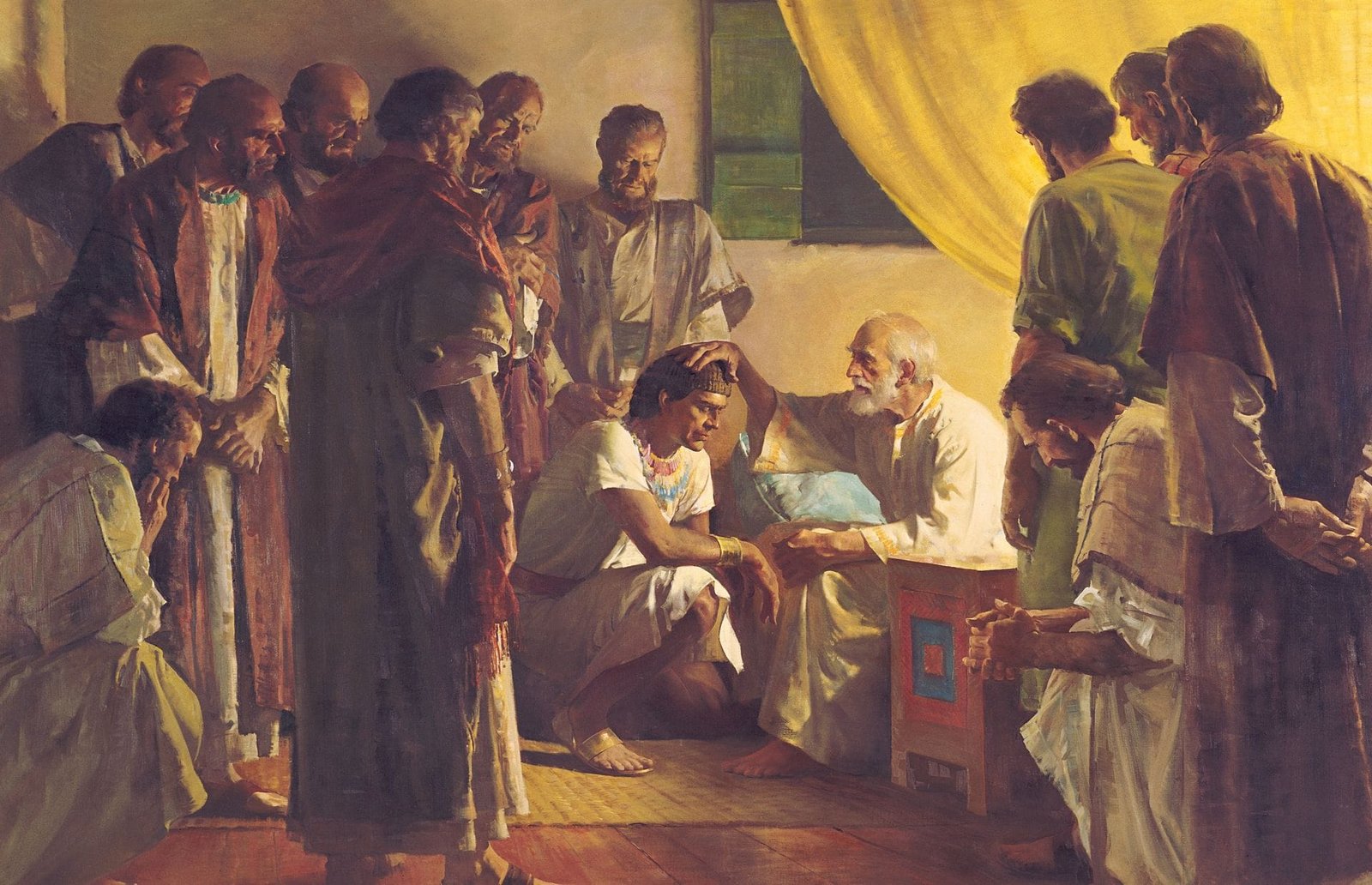
After essentially adopting Manasseh and Ephraim as his sons, Israel then told Joseph that he wanted to bless them.22 Joseph positioned them so Manasseh was on Israel’s right, and Ephraim was on Israel’s left, presumably so that Manasseh, as the firstborn, would receive the blessing of the birthright son.23 However, Israel crossed his hands, putting his right hand on Ephraim’s head, and his left hand on Manasseh’s head.24 Joseph didn’t like this, and wanted Israel to put his right hand on Manasseh’s head, but Israel refused, saying, “I know it, my son, I know it: he also shall become a people, and he also shall be great: but truly his younger brother shall be greater than he, and his seed shall become a multitude of nations.”25
And so, Israel blessed Ephraim and Manasseh, giving Ephraim the birthright, saying: “In thee shall Israel bless, saying, God make thee as Ephraim and as Manasseh: and he set Ephraim before Manasseh.”26
The Levites were not numbered among the children of Israel
After Moses brought the children of Israel out of Egypt, and while they wandered in the wilderness, the Lord commanded Moses to number Israel: “Take ye the sum of all the congregation of the children of Israel, after their families, by the house of their fathers.”27 However, he was told to “not number the tribe of Levi.”28
Instead, the Levites were to be made responsible for the tabernacle.29 Throughout the books of Numbers, Deuteronomy, and Joshua, it is frequently explained why Levi was not numbered among the other tribes of Israel:
- Numbers 3:6–10: The Levites are given to Aaron and his sons to keep charge of the tabernacle, and to wait on their priest’s office.
- Numbers 8:14–19: The Levites are given to the Lord as a substitute for all the firstborn of the children of Israel; they are given to Aaron and his sons to serve in the tabernacle.
- Deuteronomy 10:8–9: Levi set apart to bear the ark of the covenant; Levi has no inheritance with his brethren, the Lord is his inheritance.
- Deuteronomy 18:1–2: Levites have no inheritance with Israel; the Lord is their inheritance.
- Joshua 13:14: Levi receives no inheritance in land; the sacrifices of the Lord are their inheritance.
- Joshua 14:3–4: The children of Joseph were two tribes, Manasseh and Ephraim; no land was given to the Levites; instead, they were given cities to dwell in.
- Joshua 21: The Levites were given cities and their suburbs in each tribe’s inheritance.
As we consider the “twelve” tribes, Levi was technically not one of those tribes. Instead, Joseph received two shares, one for Ephraim and one for Manasseh. Levi was given cities within each tribe.
Each tribe, except Levi, was given an inheritance of land
Joshua was called to lead the children of Israel into the promised land. As he did, each tribe was given an “inheritance” in the land,30 except for Levi, who received cities in each tribe, instead of its own inheritance.
Map 3 of the Bible Maps found in the Church’s Study Helps shows the division of the Twelve Tribes:
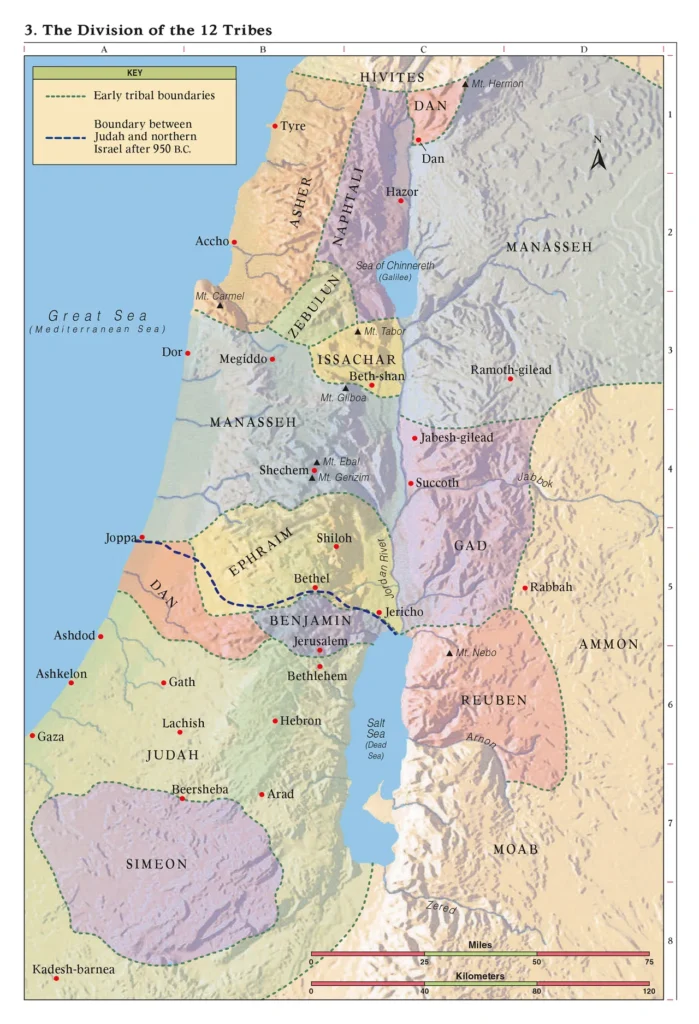
It is important to consider that over time, these “inheritances” took on a similar meaning for the Israelites that states mean to us today. So someone saying they are of “Benjamin” or “Judah,” would be like us saying we are from “Utah” or “California.”
Consider the example of Lehi. After they left Jerusalem, the Lord told Lehi to have his sons return to Jerusalem and obtain “the record of the Jews and also a genealogy of my forefathers,” which were engraven on “plates of brass.”31 After they were obtained, Lehi “searched them from the beginning,” and he found a “genealogy of his fathers; wherefore he knew that he was a descendant of Joseph.”32 Later in the Book of Mormon, it is revealed that Lehi was a descendant of Manasseh.33
What this tells us is that Lehi did not know his ancestry. He did not know he was of the lineage of Manasseh. The lost ten tribes were scattered by Assyria in about 721 B.C.34 The two tribes that were not scattered were Judah and Benjamin.35 Lehi and his family left Jerusalem in about 600 B.C. 36 So, this tells us that Lehi was a part of one of the lost ten tribes. How did he not know that? How did he not know that he was of Manasseh, and how did his ancestors survive the scattering by Assyria?
I believe it is reasonable to assume that people migrate, even back then. Despite travel challenges, Israel was not large, and people move. Biblical chronology is challenging before the time of Solomon, but many estimate that Joshua led the children of Israel into the promised land in about 1400 B.C. If that is accurate, then it was almost 700 years from the division of the promised land into tribes, until the ten tribes were scattered by Assyria. That is a long time for people to move around and to associate themselves by their location rather than their genealogy.
As we consider the tribes of Israel, we need to think of them as land, like territories, or states, or geopolitical subdivisions. But that isn’t the exclusive way that biblical prophets referred to the tribes of Israel. It is all about context, so we need to be careful as we read, and we need to carefully interpret passages that reference the Twelve Tribes.
The tribes receive blessings from Israel and Moses
Genesis 49 details blessings and prophecies that Israel gave to his sons. Deuteronomy 33 contains blessings that Moses gave to the tribes of Israel at the end of their sojourn in the wilderness, and before Joshua led them into the promised land. The following table gives a brief comparison of those blessings:
| Tribe | Israel’s Blessing/Prophecy | Moses’s Blessing |
| Reuben | Firstborn, strong, but unstable. (Gen 49:3–4) | Let Reuben live, and not die. (Deut 33:6) |
| Simeon | Cruel, condemned because of violence, will be divided and scattered. (Gen 49:5–7) | Not mentioned by name |
| Levi | Same cursing as Simeon. (Gen 49:5–7) | They shall teach Jacob thy judgments, and Israel thy law. (Deut 33:8–11) |
| Judah | Savior will come from him. (Gen 49:8–12) | Bring him unto his people, let his hands be sufficient. (Deut 33:7) |
| Zebulun | Dwelling by the sea; haven for ships. (Gen 49:13) | Receive the abundance from the seas. (Deut 33:18–19) |
| Issachar | Strong servant; bears burdens. (Gen 49:14–15) | Rejoice in thy tents. (Deut 33:18–19) |
| Dan | Judge, likened to a serpent (Gen 49:16–18) | A lion’s whelp. (Deut 33:22) |
| Naphtali | A doe let loose; eloquent. (Gen 49:21) | Full with the blessing of the Lord. (Deut 33:23) |
| Gad | Overcome by troops but ultimately victorious. (Gen 49:19) | Executed the justice of the Lord. (Deut 33:20–21) |
| Asher | Abundance; rich food. (Gen 49:20) | Blessed with children, strength. (Deut 33:24–25) |
| Joseph (Ephraim & Manasseh) | Fruitful bough; greatest blessings exceed those of the fathers. (Gen 49:22–26) | Blessed of the Lord, he shall push the people together to the ends of the earth. (Deut 33:13–17) |
| Benjamin | Fierce warrior imagery. (Gen 49:27) | Dwells safely by the Lord; divine protection. (Deut 33:12) |
The kingdom of Israel, and the scattering of the Ten Tribes
After Joshua brought the Israelites into the promised land, and divided the promised land into an inheritance for each tribe (excluding Levi), they operated as separate, independent geopolitical subdivisions, until they asked Samuel to appoint a king for them.37 The story is too long to provide details, except to say that Samuel anointed Saul (of the tribe of Benjamin)38 to be the first king of Israel.39
Saul was followed by David (of the tribe of Judah),40 who was followed by Solomon,41 then Rehoboam.42 Shortly into Rehoboam’s reign, a man named Jeroboam, an Ephraimite,43 came to Rehoboam and demanded that he lighten the “heavy yoke” that had been put upon them by Solomon.44 The Old Testament Institute Manual explains this “heavy yoke”: “Israel desired relief from the burdens of Solomon’s extravagance, which had brought upon them exorbitant taxes and conscript labor.”45 Rehoboam instead did the opposite, threatening to increase their burdens rather than lighten them.46
As a result, “all Israel,” meaning all tribes other than Judah and Benjamin, said, “What portion have we in David? neither have we inheritance in the son of Jesse: to your tents, O Israel: now see to thine own house, David. So Israel departed unto their tents. . . . So Israel rebelled against the house of David unto this day.”47
Following that split, the kingdoms of Israel (the northern 10 tribes) and Judah (the southern 2 tribes of Judah and Benjamin) were in conflict, until the kingdom of Assyria invaded and scattered the northern kingdom in approximately 721 B.C.:
Because the people of the Northern Kingdom disobeyed the Lord’s laws, embraced idolatry, and rejected the prophets, they lost the Lord’s protection and were eventually conquered by the Assyrians. While many were killed during the Assyrian conquests, others were spared. Some of these survivors migrated to the Southern Kingdom and joined the population of other Israelites residing in Judah. Some remained in Israel and eventually intermixed with the foreign people the Assyrians relocated there. This mixed group became known as the Samaritans. Still other survivors were taken into exile in Assyria in large numbers, and they eventually became lost to history. This group is often referred to as the lost tribes of Israel, and their scattering is part of what the scriptures call the scattering of Israel.48
With that, the northern kingdom of Israel, or the Ten tribes of Israel, became lost.
Ephraim’s role in the latter days
As members of the Church of Jesus Christ of Latter-day Saints, we teach that the true Church of Jesus Christ, established by our Savior during his mortal ministry, has been restored. But for Israel, and particularly Isaiah, the “restoration” is a restoration, or gathering, of the lost tribes of Israel:
And it shall come to pass in that day, that the Lord shall set his hand again the second time to recover the remnant of his people, which shall be left, from Assyria, and from Egypt, and from Pathros, and from Cush, and from Elam, and from Shinar, and from Hamath, and from the islands of the sea.
And he shall set up an ensign for the nations, and shall assemble the outcasts of Israel, and gather together the dispersed of Judah from the four corners of the earth.
The envy also of Ephraim shall depart, and the adversaries of Judah shall be cut off: Ephraim shall not envy Judah, and Judah shall not vex Ephraim.49
Isaiah’s reference to the “envy of Ephraim,” and that “Judah shall not vex Ephraim,” refers to the conflict between the northern and southern kingdoms. But it also has reference to the latter days, because as the tribe with the birthright, Ephraim has the responsibility to restore the gospel of Jesus Christ, and gather scattered Israel.
Ezekiel prophesied of the “stick of Ephraim,” saying, “I will take the stick of Joseph, which is in the hand of Ephraim, and the tribes of Israel his fellows, and will put them with him, even with the stick of Judah, and make them one stick, and they shall be one in mine hand.”50 This is understood as a “prophetic reference to the Book of Mormon,” and the Bible (the stick of Judah).51
Lehi prophesied about Joseph Smith, an ancestor of Joseph of Egypt.52 He quoted a prophecy of Joseph of Egypt (which he obtained from the brass plates), similar to Ezekiel’s prophesy: “[T]he fruit of thy loins [Joseph’s posterity] shall write; and the fruit of the loins of Judah shall write; and that which shall be written by the fruit of thy loins, and also that which shall be written by the fruit of the loins of Judah, shall grow together, unto the confounding of false doctrines and laying down of contentions, and establishing peace among the fruit of thy loins, and bringing them to the knowledge of their fathers in the latter days, and also to the knowledge of my covenants, saith the Lord.”53
As the tribe that carried the birthright, Ephraim was tasked with bringing forth the gospel of Jesus Christ in the latter days. Moses’s blessing and prophecy for Joseph, now looking in hindsight, seems clear that Joseph’s lineage would be responsible for the restoration of the gospel of Jesus Christ:
And of Joseph he said, Blessed of the Lord be his land, for the precious things of heaven, for the dew, and for the deep that coucheth beneath,
And for the precious fruits brought forth by the sun, and for the precious things put forth by the moon,
And for the chief things of the ancient mountains, and for the precious things of the lasting hills,
And for the precious things of the earth and fulness thereof, and for the good will of him that dwelt in the bush: let the blessing come upon the head of Joseph, and upon the top of the head of him that was separated from his brethren.
His glory is like the firstling of his bullock, and his horns are like the horns of unicorns: with them he shall push the people together to the ends of the earth: and they are the ten thousands of Ephraim, and they are the thousands of Manasseh.54
“Push the people together to the ends of the earth.” That, to me, certainly sounds like the gathering of Israel. Russell M. Nelson often taught of the gathering of Israel, and spoke of the responsibilities of Judah and Ephraim:
The tribe of Judah was given responsibility to prepare the world for the first coming of the Lord. From that tribe, Mary was called upon to be the mother of the Son of God.
The tribe of Joseph, through his and Asenath’s sons, Ephraim and Manasseh (see Genesis 41:50–52; 46:20), was given the responsibility to lead in the gathering of Israel, to prepare the world for the Second Coming of the Lord. …55
President Nelson emphasized the importance of the gathering: “There is nothing happening on this earth right now that is more important than [the gathering of Israel]. There is nothing of greater consequence. Absolutely nothing.”56
The story of the Twelve Tribes teaches us the story of Israel
God made His covenant with Abraham, then Isaac, then Jacob. Jacob’s, or Israel’s, posterity grew into a large nation, and bears the responsibility to carry the knowledge of a Savior to the entire world. The story of the Twelve Tribes teaches us about the Lord’s covenant with His people, and the responsibilities that the covenant people of the Lord have to preach the gospel, or to bless the nations of the earth. The more we understand about the Twelve Tribes of Israel, the more we will understand what it means to have a covenant relationship with the Lord.
References
- Genesis 12:1-3. ↩︎
- Abraham 2:6-11. ↩︎
- Genesis 17:21; 26:1-5. ↩︎
- Genesis 28:10-15. ↩︎
- Bible Dictionary, “Abraham, covenant of,” https://www.churchofjesuschrist.org/study/scriptures/bd/abraham-covenant-of?lang=eng. ↩︎
- Bible Dictionary, “Birthright,” https://www.churchofjesuschrist.org/study/scriptures/bd/birthright?lang=eng. ↩︎
- Deuteronomy 21:17. ↩︎
- R. Val Johnson, “You Have a Birthright,” New Era, November 2005, https://www.churchofjesuschrist.org/study/new-era/2005/11/you-have-a-birthright?lang=eng&id=p3#p3, quoting Bible Dictionary, “Firstborn,” https://www.churchofjesuschrist.org/study/scriptures/bd/firstborn?lang=eng. ↩︎
- 1 Nephi 16:37-38. ↩︎
- Genesis 16:15-16; 25:5. ↩︎
- Genesis 25:25; 27:27-40. ↩︎
- Bible Dictionary, “Birthright,” https://www.churchofjesuschrist.org/study/scriptures/bd/birthright?lang=eng. ↩︎
- Genesis 32:28. ↩︎
- Genesis 35:22. ↩︎
- 1 Chronicles 5:1. ↩︎
- See Genesis 37:3; Scripture Helps: Old Testament, “Genesis 37-41,” https://www.churchofjesuschrist.org/study/manual/scripture-helps-old-testament/10-genesis-37-41?lang=eng&id=p_bWQ7q#p_bWQ7q, “It is possible that Joseph received this coat to represent his role as Jacob’s birthright son.” ↩︎
- See generally Genesis 34. “Simeon and Levi, Dinah’s brethren, took each man his sword, and came upon the city boldly, and slew all the males. . . . And Jacob said to Simeon and Levi, Ye have troubled me to make me to stink among the inhabitants of the land, among the Canaanites and the Perizzites: and I being few in number, they shall gather themselves together against me, and slay me; and I shall be destroyed, I and my house.” ↩︎
- Guide to the Scriptures, “Reuben,” https://www.churchofjesuschrist.org/study/scriptures/gs/reuben?lang=eng. ↩︎
- Genesis 41:43. ↩︎
- Genesis 41:45; 41:50-52. ↩︎
- Genesis 48:5-6. ↩︎
- Genesis 48:9. ↩︎
- Genesis 48:13. ↩︎
- Genesis 48:14. ↩︎
- Genesis 48:17-19. ↩︎
- Genesis 48:20. ↩︎
- Numbers 1:2. ↩︎
- Numbers 1:49. ↩︎
- Numbers 1:50-53. ↩︎
- Joshua 1:6. ↩︎
- 1 Nephi 3:2-3. ↩︎
- 1 Nephi 5:10-14. ↩︎
- Alma 10:3. ↩︎
- Chronology of the Old Testament, https://www.churchofjesuschrist.org/study/scriptures/bible-chron/old-testament?lang=eng&id=p220-p221#p220. ↩︎
- Bible Dictionary, “Israel, Kingdom of,” https://www.churchofjesuschrist.org/study/scriptures/bd/israel-kingdom-of?lang=eng. ↩︎
- 1 Nephi 10:4. ↩︎
- 1 Samuel 8:4-5, “Then all the elders of Israel gathered themselves together, and came to Samuel unto Ramah, And said unto him, Behold, thou art old, and thy sons walk not in thy ways: now make us a king to judge us like all the nations. ↩︎
- 1 Samuel 9:21. ↩︎
- 1 Samuel 10:1. ↩︎
- 1 Samuel 16:13; 1 Samuel 17:12. ↩︎
- 1 Kings 1:38-39. ↩︎
- 1 Kings 11:43. ↩︎
- 1 Kings 11:26. ↩︎
- 1 Kings 12:3-4. ↩︎
- Old Testament Student Manual Kings-Malachi, “1 Kings 12-16: A Kingdom Divided against Itself,” https://www.churchofjesuschrist.org/study/manual/old-testament-student-manual-kings-malachi/chapter-4?lang=eng&id=p9#p9. ↩︎
- 1 Kings 12:13-14. ↩︎
- 1 Kings 12:16-19. ↩︎
- Scripture Helps: Old Testament, “2 Kings 16-25; 2 Kings 17:5-23; What happened to the tribes of Israel after they were conquered by Assyria,” https://www.churchofjesuschrist.org/study/manual/scripture-helps-old-testament/27-2-kings-16-25?lang=eng&id=p_b1VPJ#p_b1VPJ. ↩︎
- Isaiah 11:11-13. ↩︎
- Ezekiel 37:19. ↩︎
- Bible Dictionary, “Ephraim, stick of,” https://www.churchofjesuschrist.org/study/scriptures/bd/ephraim-stick-of?lang=eng. ↩︎
- 2 Nephi 3:6-15. ↩︎
- 2 Nephi 3:12. ↩︎
- Deuteronomy 33:13-17. ↩︎
- Teachings of the Presidents of the Church: Russell M. Nelson, “Chapter 9: The Gathering of Israel,” https://www.churchofjesuschrist.org/study/manual/teachings-of-presidents-of-the-church-russell-m-nelson/09-the-gathering-of-israel?lang=eng&id=p14-p15#p14. ↩︎
- Ibid. ↩︎